Story maps · Grades 11–12
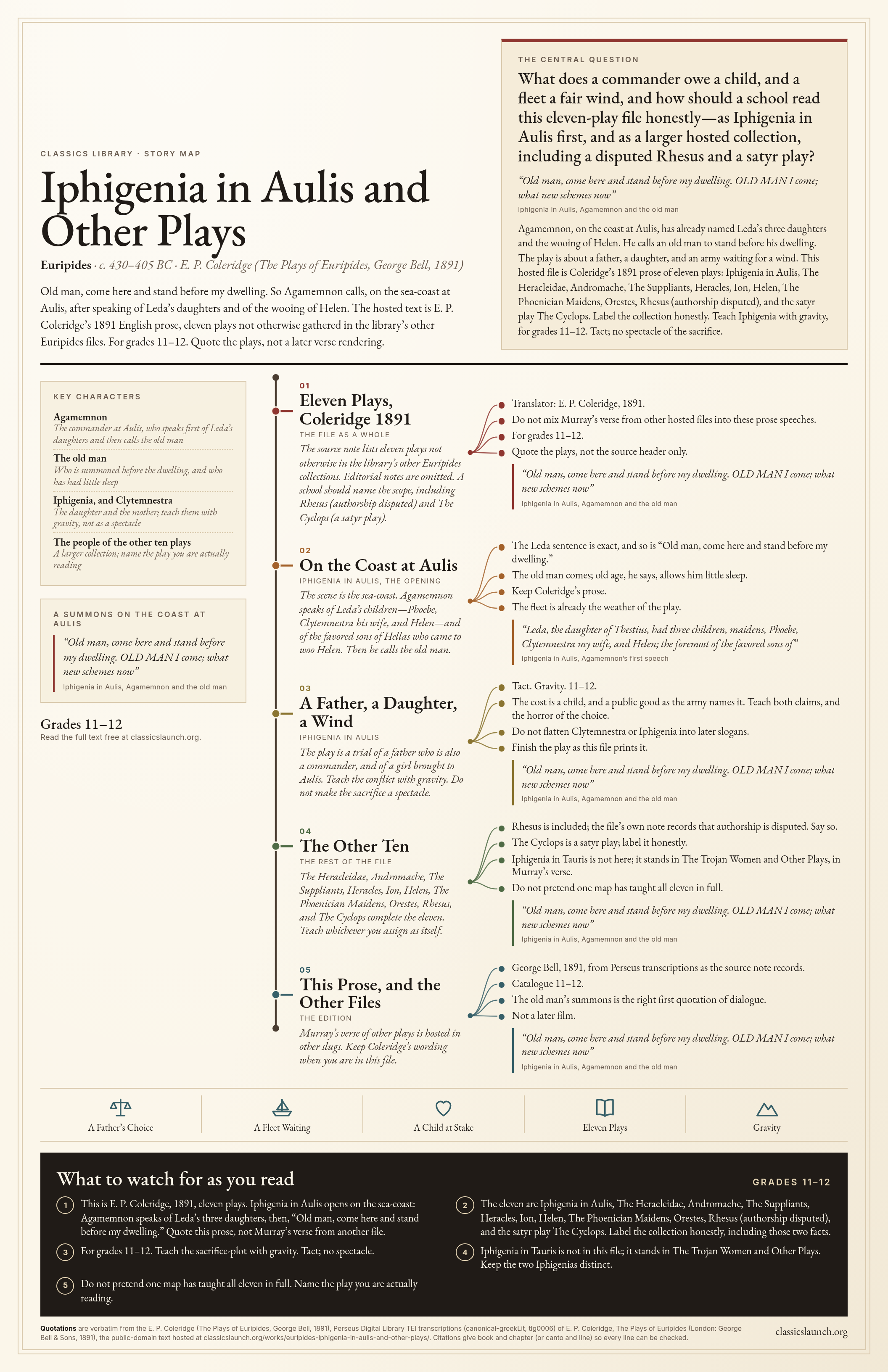
Iphigenia in Aulis and Other Plays: A Story Map
The PDF is one tabloid page (11 × 17 in). On letter paper, choose “Fit to page.”
Old man, come here and stand before my dwelling. So Agamemnon calls, on the sea-coast at Aulis, after speaking of Leda’s daughters and of the wooing of Helen. The hosted text is E. P. Coleridge’s 1891 English prose, eleven plays not otherwise gathered in the library’s other Euripides files. For grades 11–12. Quote the plays, not a later verse rendering.
The central question
What does a commander owe a child, and a fleet a fair wind, and how should a school read this eleven-play file honestly—as Iphigenia in Aulis first, and as a larger hosted collection, including a disputed Rhesus and a satyr play?
“Old man, come here and stand before my dwelling. OLD MAN I come; what new schemes now”
Agamemnon, on the coast at Aulis, has already named Leda’s three daughters and the wooing of Helen. He calls an old man to stand before his dwelling. The play is about a father, a daughter, and an army waiting for a wind. This hosted file is Coleridge’s 1891 prose of eleven plays: Iphigenia in Aulis, The Heracleidae, Andromache, The Suppliants, Heracles, Ion, Helen, The Phoenician Maidens, Orestes, Rhesus (authorship disputed), and the satyr play The Cyclops. Label the collection honestly. Teach Iphigenia with gravity, for grades 11–12. Tact; no spectacle of the sacrifice.
- 01
Eleven Plays, Coleridge 1891
The file as a whole
The source note lists eleven plays not otherwise in the library’s other Euripides collections. Editorial notes are omitted. A school should name the scope, including Rhesus (authorship disputed) and The Cyclops (a satyr play).
- Translator: E. P. Coleridge, 1891.
- Do not mix Murray’s verse from other hosted files into these prose speeches.
- For grades 11–12.
- Quote the plays, not the source header only.
“Old man, come here and stand before my dwelling. OLD MAN I come; what new schemes now”
- 02
On the Coast at Aulis
Iphigenia in Aulis, the opening
The scene is the sea-coast. Agamemnon speaks of Leda’s children—Phoebe, Clytemnestra his wife, and Helen—and of the favored sons of Hellas who came to woo Helen. Then he calls the old man.
- The Leda sentence is exact, and so is “Old man, come here and stand before my dwelling.”
- The old man comes; old age, he says, allows him little sleep.
- Keep Coleridge’s prose.
- The fleet is already the weather of the play.
“Leda, the daughter of Thestius, had three children, maidens, Phoebe, Clytemnestra my wife, and Helen; the foremost of the favored sons of”
- 03
A Father, a Daughter, a Wind
Iphigenia in Aulis
The play is a trial of a father who is also a commander, and of a girl brought to Aulis. Teach the conflict with gravity. Do not make the sacrifice a spectacle.
- Tact. Gravity. 11–12.
- The cost is a child, and a public good as the army names it. Teach both claims, and the horror of the choice.
- Do not flatten Clytemnestra or Iphigenia into later slogans.
- Finish the play as this file prints it.
“Old man, come here and stand before my dwelling. OLD MAN I come; what new schemes now”
- 04
The Other Ten
The rest of the file
The Heracleidae, Andromache, The Suppliants, Heracles, Ion, Helen, The Phoenician Maidens, Orestes, Rhesus, and The Cyclops complete the eleven. Teach whichever you assign as itself.
- Rhesus is included; the file’s own note records that authorship is disputed. Say so.
- The Cyclops is a satyr play; label it honestly.
- Iphigenia in Tauris is not here; it stands in The Trojan Women and Other Plays, in Murray’s verse.
- Do not pretend one map has taught all eleven in full.
“Old man, come here and stand before my dwelling. OLD MAN I come; what new schemes now”
- 05
This Prose, and the Other Files
The edition
Murray’s verse of other plays is hosted in other slugs. Keep Coleridge’s wording when you are in this file.
- George Bell, 1891, from Perseus transcriptions as the source note records.
- Catalogue 11–12.
- The old man’s summons is the right first quotation of dialogue.
- Not a later film.
“Old man, come here and stand before my dwelling. OLD MAN I come; what new schemes now”
- A Father’s Choice
- A Fleet Waiting
- A Child at Stake
- Eleven Plays
- Gravity
What to watch for as you read
Grades 11–12- This is E. P. Coleridge, 1891, eleven plays. Iphigenia in Aulis opens on the sea-coast: Agamemnon speaks of Leda’s three daughters, then, “Old man, come here and stand before my dwelling.” Quote this prose, not Murray’s verse from another file.
- The eleven are Iphigenia in Aulis, The Heracleidae, Andromache, The Suppliants, Heracles, Ion, Helen, The Phoenician Maidens, Orestes, Rhesus (authorship disputed), and the satyr play The Cyclops. Label the collection honestly, including those two facts.
- For grades 11–12. Teach the sacrifice-plot with gravity. Tact; no spectacle.
- Iphigenia in Tauris is not in this file; it stands in The Trojan Women and Other Plays. Keep the two Iphigenias distinct.
- Do not pretend one map has taught all eleven in full. Name the play you are actually reading.
Every quotation is word for word from the E. P. Coleridge (The Plays of Euripides, George Bell, 1891) hosted in this library and is checked against that text each time the site is built. Citations give book and chapter (or canto and line).