Story maps · Grades 11–12
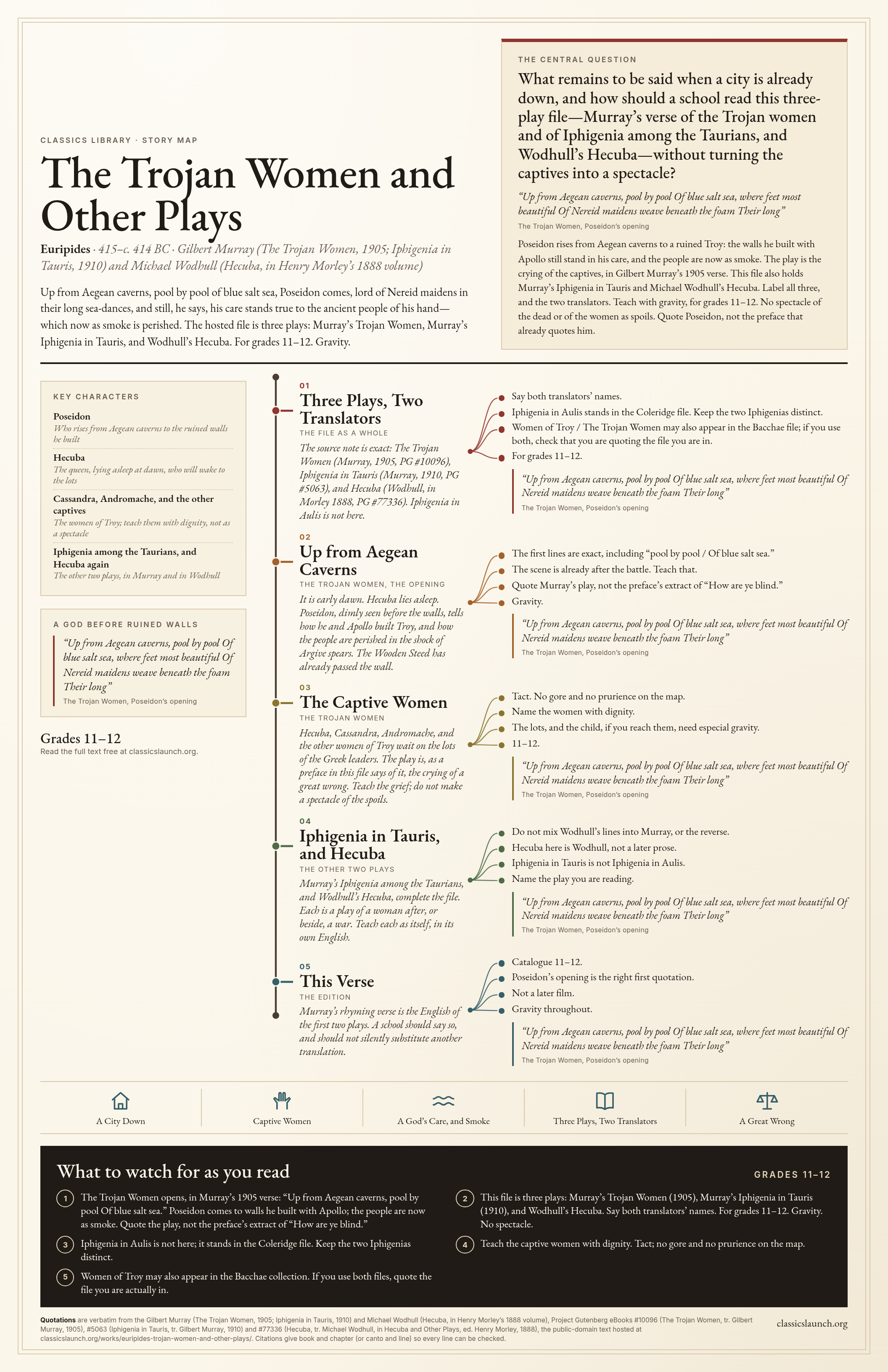
The Trojan Women and Other Plays: A Story Map
The PDF is one tabloid page (11 × 17 in). On letter paper, choose “Fit to page.”
Up from Aegean caverns, pool by pool of blue salt sea, Poseidon comes, lord of Nereid maidens in their long sea-dances, and still, he says, his care stands true to the ancient people of his hand—which now as smoke is perished. The hosted file is three plays: Murray’s Trojan Women, Murray’s Iphigenia in Tauris, and Wodhull’s Hecuba. For grades 11–12. Gravity.
The central question
What remains to be said when a city is already down, and how should a school read this three-play file—Murray’s verse of the Trojan women and of Iphigenia among the Taurians, and Wodhull’s Hecuba—without turning the captives into a spectacle?
“Up from Aegean caverns, pool by pool Of blue salt sea, where feet most beautiful Of Nereid maidens weave beneath the foam Their long”
Poseidon rises from Aegean caverns to a ruined Troy: the walls he built with Apollo still stand in his care, and the people are now as smoke. The play is the crying of the captives, in Gilbert Murray’s 1905 verse. This file also holds Murray’s Iphigenia in Tauris and Michael Wodhull’s Hecuba. Label all three, and the two translators. Teach with gravity, for grades 11–12. No spectacle of the dead or of the women as spoils. Quote Poseidon, not the preface that already quotes him.
- 01
Three Plays, Two Translators
The file as a whole
The source note is exact: The Trojan Women (Murray, 1905, PG #10096), Iphigenia in Tauris (Murray, 1910, PG #5063), and Hecuba (Wodhull, in Morley 1888, PG #77336). Iphigenia in Aulis is not here.
- Say both translators’ names.
- Iphigenia in Aulis stands in the Coleridge file. Keep the two Iphigenias distinct.
- Women of Troy / The Trojan Women may also appear in the Bacchae file; if you use both, check that you are quoting the file you are in.
- For grades 11–12.
“Up from Aegean caverns, pool by pool Of blue salt sea, where feet most beautiful Of Nereid maidens weave beneath the foam Their long”
- 02
Up from Aegean Caverns
The Trojan Women, the opening
It is early dawn. Hecuba lies asleep. Poseidon, dimly seen before the walls, tells how he and Apollo built Troy, and how the people are perished in the shock of Argive spears. The Wooden Steed has already passed the wall.
- The first lines are exact, including “pool by pool / Of blue salt sea.”
- The scene is already after the battle. Teach that.
- Quote Murray’s play, not the preface’s extract of “How are ye blind.”
- Gravity.
“Up from Aegean caverns, pool by pool Of blue salt sea, where feet most beautiful Of Nereid maidens weave beneath the foam Their long”
- 03
The Captive Women
The Trojan Women
Hecuba, Cassandra, Andromache, and the other women of Troy wait on the lots of the Greek leaders. The play is, as a preface in this file says of it, the crying of a great wrong. Teach the grief; do not make a spectacle of the spoils.
- Tact. No gore and no prurience on the map.
- Name the women with dignity.
- The lots, and the child, if you reach them, need especial gravity.
- 11–12.
“Up from Aegean caverns, pool by pool Of blue salt sea, where feet most beautiful Of Nereid maidens weave beneath the foam Their long”
- 04
Iphigenia in Tauris, and Hecuba
The other two plays
Murray’s Iphigenia among the Taurians, and Wodhull’s Hecuba, complete the file. Each is a play of a woman after, or beside, a war. Teach each as itself, in its own English.
- Do not mix Wodhull’s lines into Murray, or the reverse.
- Hecuba here is Wodhull, not a later prose.
- Iphigenia in Tauris is not Iphigenia in Aulis.
- Name the play you are reading.
“Up from Aegean caverns, pool by pool Of blue salt sea, where feet most beautiful Of Nereid maidens weave beneath the foam Their long”
- 05
This Verse
The edition
Murray’s rhyming verse is the English of the first two plays. A school should say so, and should not silently substitute another translation.
- Catalogue 11–12.
- Poseidon’s opening is the right first quotation.
- Not a later film.
- Gravity throughout.
“Up from Aegean caverns, pool by pool Of blue salt sea, where feet most beautiful Of Nereid maidens weave beneath the foam Their long”
- A City Down
- Captive Women
- A God’s Care, and Smoke
- Three Plays, Two Translators
- A Great Wrong
What to watch for as you read
Grades 11–12- The Trojan Women opens, in Murray’s 1905 verse: “Up from Aegean caverns, pool by pool Of blue salt sea.” Poseidon comes to walls he built with Apollo; the people are now as smoke. Quote the play, not the preface’s extract of “How are ye blind.”
- This file is three plays: Murray’s Trojan Women (1905), Murray’s Iphigenia in Tauris (1910), and Wodhull’s Hecuba. Say both translators’ names. For grades 11–12. Gravity. No spectacle.
- Iphigenia in Aulis is not here; it stands in the Coleridge file. Keep the two Iphigenias distinct.
- Teach the captive women with dignity. Tact; no gore and no prurience on the map.
- Women of Troy may also appear in the Bacchae collection. If you use both files, quote the file you are actually in.
Every quotation is word for word from the Gilbert Murray (The Trojan Women, 1905; Iphigenia in Tauris, 1910) and Michael Wodhull (Hecuba, in Henry Morley’s 1888 volume) hosted in this library and is checked against that text each time the site is built. Citations give book and chapter (or canto and line).