Story maps · Grades 9–12
The Sound and the Fury: A Story Map
The PDF is one tabloid page (11 × 17 in). On letter paper, choose “Fit to page.”
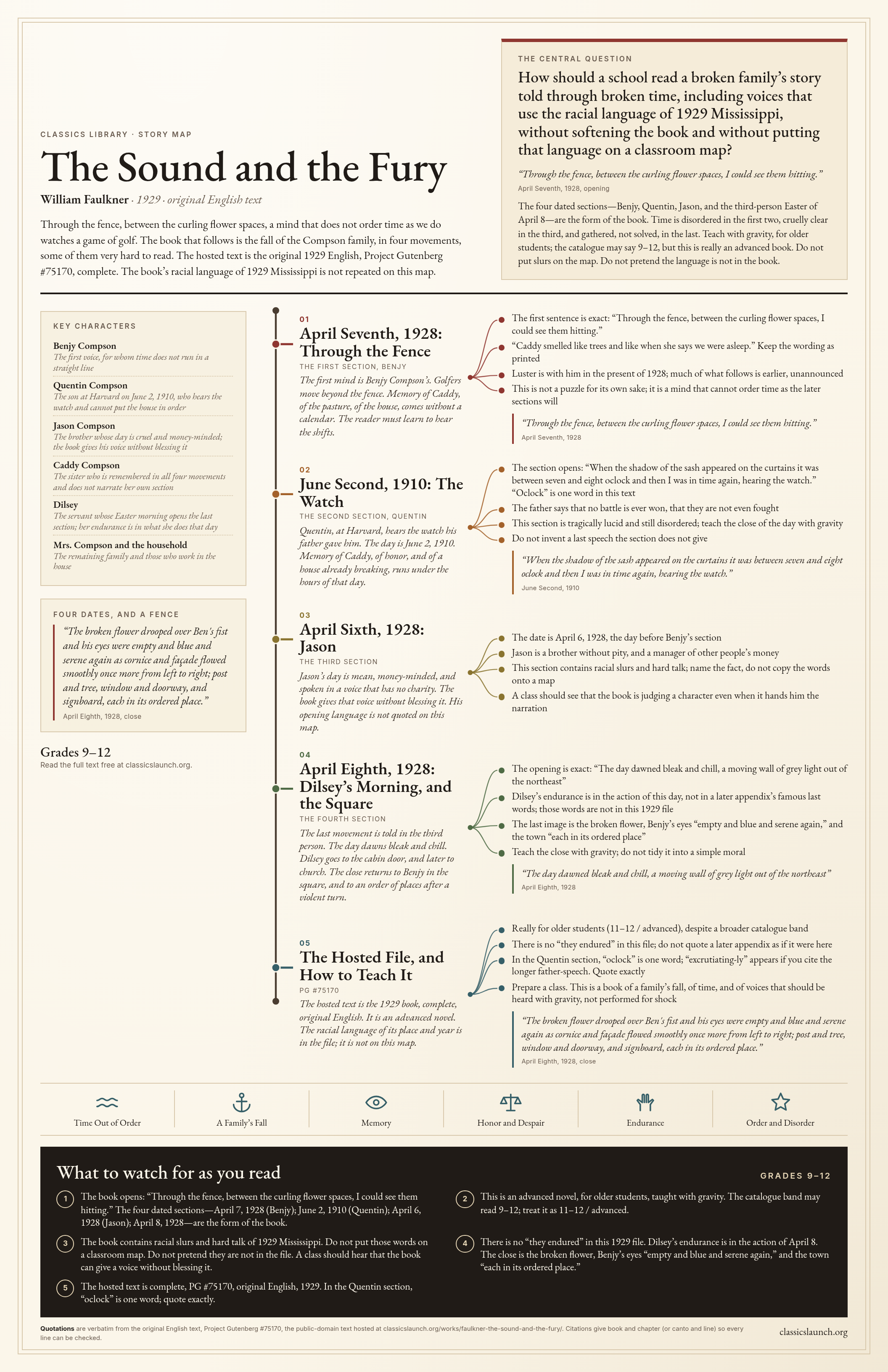
Through the fence, between the curling flower spaces, a mind that does not order time as we do watches a game of golf. The book that follows is the fall of the Compson family, in four movements, some of them very hard to read. The hosted text is the original 1929 English, Project Gutenberg #75170, complete. The book’s racial language of 1929 Mississippi is not repeated on this map.
The central question
How should a school read a broken family’s story told through broken time, including voices that use the racial language of 1929 Mississippi, without softening the book and without putting that language on a classroom map?
“Through the fence, between the curling flower spaces, I could see them hitting.”
The four dated sections—Benjy, Quentin, Jason, and the third-person Easter of April 8—are the form of the book. Time is disordered in the first two, cruelly clear in the third, and gathered, not solved, in the last. Teach with gravity, for older students; the catalogue may say 9–12, but this is really an advanced book. Do not put slurs on the map. Do not pretend the language is not in the book.
- 01
April Seventh, 1928: Through the Fence
The first section, Benjy
The first mind is Benjy Compson’s. Golfers move beyond the fence. Memory of Caddy, of the pasture, of the house, comes without a calendar. The reader must learn to hear the shifts.
- The first sentence is exact: “Through the fence, between the curling flower spaces, I could see them hitting.”
- “Caddy smelled like trees and like when she says we were asleep.” Keep the wording as printed
- Luster is with him in the present of 1928; much of what follows is earlier, unannounced
- This is not a puzzle for its own sake; it is a mind that cannot order time as the later sections will
“Through the fence, between the curling flower spaces, I could see them hitting.”
- 02
June Second, 1910: The Watch
The second section, Quentin
Quentin, at Harvard, hears the watch his father gave him. The day is June 2, 1910. Memory of Caddy, of honor, and of a house already breaking, runs under the hours of that day.
- The section opens: “When the shadow of the sash appeared on the curtains it was between seven and eight oclock and then I was in time again, hearing the watch.” “Oclock” is one word in this text
- The father says that no battle is ever won, that they are not even fought
- This section is tragically lucid and still disordered; teach the close of the day with gravity
- Do not invent a last speech the section does not give
“When the shadow of the sash appeared on the curtains it was between seven and eight oclock and then I was in time again, hearing the watch.”
- 03
April Sixth, 1928: Jason
The third section
Jason’s day is mean, money-minded, and spoken in a voice that has no charity. The book gives that voice without blessing it. His opening language is not quoted on this map.
- The date is April 6, 1928, the day before Benjy’s section
- Jason is a brother without pity, and a manager of other people’s money
- This section contains racial slurs and hard talk; name the fact, do not copy the words onto a map
- A class should see that the book is judging a character even when it hands him the narration
- 04
April Eighth, 1928: Dilsey’s Morning, and the Square
The fourth section
The last movement is told in the third person. The day dawns bleak and chill. Dilsey goes to the cabin door, and later to church. The close returns to Benjy in the square, and to an order of places after a violent turn.
- The opening is exact: “The day dawned bleak and chill, a moving wall of grey light out of the northeast”
- Dilsey’s endurance is in the action of this day, not in a later appendix’s famous last words; those words are not in this 1929 file
- The last image is the broken flower, Benjy’s eyes “empty and blue and serene again,” and the town “each in its ordered place”
- Teach the close with gravity; do not tidy it into a simple moral
“The day dawned bleak and chill, a moving wall of grey light out of the northeast”
- 05
The Hosted File, and How to Teach It
PG #75170
The hosted text is the 1929 book, complete, original English. It is an advanced novel. The racial language of its place and year is in the file; it is not on this map.
- Really for older students (11–12 / advanced), despite a broader catalogue band
- There is no “they endured” in this file; do not quote a later appendix as if it were here
- In the Quentin section, “oclock” is one word; “excrutiating-ly” appears if you cite the longer father-speech. Quote exactly
- Prepare a class. This is a book of a family’s fall, of time, and of voices that should be heard with gravity, not performed for shock
“The broken flower drooped over Ben's fist and his eyes were empty and blue and serene again as cornice and façade flowed smoothly once more from left to right; post and tree, window and doorway, and signboard, each in its ordered place.”
- Time Out of Order
- A Family’s Fall
- Memory
- Honor and Despair
- Endurance
- Order and Disorder
What to watch for as you read
Grades 9–12- The book opens: “Through the fence, between the curling flower spaces, I could see them hitting.” The four dated sections—April 7, 1928 (Benjy); June 2, 1910 (Quentin); April 6, 1928 (Jason); April 8, 1928—are the form of the book.
- This is an advanced novel, for older students, taught with gravity. The catalogue band may read 9–12; treat it as 11–12 / advanced.
- The book contains racial slurs and hard talk of 1929 Mississippi. Do not put those words on a classroom map. Do not pretend they are not in the file. A class should hear that the book can give a voice without blessing it.
- There is no “they endured” in this 1929 file. Dilsey’s endurance is in the action of April 8. The close is the broken flower, Benjy’s eyes “empty and blue and serene again,” and the town “each in its ordered place.”
- The hosted text is complete, PG #75170, original English, 1929. In the Quentin section, “oclock” is one word; quote exactly.
Every quotation is word for word from the original English text hosted in this library and is checked against that text each time the site is built. Citations give book and chapter (or canto and line).