Story maps · Grades 11–12
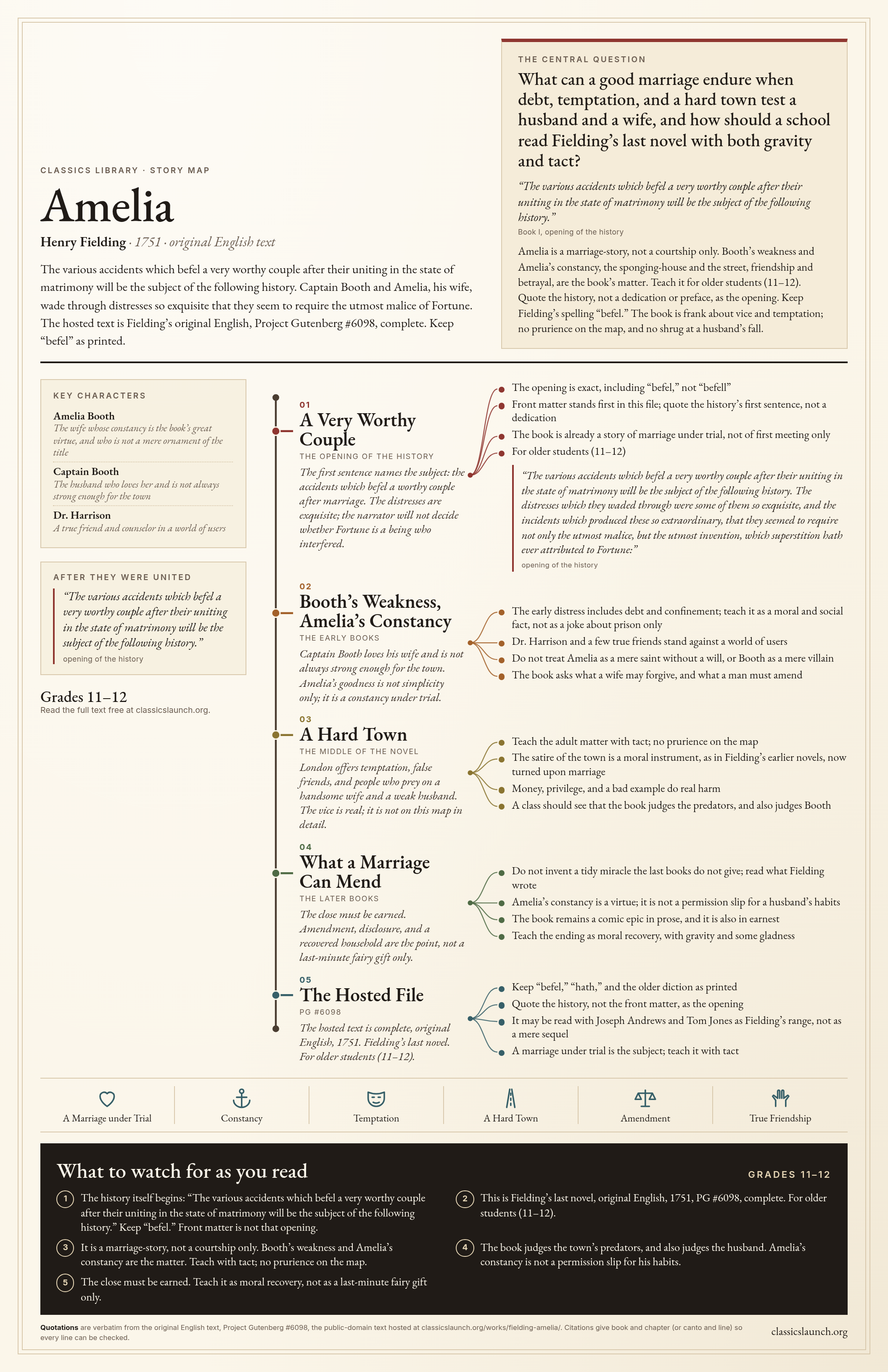
Amelia: A Story Map
The PDF is one tabloid page (11 × 17 in). On letter paper, choose “Fit to page.”
The various accidents which befel a very worthy couple after their uniting in the state of matrimony will be the subject of the following history. Captain Booth and Amelia, his wife, wade through distresses so exquisite that they seem to require the utmost malice of Fortune. The hosted text is Fielding’s original English, Project Gutenberg #6098, complete. Keep “befel” as printed.
The central question
What can a good marriage endure when debt, temptation, and a hard town test a husband and a wife, and how should a school read Fielding’s last novel with both gravity and tact?
“The various accidents which befel a very worthy couple after their uniting in the state of matrimony will be the subject of the following history.”
Amelia is a marriage-story, not a courtship only. Booth’s weakness and Amelia’s constancy, the sponging-house and the street, friendship and betrayal, are the book’s matter. Teach it for older students (11–12). Quote the history, not a dedication or preface, as the opening. Keep Fielding’s spelling “befel.” The book is frank about vice and temptation; no prurience on the map, and no shrug at a husband’s fall.
- 01
A Very Worthy Couple
The opening of the history
The first sentence names the subject: the accidents which befel a worthy couple after marriage. The distresses are exquisite; the narrator will not decide whether Fortune is a being who interfered.
- The opening is exact, including “befel,” not “befell”
- Front matter stands first in this file; quote the history’s first sentence, not a dedication
- The book is already a story of marriage under trial, not of first meeting only
- For older students (11–12)
“The various accidents which befel a very worthy couple after their uniting in the state of matrimony will be the subject of the following history. The distresses which they waded through were some of them so exquisite, and the incidents which produced these so extraordinary, that they seemed to require not only the utmost malice, but the utmost invention, which superstition hath ever attributed to Fortune:”
- 02
Booth’s Weakness, Amelia’s Constancy
The early books
Captain Booth loves his wife and is not always strong enough for the town. Amelia’s goodness is not simplicity only; it is a constancy under trial.
- The early distress includes debt and confinement; teach it as a moral and social fact, not as a joke about prison only
- Dr. Harrison and a few true friends stand against a world of users
- Do not treat Amelia as a mere saint without a will, or Booth as a mere villain
- The book asks what a wife may forgive, and what a man must amend
- 03
A Hard Town
The middle of the novel
London offers temptation, false friends, and people who prey on a handsome wife and a weak husband. The vice is real; it is not on this map in detail.
- Teach the adult matter with tact; no prurience on the map
- The satire of the town is a moral instrument, as in Fielding’s earlier novels, now turned upon marriage
- Money, privilege, and a bad example do real harm
- A class should see that the book judges the predators, and also judges Booth
- 04
What a Marriage Can Mend
The later books
The close must be earned. Amendment, disclosure, and a recovered household are the point, not a last-minute fairy gift only.
- Do not invent a tidy miracle the last books do not give; read what Fielding wrote
- Amelia’s constancy is a virtue; it is not a permission slip for a husband’s habits
- The book remains a comic epic in prose, and it is also in earnest
- Teach the ending as moral recovery, with gravity and some gladness
- 05
The Hosted File
PG #6098
The hosted text is complete, original English, 1751. Fielding’s last novel. For older students (11–12).
- Keep “befel,” “hath,” and the older diction as printed
- Quote the history, not the front matter, as the opening
- It may be read with Joseph Andrews and Tom Jones as Fielding’s range, not as a mere sequel
- A marriage under trial is the subject; teach it with tact
- A Marriage under Trial
- Constancy
- Temptation
- A Hard Town
- Amendment
- True Friendship
What to watch for as you read
Grades 11–12- The history itself begins: “The various accidents which befel a very worthy couple after their uniting in the state of matrimony will be the subject of the following history.” Keep “befel.” Front matter is not that opening.
- This is Fielding’s last novel, original English, 1751, PG #6098, complete. For older students (11–12).
- It is a marriage-story, not a courtship only. Booth’s weakness and Amelia’s constancy are the matter. Teach with tact; no prurience on the map.
- The book judges the town’s predators, and also judges the husband. Amelia’s constancy is not a permission slip for his habits.
- The close must be earned. Teach it as moral recovery, not as a last-minute fairy gift only.
Every quotation is word for word from the original English text hosted in this library and is checked against that text each time the site is built. Citations give book and chapter (or canto and line).