Story maps · Grades 11–12
An Apology for the Life of Mrs. Shamela Andrews: A Story Map
The PDF is one tabloid page (11 × 17 in). On letter paper, choose “Fit to page.”
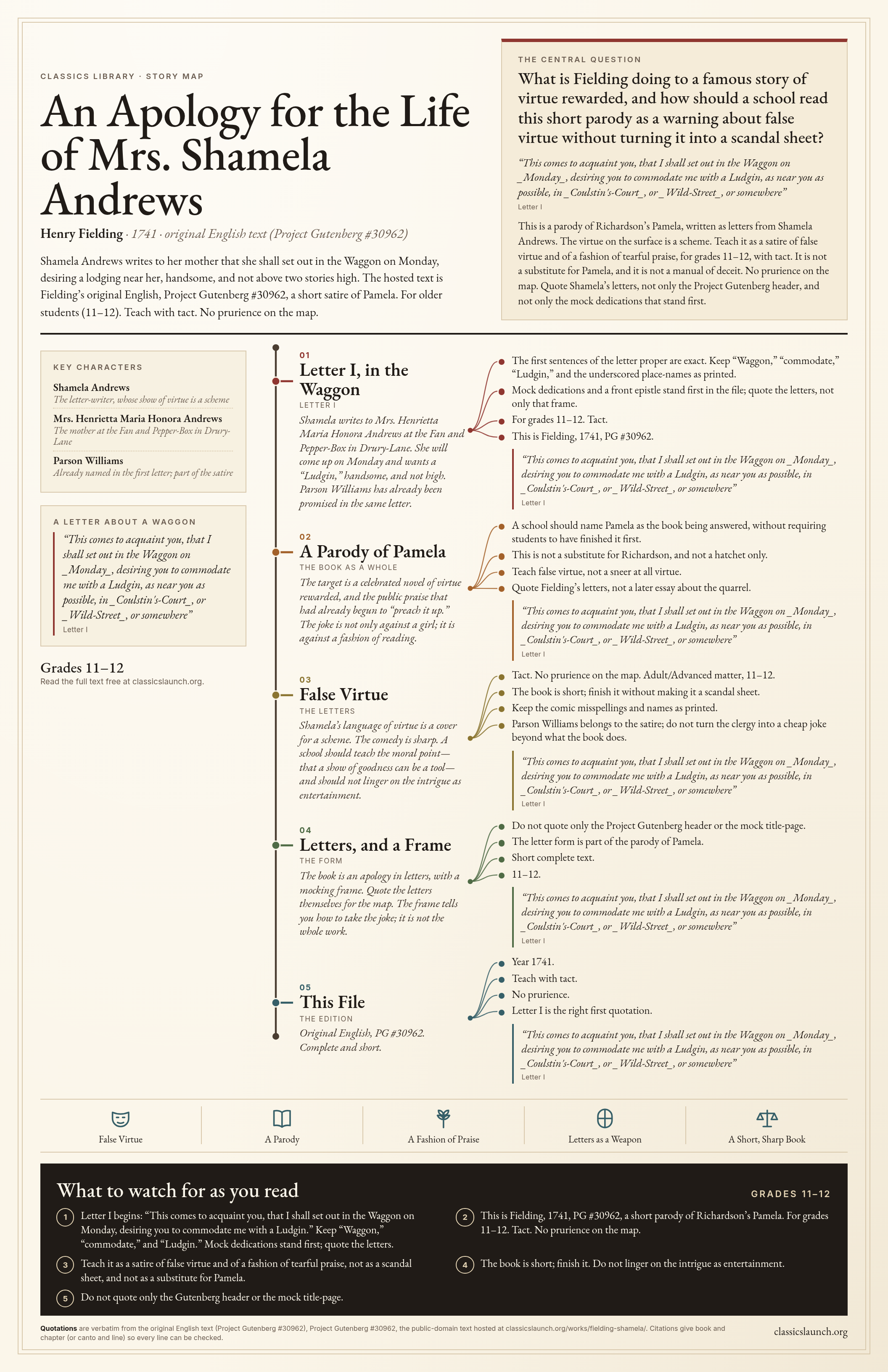
Shamela Andrews writes to her mother that she shall set out in the Waggon on Monday, desiring a lodging near her, handsome, and not above two stories high. The hosted text is Fielding’s original English, Project Gutenberg #30962, a short satire of Pamela. For older students (11–12). Teach with tact. No prurience on the map.
The central question
What is Fielding doing to a famous story of virtue rewarded, and how should a school read this short parody as a warning about false virtue without turning it into a scandal sheet?
“This comes to acquaint you, that I shall set out in the Waggon on _Monday_, desiring you to commodate me with a Ludgin, as near you as possible, in _Coulstin's-Court_, or _Wild-Street_, or somewhere”
This is a parody of Richardson’s Pamela, written as letters from Shamela Andrews. The virtue on the surface is a scheme. Teach it as a satire of false virtue and of a fashion of tearful praise, for grades 11–12, with tact. It is not a substitute for Pamela, and it is not a manual of deceit. No prurience on the map. Quote Shamela’s letters, not only the Project Gutenberg header, and not only the mock dedications that stand first.
- 01
Letter I, in the Waggon
Letter I
Shamela writes to Mrs. Henrietta Maria Honora Andrews at the Fan and Pepper-Box in Drury-Lane. She will come up on Monday and wants a “Ludgin,” handsome, and not high. Parson Williams has already been promised in the same letter.
- The first sentences of the letter proper are exact. Keep “Waggon,” “commodate,” “Ludgin,” and the underscored place-names as printed.
- Mock dedications and a front epistle stand first in the file; quote the letters, not only that frame.
- For grades 11–12. Tact.
- This is Fielding, 1741, PG #30962.
“This comes to acquaint you, that I shall set out in the Waggon on _Monday_, desiring you to commodate me with a Ludgin, as near you as possible, in _Coulstin's-Court_, or _Wild-Street_, or somewhere”
- 02
A Parody of Pamela
The book as a whole
The target is a celebrated novel of virtue rewarded, and the public praise that had already begun to “preach it up.” The joke is not only against a girl; it is against a fashion of reading.
- A school should name Pamela as the book being answered, without requiring students to have finished it first.
- This is not a substitute for Richardson, and not a hatchet only.
- Teach false virtue, not a sneer at all virtue.
- Quote Fielding’s letters, not a later essay about the quarrel.
“This comes to acquaint you, that I shall set out in the Waggon on _Monday_, desiring you to commodate me with a Ludgin, as near you as possible, in _Coulstin's-Court_, or _Wild-Street_, or somewhere”
- 03
False Virtue
The letters
Shamela’s language of virtue is a cover for a scheme. The comedy is sharp. A school should teach the moral point—that a show of goodness can be a tool—and should not linger on the intrigue as entertainment.
- Tact. No prurience on the map. Adult/Advanced matter, 11–12.
- The book is short; finish it without making it a scandal sheet.
- Keep the comic misspellings and names as printed.
- Parson Williams belongs to the satire; do not turn the clergy into a cheap joke beyond what the book does.
“This comes to acquaint you, that I shall set out in the Waggon on _Monday_, desiring you to commodate me with a Ludgin, as near you as possible, in _Coulstin's-Court_, or _Wild-Street_, or somewhere”
- 04
Letters, and a Frame
The form
The book is an apology in letters, with a mocking frame. Quote the letters themselves for the map. The frame tells you how to take the joke; it is not the whole work.
- Do not quote only the Project Gutenberg header or the mock title-page.
- The letter form is part of the parody of Pamela.
- Short complete text.
- 11–12.
“This comes to acquaint you, that I shall set out in the Waggon on _Monday_, desiring you to commodate me with a Ludgin, as near you as possible, in _Coulstin's-Court_, or _Wild-Street_, or somewhere”
- 05
This File
The edition
Original English, PG #30962. Complete and short.
- Year 1741.
- Teach with tact.
- No prurience.
- Letter I is the right first quotation.
“This comes to acquaint you, that I shall set out in the Waggon on _Monday_, desiring you to commodate me with a Ludgin, as near you as possible, in _Coulstin's-Court_, or _Wild-Street_, or somewhere”
- False Virtue
- A Parody
- A Fashion of Praise
- Letters as a Weapon
- A Short, Sharp Book
What to watch for as you read
Grades 11–12- Letter I begins: “This comes to acquaint you, that I shall set out in the Waggon on Monday, desiring you to commodate me with a Ludgin.” Keep “Waggon,” “commodate,” and “Ludgin.” Mock dedications stand first; quote the letters.
- This is Fielding, 1741, PG #30962, a short parody of Richardson’s Pamela. For grades 11–12. Tact. No prurience on the map.
- Teach it as a satire of false virtue and of a fashion of tearful praise, not as a scandal sheet, and not as a substitute for Pamela.
- The book is short; finish it. Do not linger on the intrigue as entertainment.
- Do not quote only the Gutenberg header or the mock title-page.
Every quotation is word for word from the original English text (Project Gutenberg #30962) hosted in this library and is checked against that text each time the site is built. Citations give book and chapter (or canto and line).