Story maps · Grades 9–12
Flatland: A Romance of Many Dimensions: A Story Map
The PDF is one tabloid page (11 × 17 in). On letter paper, choose “Fit to page.”
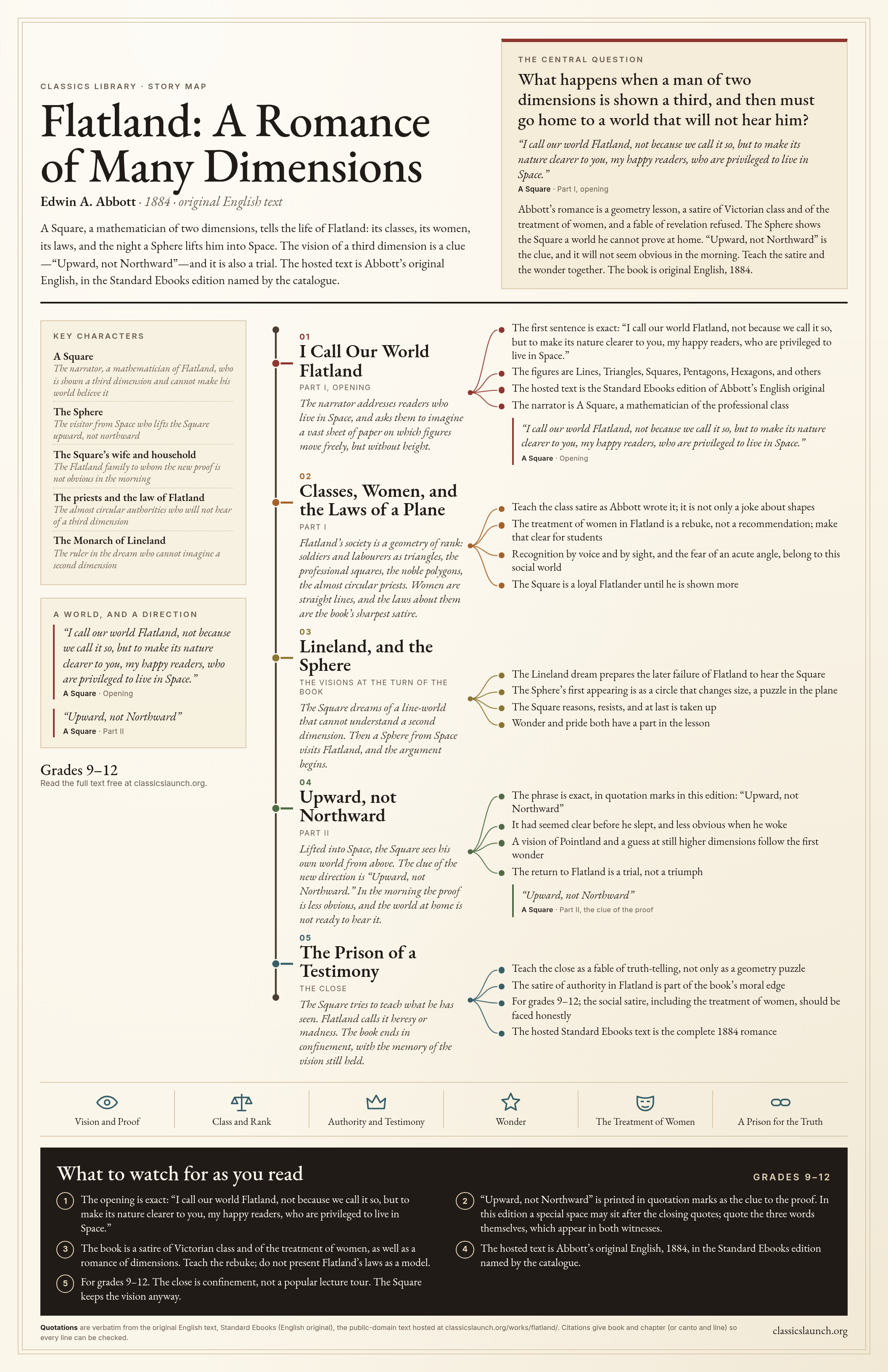
A Square, a mathematician of two dimensions, tells the life of Flatland: its classes, its women, its laws, and the night a Sphere lifts him into Space. The vision of a third dimension is a clue—“Upward, not Northward”—and it is also a trial. The hosted text is Abbott’s original English, in the Standard Ebooks edition named by the catalogue.
The central question
What happens when a man of two dimensions is shown a third, and then must go home to a world that will not hear him?
“I call our world Flatland, not because we call it so, but to make its nature clearer to you, my happy readers, who are privileged to live in Space.”
Abbott’s romance is a geometry lesson, a satire of Victorian class and of the treatment of women, and a fable of revelation refused. The Sphere shows the Square a world he cannot prove at home. “Upward, not Northward” is the clue, and it will not seem obvious in the morning. Teach the satire and the wonder together. The book is original English, 1884.
- 01
I Call Our World Flatland
Part I, opening
The narrator addresses readers who live in Space, and asks them to imagine a vast sheet of paper on which figures move freely, but without height.
- The first sentence is exact: “I call our world Flatland, not because we call it so, but to make its nature clearer to you, my happy readers, who are privileged to live in Space.”
- The figures are Lines, Triangles, Squares, Pentagons, Hexagons, and others
- The hosted text is the Standard Ebooks edition of Abbott’s English original
- The narrator is A Square, a mathematician of the professional class
“I call our world Flatland, not because we call it so, but to make its nature clearer to you, my happy readers, who are privileged to live in Space.”
- 02
Classes, Women, and the Laws of a Plane
Part I
Flatland’s society is a geometry of rank: soldiers and labourers as triangles, the professional squares, the noble polygons, the almost circular priests. Women are straight lines, and the laws about them are the book’s sharpest satire.
- Teach the class satire as Abbott wrote it; it is not only a joke about shapes
- The treatment of women in Flatland is a rebuke, not a recommendation; make that clear for students
- Recognition by voice and by sight, and the fear of an acute angle, belong to this social world
- The Square is a loyal Flatlander until he is shown more
- 03
Lineland, and the Sphere
The visions at the turn of the book
The Square dreams of a line-world that cannot understand a second dimension. Then a Sphere from Space visits Flatland, and the argument begins.
- The Lineland dream prepares the later failure of Flatland to hear the Square
- The Sphere’s first appearing is as a circle that changes size, a puzzle in the plane
- The Square reasons, resists, and at last is taken up
- Wonder and pride both have a part in the lesson
- 04
Upward, not Northward
Part II
Lifted into Space, the Square sees his own world from above. The clue of the new direction is “Upward, not Northward.” In the morning the proof is less obvious, and the world at home is not ready to hear it.
- The phrase is exact, in quotation marks in this edition: “Upward, not Northward”
- It had seemed clear before he slept, and less obvious when he woke
- A vision of Pointland and a guess at still higher dimensions follow the first wonder
- The return to Flatland is a trial, not a triumph
“Upward, not Northward”
- 05
The Prison of a Testimony
The close
The Square tries to teach what he has seen. Flatland calls it heresy or madness. The book ends in confinement, with the memory of the vision still held.
- Teach the close as a fable of truth-telling, not only as a geometry puzzle
- The satire of authority in Flatland is part of the book’s moral edge
- For grades 9–12; the social satire, including the treatment of women, should be faced honestly
- The hosted Standard Ebooks text is the complete 1884 romance
- Vision and Proof
- Class and Rank
- Authority and Testimony
- Wonder
- The Treatment of Women
- A Prison for the Truth
What to watch for as you read
Grades 9–12- The opening is exact: “I call our world Flatland, not because we call it so, but to make its nature clearer to you, my happy readers, who are privileged to live in Space.”
- “Upward, not Northward” is printed in quotation marks as the clue to the proof. In this edition a special space may sit after the closing quotes; quote the three words themselves, which appear in both witnesses.
- The book is a satire of Victorian class and of the treatment of women, as well as a romance of dimensions. Teach the rebuke; do not present Flatland’s laws as a model.
- The hosted text is Abbott’s original English, 1884, in the Standard Ebooks edition named by the catalogue.
- For grades 9–12. The close is confinement, not a popular lecture tour. The Square keeps the vision anyway.
Every quotation is word for word from the original English text hosted in this library and is checked against that text each time the site is built. Citations give book and chapter (or canto and line).