Story maps · Grades 10–12
My Life and Work: A Story Map
The PDF is one tabloid page (11 × 17 in). On letter paper, choose “Fit to page.”
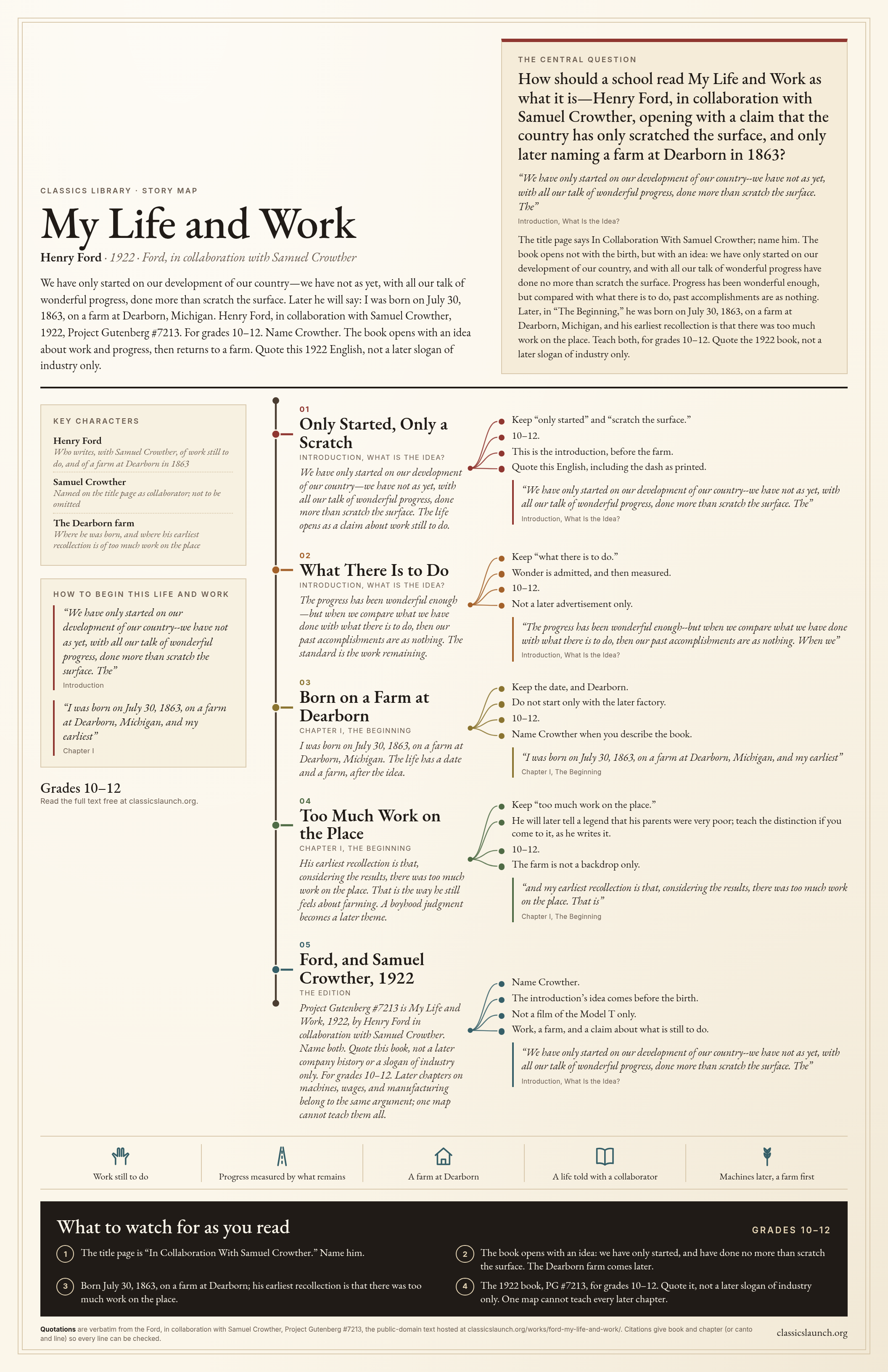
We have only started on our development of our country—we have not as yet, with all our talk of wonderful progress, done more than scratch the surface. Later he will say: I was born on July 30, 1863, on a farm at Dearborn, Michigan. Henry Ford, in collaboration with Samuel Crowther, 1922, Project Gutenberg #7213. For grades 10–12. Name Crowther. The book opens with an idea about work and progress, then returns to a farm. Quote this 1922 English, not a later slogan of industry only.
The central question
How should a school read My Life and Work as what it is—Henry Ford, in collaboration with Samuel Crowther, opening with a claim that the country has only scratched the surface, and only later naming a farm at Dearborn in 1863?
“We have only started on our development of our country--we have not as yet, with all our talk of wonderful progress, done more than scratch the surface. The”
The title page says In Collaboration With Samuel Crowther; name him. The book opens not with the birth, but with an idea: we have only started on our development of our country, and with all our talk of wonderful progress have done no more than scratch the surface. Progress has been wonderful enough, but compared with what there is to do, past accomplishments are as nothing. Later, in “The Beginning,” he was born on July 30, 1863, on a farm at Dearborn, Michigan, and his earliest recollection is that there was too much work on the place. Teach both, for grades 10–12. Quote the 1922 book, not a later slogan of industry only.
- 01
Only Started, Only a Scratch
Introduction, What Is the Idea?
We have only started on our development of our country—we have not as yet, with all our talk of wonderful progress, done more than scratch the surface. The life opens as a claim about work still to do.
- Keep “only started” and “scratch the surface.”
- 10–12.
- This is the introduction, before the farm.
- Quote this English, including the dash as printed.
“We have only started on our development of our country--we have not as yet, with all our talk of wonderful progress, done more than scratch the surface. The”
- 02
What There Is to Do
Introduction, What Is the Idea?
The progress has been wonderful enough—but when we compare what we have done with what there is to do, then our past accomplishments are as nothing. The standard is the work remaining.
- Keep “what there is to do.”
- Wonder is admitted, and then measured.
- 10–12.
- Not a later advertisement only.
“The progress has been wonderful enough--but when we compare what we have done with what there is to do, then our past accomplishments are as nothing. When we”
- 03
Born on a Farm at Dearborn
Chapter I, The Beginning
I was born on July 30, 1863, on a farm at Dearborn, Michigan. The life has a date and a farm, after the idea.
- Keep the date, and Dearborn.
- Do not start only with the later factory.
- 10–12.
- Name Crowther when you describe the book.
“I was born on July 30, 1863, on a farm at Dearborn, Michigan, and my earliest”
- 04
Too Much Work on the Place
Chapter I, The Beginning
His earliest recollection is that, considering the results, there was too much work on the place. That is the way he still feels about farming. A boyhood judgment becomes a later theme.
- Keep “too much work on the place.”
- He will later tell a legend that his parents were very poor; teach the distinction if you come to it, as he writes it.
- 10–12.
- The farm is not a backdrop only.
“and my earliest recollection is that, considering the results, there was too much work on the place. That is”
- 05
Ford, and Samuel Crowther, 1922
The edition
Project Gutenberg #7213 is My Life and Work, 1922, by Henry Ford in collaboration with Samuel Crowther. Name both. Quote this book, not a later company history or a slogan of industry only. For grades 10–12. Later chapters on machines, wages, and manufacturing belong to the same argument; one map cannot teach them all.
- Name Crowther.
- The introduction’s idea comes before the birth.
- Not a film of the Model T only.
- Work, a farm, and a claim about what is still to do.
“We have only started on our development of our country--we have not as yet, with all our talk of wonderful progress, done more than scratch the surface. The”
- Work still to do
- Progress measured by what remains
- A farm at Dearborn
- A life told with a collaborator
- Machines later, a farm first
What to watch for as you read
Grades 10–12- The title page is “In Collaboration With Samuel Crowther.” Name him.
- The book opens with an idea: we have only started, and have done no more than scratch the surface. The Dearborn farm comes later.
- Born July 30, 1863, on a farm at Dearborn; his earliest recollection is that there was too much work on the place.
- The 1922 book, PG #7213, for grades 10–12. Quote it, not a later slogan of industry only. One map cannot teach every later chapter.
Every quotation is word for word from the Ford, in collaboration with Samuel Crowther hosted in this library and is checked against that text each time the site is built. Citations give book and chapter (or canto and line).