Story maps · Grades 8–12
Good Newes from New England: A Story Map
The PDF is one tabloid page (11 × 17 in). On letter paper, choose “Fit to page.”
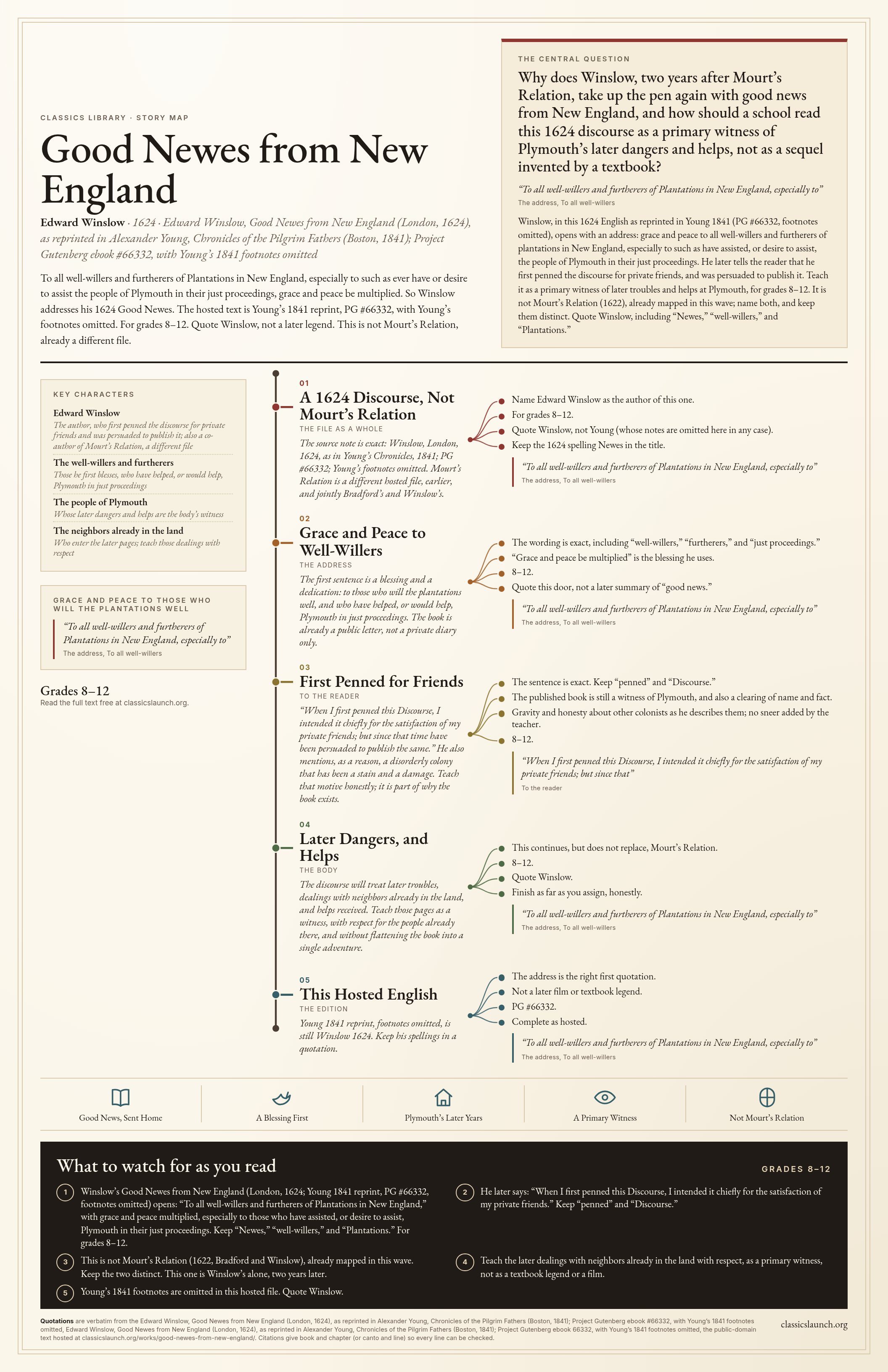
To all well-willers and furtherers of Plantations in New England, especially to such as ever have or desire to assist the people of Plymouth in their just proceedings, grace and peace be multiplied. So Winslow addresses his 1624 Good Newes. The hosted text is Young’s 1841 reprint, PG #66332, with Young’s footnotes omitted. For grades 8–12. Quote Winslow, not a later legend. This is not Mourt’s Relation, already a different file.
The central question
Why does Winslow, two years after Mourt’s Relation, take up the pen again with good news from New England, and how should a school read this 1624 discourse as a primary witness of Plymouth’s later dangers and helps, not as a sequel invented by a textbook?
“To all well-willers and furtherers of Plantations in New England, especially to”
Winslow, in this 1624 English as reprinted in Young 1841 (PG #66332, footnotes omitted), opens with an address: grace and peace to all well-willers and furtherers of plantations in New England, especially to such as have assisted, or desire to assist, the people of Plymouth in their just proceedings. He later tells the reader that he first penned the discourse for private friends, and was persuaded to publish it. Teach it as a primary witness of later troubles and helps at Plymouth, for grades 8–12. It is not Mourt’s Relation (1622), already mapped in this wave; name both, and keep them distinct. Quote Winslow, including “Newes,” “well-willers,” and “Plantations.”
- 01
A 1624 Discourse, Not Mourt’s Relation
The file as a whole
The source note is exact: Winslow, London, 1624, as in Young’s Chronicles, 1841; PG #66332; Young’s footnotes omitted. Mourt’s Relation is a different hosted file, earlier, and jointly Bradford’s and Winslow’s.
- Name Edward Winslow as the author of this one.
- For grades 8–12.
- Quote Winslow, not Young (whose notes are omitted here in any case).
- Keep the 1624 spelling Newes in the title.
“To all well-willers and furtherers of Plantations in New England, especially to”
- 02
Grace and Peace to Well-Willers
The address
The first sentence is a blessing and a dedication: to those who will the plantations well, and who have helped, or would help, Plymouth in just proceedings. The book is already a public letter, not a private diary only.
- The wording is exact, including “well-willers,” “furtherers,” and “just proceedings.”
- “Grace and peace be multiplied” is the blessing he uses.
- 8–12.
- Quote this door, not a later summary of “good news.”
“To all well-willers and furtherers of Plantations in New England, especially to”
- 03
First Penned for Friends
To the reader
“When I first penned this Discourse, I intended it chiefly for the satisfaction of my private friends; but since that time have been persuaded to publish the same.” He also mentions, as a reason, a disorderly colony that has been a stain and a damage. Teach that motive honestly; it is part of why the book exists.
- The sentence is exact. Keep “penned” and “Discourse.”
- The published book is still a witness of Plymouth, and also a clearing of name and fact.
- Gravity and honesty about other colonists as he describes them; no sneer added by the teacher.
- 8–12.
“When I first penned this Discourse, I intended it chiefly for the satisfaction of my private friends; but since that”
- 04
Later Dangers, and Helps
The body
The discourse will treat later troubles, dealings with neighbors already in the land, and helps received. Teach those pages as a witness, with respect for the people already there, and without flattening the book into a single adventure.
- This continues, but does not replace, Mourt’s Relation.
- 8–12.
- Quote Winslow.
- Finish as far as you assign, honestly.
“To all well-willers and furtherers of Plantations in New England, especially to”
- 05
This Hosted English
The edition
Young 1841 reprint, footnotes omitted, is still Winslow 1624. Keep his spellings in a quotation.
- The address is the right first quotation.
- Not a later film or textbook legend.
- PG #66332.
- Complete as hosted.
“To all well-willers and furtherers of Plantations in New England, especially to”
- Good News, Sent Home
- A Blessing First
- Plymouth’s Later Years
- A Primary Witness
- Not Mourt’s Relation
What to watch for as you read
Grades 8–12- Winslow’s Good Newes from New England (London, 1624; Young 1841 reprint, PG #66332, footnotes omitted) opens: “To all well-willers and furtherers of Plantations in New England,” with grace and peace multiplied, especially to those who have assisted, or desire to assist, Plymouth in their just proceedings. Keep “Newes,” “well-willers,” and “Plantations.” For grades 8–12.
- He later says: “When I first penned this Discourse, I intended it chiefly for the satisfaction of my private friends.” Keep “penned” and “Discourse.”
- This is not Mourt’s Relation (1622, Bradford and Winslow), already mapped in this wave. Keep the two distinct. This one is Winslow’s alone, two years later.
- Teach the later dealings with neighbors already in the land with respect, as a primary witness, not as a textbook legend or a film.
- Young’s 1841 footnotes are omitted in this hosted file. Quote Winslow.
Every quotation is word for word from the Edward Winslow, Good Newes from New England (London, 1624), as reprinted in Alexander Young, Chronicles of the Pilgrim Fathers (Boston, 1841); Project Gutenberg ebook #66332, with Young’s 1841 footnotes omitted hosted in this library and is checked against that text each time the site is built. Citations give book and chapter (or canto and line).