Story maps · Grades 3–5
Heidi: A Story Map
The PDF is one tabloid page (11 × 17 in). On letter paper, choose “Fit to page.”
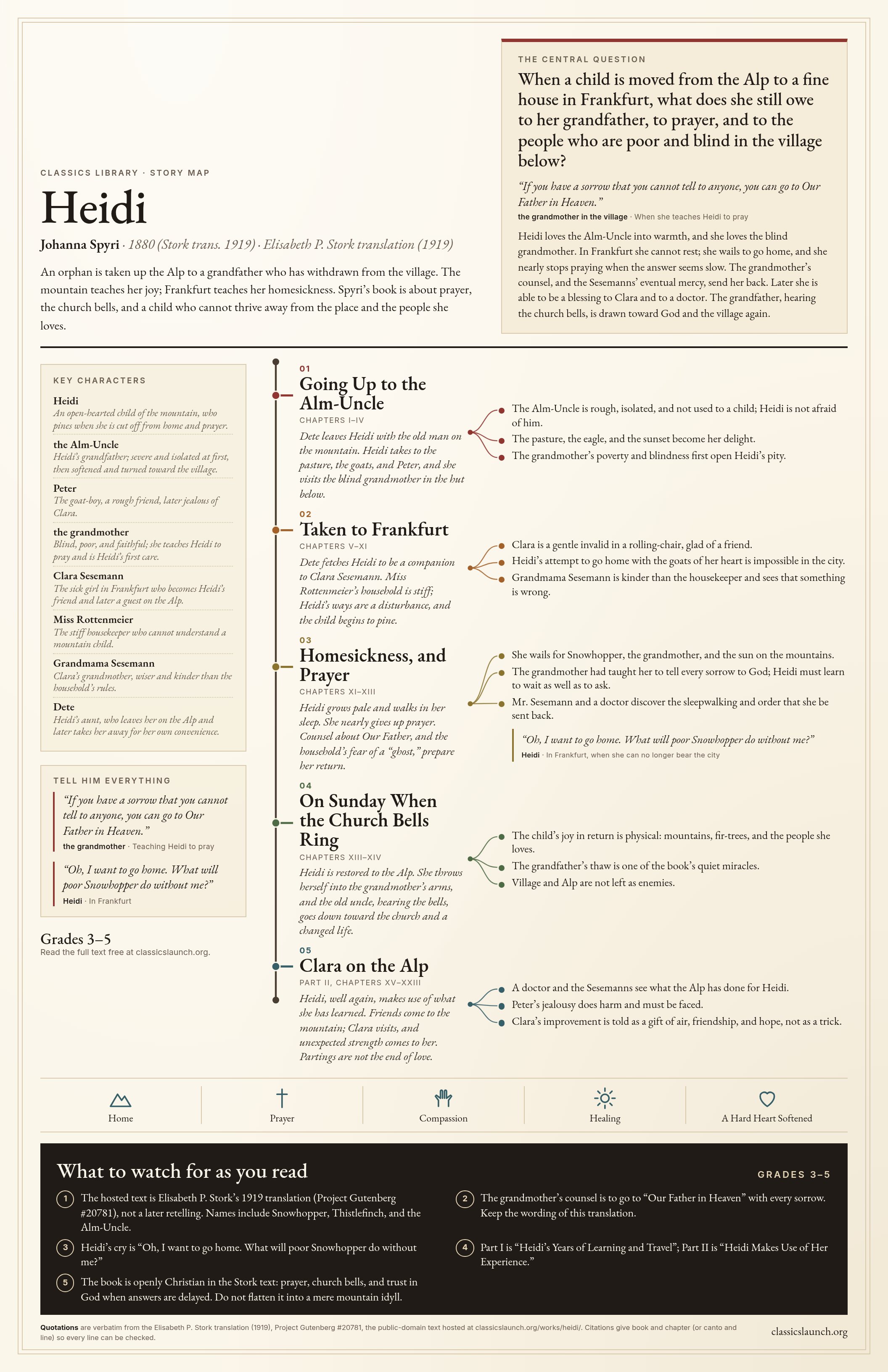
An orphan is taken up the Alp to a grandfather who has withdrawn from the village. The mountain teaches her joy; Frankfurt teaches her homesickness. Spyri’s book is about prayer, the church bells, and a child who cannot thrive away from the place and the people she loves.
The central question
When a child is moved from the Alp to a fine house in Frankfurt, what does she still owe to her grandfather, to prayer, and to the people who are poor and blind in the village below?
“If you have a sorrow that you cannot tell to anyone, you can go to Our Father in Heaven.”
Heidi loves the Alm-Uncle into warmth, and she loves the blind grandmother. In Frankfurt she cannot rest; she wails to go home, and she nearly stops praying when the answer seems slow. The grandmother’s counsel, and the Sesemanns’ eventual mercy, send her back. Later she is able to be a blessing to Clara and to a doctor. The grandfather, hearing the church bells, is drawn toward God and the village again.
- 01
Going Up to the Alm-Uncle
Chapters I–IV
Dete leaves Heidi with the old man on the mountain. Heidi takes to the pasture, the goats, and Peter, and she visits the blind grandmother in the hut below.
- The Alm-Uncle is rough, isolated, and not used to a child; Heidi is not afraid of him.
- The pasture, the eagle, and the sunset become her delight.
- The grandmother’s poverty and blindness first open Heidi’s pity.
- 02
Taken to Frankfurt
Chapters V–XI
Dete fetches Heidi to be a companion to Clara Sesemann. Miss Rottenmeier’s household is stiff; Heidi’s ways are a disturbance, and the child begins to pine.
- Clara is a gentle invalid in a rolling-chair, glad of a friend.
- Heidi’s attempt to go home with the goats of her heart is impossible in the city.
- Grandmama Sesemann is kinder than the housekeeper and sees that something is wrong.
- 03
Homesickness, and Prayer
Chapters XI–XIII
Heidi grows pale and walks in her sleep. She nearly gives up prayer. Counsel about Our Father, and the household’s fear of a “ghost,” prepare her return.
- She wails for Snowhopper, the grandmother, and the sun on the mountains.
- The grandmother had taught her to tell every sorrow to God; Heidi must learn to wait as well as to ask.
- Mr. Sesemann and a doctor discover the sleepwalking and order that she be sent back.
“Oh, I want to go home. What will poor Snowhopper do without me?”
- 04
On Sunday When the Church Bells Ring
Chapters XIII–XIV
Heidi is restored to the Alp. She throws herself into the grandmother’s arms, and the old uncle, hearing the bells, goes down toward the church and a changed life.
- The child’s joy in return is physical: mountains, fir-trees, and the people she loves.
- The grandfather’s thaw is one of the book’s quiet miracles.
- Village and Alp are not left as enemies.
- 05
Clara on the Alp
Part II, Chapters XV–XXIII
Heidi, well again, makes use of what she has learned. Friends come to the mountain; Clara visits, and unexpected strength comes to her. Partings are not the end of love.
- A doctor and the Sesemanns see what the Alp has done for Heidi.
- Peter’s jealousy does harm and must be faced.
- Clara’s improvement is told as a gift of air, friendship, and hope, not as a trick.
- Home
- Prayer
- Compassion
- Healing
- A Hard Heart Softened
What to watch for as you read
Grades 3–5- The hosted text is Elisabeth P. Stork’s 1919 translation (Project Gutenberg #20781), not a later retelling. Names include Snowhopper, Thistlefinch, and the Alm-Uncle.
- The grandmother’s counsel is to go to “Our Father in Heaven” with every sorrow. Keep the wording of this translation.
- Heidi’s cry is “Oh, I want to go home. What will poor Snowhopper do without me?”
- Part I is “Heidi’s Years of Learning and Travel”; Part II is “Heidi Makes Use of Her Experience.”
- The book is openly Christian in the Stork text: prayer, church bells, and trust in God when answers are delayed. Do not flatten it into a mere mountain idyll.
Every quotation is word for word from the Elisabeth P. Stork translation (1919) hosted in this library and is checked against that text each time the site is built. Citations give book and chapter (or canto and line).