Story maps · Grades 9–12
Herland: A Story Map
The PDF is one tabloid page (11 × 17 in). On letter paper, choose “Fit to page.”
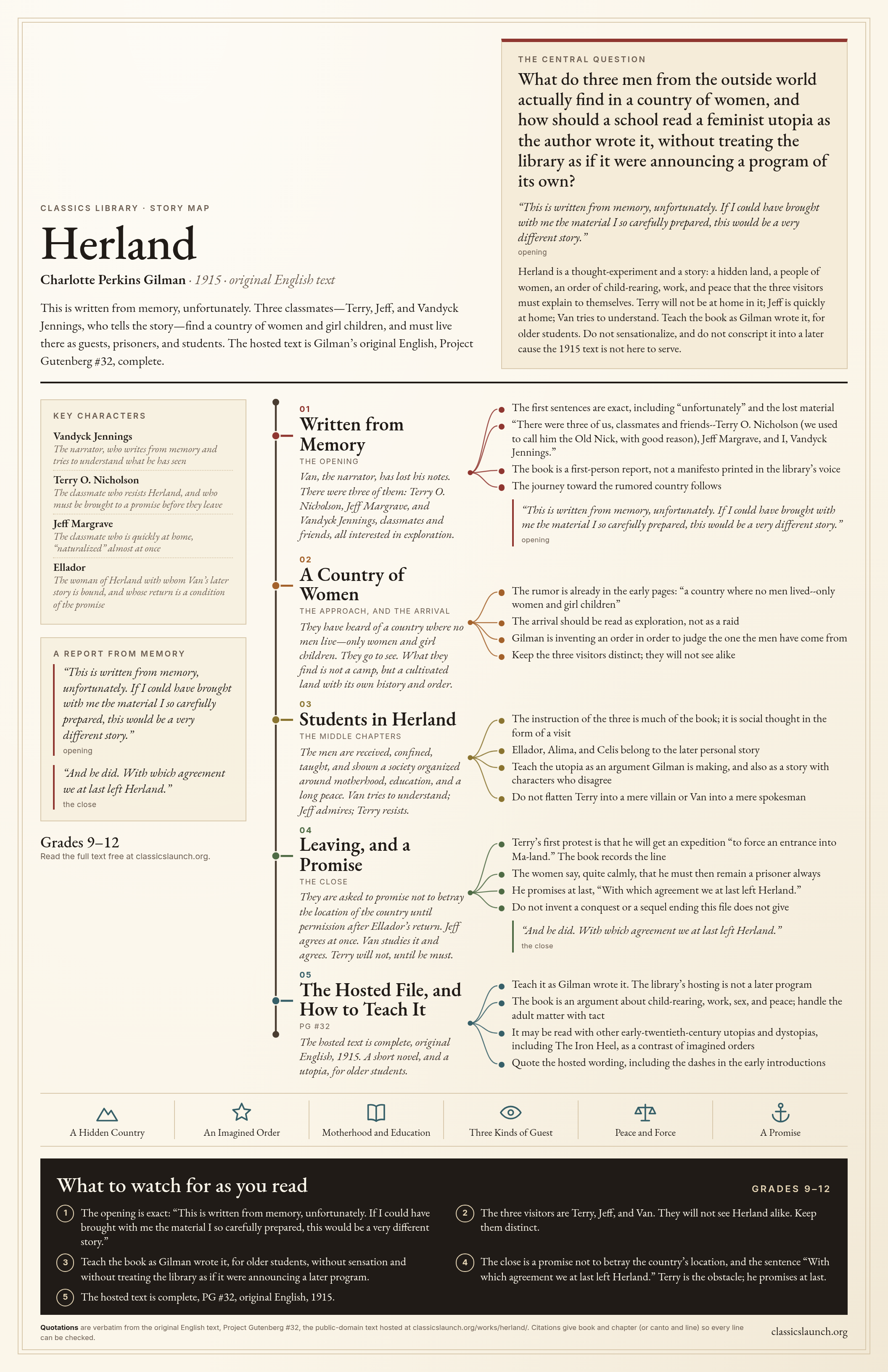
This is written from memory, unfortunately. Three classmates—Terry, Jeff, and Vandyck Jennings, who tells the story—find a country of women and girl children, and must live there as guests, prisoners, and students. The hosted text is Gilman’s original English, Project Gutenberg #32, complete.
The central question
What do three men from the outside world actually find in a country of women, and how should a school read a feminist utopia as the author wrote it, without treating the library as if it were announcing a program of its own?
“This is written from memory, unfortunately. If I could have brought with me the material I so carefully prepared, this would be a very different story.”
Herland is a thought-experiment and a story: a hidden land, a people of women, an order of child-rearing, work, and peace that the three visitors must explain to themselves. Terry will not be at home in it; Jeff is quickly at home; Van tries to understand. Teach the book as Gilman wrote it, for older students. Do not sensationalize, and do not conscript it into a later cause the 1915 text is not here to serve.
- 01
Written from Memory
The opening
Van, the narrator, has lost his notes. There were three of them: Terry O. Nicholson, Jeff Margrave, and Vandyck Jennings, classmates and friends, all interested in exploration.
- The first sentences are exact, including “unfortunately” and the lost material
- “There were three of us, classmates and friends--Terry O. Nicholson (we used to call him the Old Nick, with good reason), Jeff Margrave, and I, Vandyck Jennings.”
- The book is a first-person report, not a manifesto printed in the library’s voice
- The journey toward the rumored country follows
“This is written from memory, unfortunately. If I could have brought with me the material I so carefully prepared, this would be a very different story.”
- 02
A Country of Women
The approach, and the arrival
They have heard of a country where no men live—only women and girl children. They go to see. What they find is not a camp, but a cultivated land with its own history and order.
- The rumor is already in the early pages: “a country where no men lived--only women and girl children”
- The arrival should be read as exploration, not as a raid
- Gilman is inventing an order in order to judge the one the men have come from
- Keep the three visitors distinct; they will not see alike
- 03
Students in Herland
The middle chapters
The men are received, confined, taught, and shown a society organized around motherhood, education, and a long peace. Van tries to understand; Jeff admires; Terry resists.
- The instruction of the three is much of the book; it is social thought in the form of a visit
- Ellador, Alima, and Celis belong to the later personal story
- Teach the utopia as an argument Gilman is making, and also as a story with characters who disagree
- Do not flatten Terry into a mere villain or Van into a mere spokesman
- 04
Leaving, and a Promise
The close
They are asked to promise not to betray the location of the country until permission after Ellador’s return. Jeff agrees at once. Van studies it and agrees. Terry will not, until he must.
- Terry’s first protest is that he will get an expedition “to force an entrance into Ma-land.” The book records the line
- The women say, quite calmly, that he must then remain a prisoner always
- He promises at last, “With which agreement we at last left Herland.”
- Do not invent a conquest or a sequel ending this file does not give
“And he did. With which agreement we at last left Herland.”
- 05
The Hosted File, and How to Teach It
PG #32
The hosted text is complete, original English, 1915. A short novel, and a utopia, for older students.
- Teach it as Gilman wrote it. The library’s hosting is not a later program
- The book is an argument about child-rearing, work, sex, and peace; handle the adult matter with tact
- It may be read with other early-twentieth-century utopias and dystopias, including The Iron Heel, as a contrast of imagined orders
- Quote the hosted wording, including the dashes in the early introductions
- A Hidden Country
- An Imagined Order
- Motherhood and Education
- Three Kinds of Guest
- Peace and Force
- A Promise
What to watch for as you read
Grades 9–12- The opening is exact: “This is written from memory, unfortunately. If I could have brought with me the material I so carefully prepared, this would be a very different story.”
- The three visitors are Terry, Jeff, and Van. They will not see Herland alike. Keep them distinct.
- Teach the book as Gilman wrote it, for older students, without sensation and without treating the library as if it were announcing a later program.
- The close is a promise not to betray the country’s location, and the sentence “With which agreement we at last left Herland.” Terry is the obstacle; he promises at last.
- The hosted text is complete, PG #32, original English, 1915.
Every quotation is word for word from the original English text hosted in this library and is checked against that text each time the site is built. Citations give book and chapter (or canto and line).