Story maps · Grades 6–12
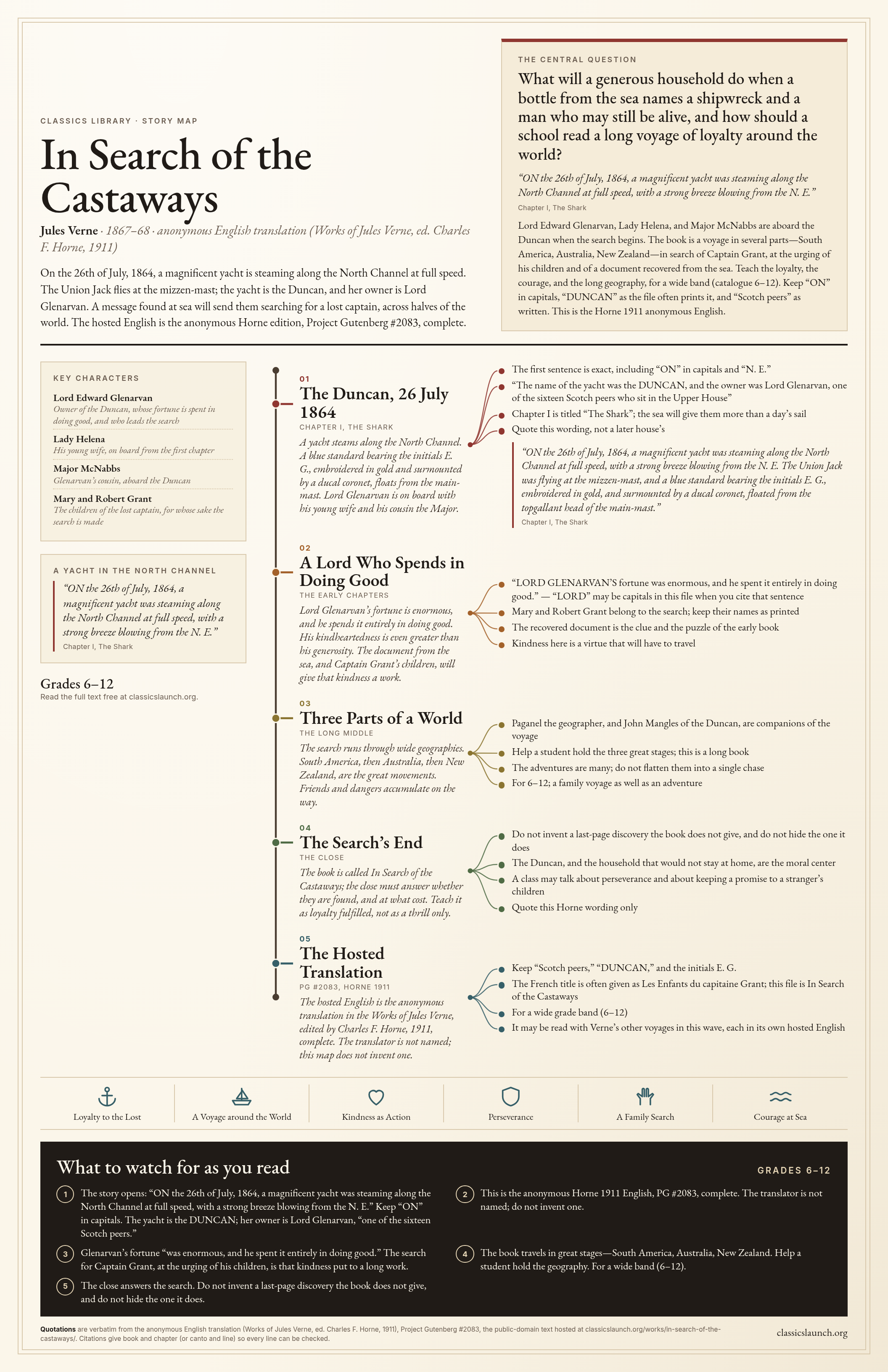
In Search of the Castaways: A Story Map
The PDF is one tabloid page (11 × 17 in). On letter paper, choose “Fit to page.”
On the 26th of July, 1864, a magnificent yacht is steaming along the North Channel at full speed. The Union Jack flies at the mizzen-mast; the yacht is the Duncan, and her owner is Lord Glenarvan. A message found at sea will send them searching for a lost captain, across halves of the world. The hosted English is the anonymous Horne edition, Project Gutenberg #2083, complete.
The central question
What will a generous household do when a bottle from the sea names a shipwreck and a man who may still be alive, and how should a school read a long voyage of loyalty around the world?
“ON the 26th of July, 1864, a magnificent yacht was steaming along the North Channel at full speed, with a strong breeze blowing from the N. E.”
Lord Edward Glenarvan, Lady Helena, and Major McNabbs are aboard the Duncan when the search begins. The book is a voyage in several parts—South America, Australia, New Zealand—in search of Captain Grant, at the urging of his children and of a document recovered from the sea. Teach the loyalty, the courage, and the long geography, for a wide band (catalogue 6–12). Keep “ON” in capitals, “DUNCAN” as the file often prints it, and “Scotch peers” as written. This is the Horne 1911 anonymous English.
- 01
The Duncan, 26 July 1864
Chapter I, The Shark
A yacht steams along the North Channel. A blue standard bearing the initials E. G., embroidered in gold and surmounted by a ducal coronet, floats from the main-mast. Lord Glenarvan is on board with his young wife and his cousin the Major.
- The first sentence is exact, including “ON” in capitals and “N. E.”
- “The name of the yacht was the DUNCAN, and the owner was Lord Glenarvan, one of the sixteen Scotch peers who sit in the Upper House”
- Chapter I is titled “The Shark”; the sea will give them more than a day’s sail
- Quote this wording, not a later house’s
“ON the 26th of July, 1864, a magnificent yacht was steaming along the North Channel at full speed, with a strong breeze blowing from the N. E. The Union Jack was flying at the mizzen-mast, and a blue standard bearing the initials E. G., embroidered in gold, and surmounted by a ducal coronet, floated from the topgallant head of the main-mast.”
- 02
A Lord Who Spends in Doing Good
The early chapters
Lord Glenarvan’s fortune is enormous, and he spends it entirely in doing good. His kindheartedness is even greater than his generosity. The document from the sea, and Captain Grant’s children, will give that kindness a work.
- “LORD GLENARVAN’S fortune was enormous, and he spent it entirely in doing good.” — “LORD” may be capitals in this file when you cite that sentence
- Mary and Robert Grant belong to the search; keep their names as printed
- The recovered document is the clue and the puzzle of the early book
- Kindness here is a virtue that will have to travel
- 03
Three Parts of a World
The long middle
The search runs through wide geographies. South America, then Australia, then New Zealand, are the great movements. Friends and dangers accumulate on the way.
- Paganel the geographer, and John Mangles of the Duncan, are companions of the voyage
- Help a student hold the three great stages; this is a long book
- The adventures are many; do not flatten them into a single chase
- For 6–12; a family voyage as well as an adventure
- 04
The Search’s End
The close
The book is called In Search of the Castaways; the close must answer whether they are found, and at what cost. Teach it as loyalty fulfilled, not as a thrill only.
- Do not invent a last-page discovery the book does not give, and do not hide the one it does
- The Duncan, and the household that would not stay at home, are the moral center
- A class may talk about perseverance and about keeping a promise to a stranger’s children
- Quote this Horne wording only
- 05
The Hosted Translation
PG #2083, Horne 1911
The hosted English is the anonymous translation in the Works of Jules Verne, edited by Charles F. Horne, 1911, complete. The translator is not named; this map does not invent one.
- Keep “Scotch peers,” “DUNCAN,” and the initials E. G.
- The French title is often given as Les Enfants du capitaine Grant; this file is In Search of the Castaways
- For a wide grade band (6–12)
- It may be read with Verne’s other voyages in this wave, each in its own hosted English
- Loyalty to the Lost
- A Voyage around the World
- Kindness as Action
- Perseverance
- A Family Search
- Courage at Sea
What to watch for as you read
Grades 6–12- The story opens: “ON the 26th of July, 1864, a magnificent yacht was steaming along the North Channel at full speed, with a strong breeze blowing from the N. E.” Keep “ON” in capitals. The yacht is the DUNCAN; her owner is Lord Glenarvan, “one of the sixteen Scotch peers.”
- This is the anonymous Horne 1911 English, PG #2083, complete. The translator is not named; do not invent one.
- Glenarvan’s fortune “was enormous, and he spent it entirely in doing good.” The search for Captain Grant, at the urging of his children, is that kindness put to a long work.
- The book travels in great stages—South America, Australia, New Zealand. Help a student hold the geography. For a wide band (6–12).
- The close answers the search. Do not invent a last-page discovery the book does not give, and do not hide the one it does.
Every quotation is word for word from the anonymous English translation (Works of Jules Verne, ed. Charles F. Horne, 1911) hosted in this library and is checked against that text each time the site is built. Citations give book and chapter (or canto and line).