Story maps · Grades 10–12
What Maisie Knew: A Story Map
The PDF is one tabloid page (11 × 17 in). On letter paper, choose “Fit to page.”
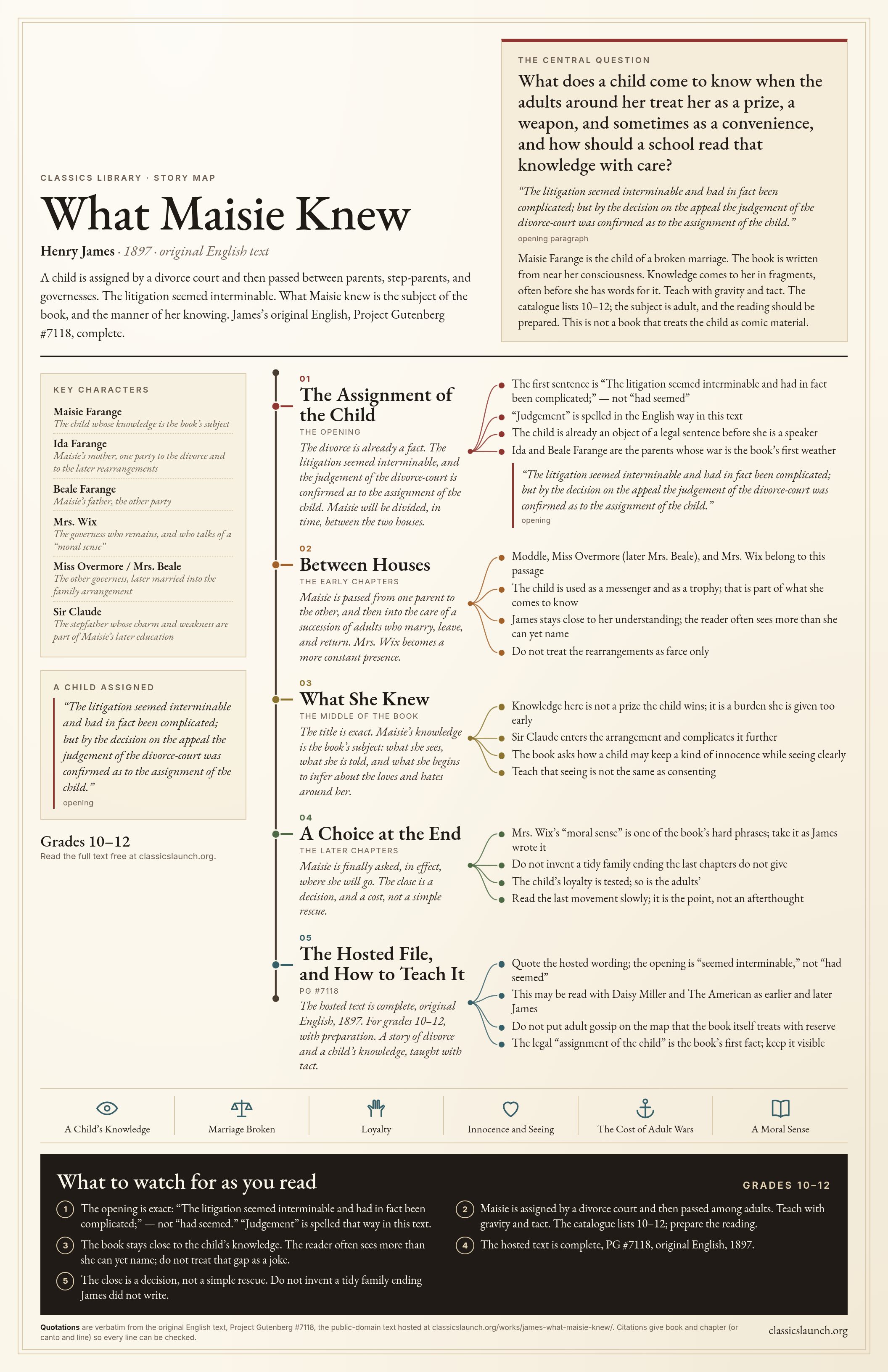
A child is assigned by a divorce court and then passed between parents, step-parents, and governesses. The litigation seemed interminable. What Maisie knew is the subject of the book, and the manner of her knowing. James’s original English, Project Gutenberg #7118, complete.
The central question
What does a child come to know when the adults around her treat her as a prize, a weapon, and sometimes as a convenience, and how should a school read that knowledge with care?
“The litigation seemed interminable and had in fact been complicated; but by the decision on the appeal the judgement of the divorce-court was confirmed as to the assignment of the child.”
Maisie Farange is the child of a broken marriage. The book is written from near her consciousness. Knowledge comes to her in fragments, often before she has words for it. Teach with gravity and tact. The catalogue lists 10–12; the subject is adult, and the reading should be prepared. This is not a book that treats the child as comic material.
- 01
The Assignment of the Child
The opening
The divorce is already a fact. The litigation seemed interminable, and the judgement of the divorce-court is confirmed as to the assignment of the child. Maisie will be divided, in time, between the two houses.
- The first sentence is “The litigation seemed interminable and had in fact been complicated;” — not “had seemed”
- “Judgement” is spelled in the English way in this text
- The child is already an object of a legal sentence before she is a speaker
- Ida and Beale Farange are the parents whose war is the book’s first weather
“The litigation seemed interminable and had in fact been complicated; but by the decision on the appeal the judgement of the divorce-court was confirmed as to the assignment of the child.”
- 02
Between Houses
The early chapters
Maisie is passed from one parent to the other, and then into the care of a succession of adults who marry, leave, and return. Mrs. Wix becomes a more constant presence.
- Moddle, Miss Overmore (later Mrs. Beale), and Mrs. Wix belong to this passage
- The child is used as a messenger and as a trophy; that is part of what she comes to know
- James stays close to her understanding; the reader often sees more than she can yet name
- Do not treat the rearrangements as farce only
- 03
What She Knew
The middle of the book
The title is exact. Maisie’s knowledge is the book’s subject: what she sees, what she is told, and what she begins to infer about the loves and hates around her.
- Knowledge here is not a prize the child wins; it is a burden she is given too early
- Sir Claude enters the arrangement and complicates it further
- The book asks how a child may keep a kind of innocence while seeing clearly
- Teach that seeing is not the same as consenting
- 04
A Choice at the End
The later chapters
Maisie is finally asked, in effect, where she will go. The close is a decision, and a cost, not a simple rescue.
- Mrs. Wix’s “moral sense” is one of the book’s hard phrases; take it as James wrote it
- Do not invent a tidy family ending the last chapters do not give
- The child’s loyalty is tested; so is the adults’
- Read the last movement slowly; it is the point, not an afterthought
- 05
The Hosted File, and How to Teach It
PG #7118
The hosted text is complete, original English, 1897. For grades 10–12, with preparation. A story of divorce and a child’s knowledge, taught with tact.
- Quote the hosted wording; the opening is “seemed interminable,” not “had seemed”
- This may be read with Daisy Miller and The American as earlier and later James
- Do not put adult gossip on the map that the book itself treats with reserve
- The legal “assignment of the child” is the book’s first fact; keep it visible
- A Child’s Knowledge
- Marriage Broken
- Loyalty
- Innocence and Seeing
- The Cost of Adult Wars
- A Moral Sense
What to watch for as you read
Grades 10–12- The opening is exact: “The litigation seemed interminable and had in fact been complicated;” — not “had seemed.” “Judgement” is spelled that way in this text.
- Maisie is assigned by a divorce court and then passed among adults. Teach with gravity and tact. The catalogue lists 10–12; prepare the reading.
- The book stays close to the child’s knowledge. The reader often sees more than she can yet name; do not treat that gap as a joke.
- The hosted text is complete, PG #7118, original English, 1897.
- The close is a decision, not a simple rescue. Do not invent a tidy family ending James did not write.
Every quotation is word for word from the original English text hosted in this library and is checked against that text each time the site is built. Citations give book and chapter (or canto and line).