Story maps · Grades 10–12
The Autobiography of an Ex-Colored Man: A Story Map
The PDF is one tabloid page (11 × 17 in). On letter paper, choose “Fit to page.”
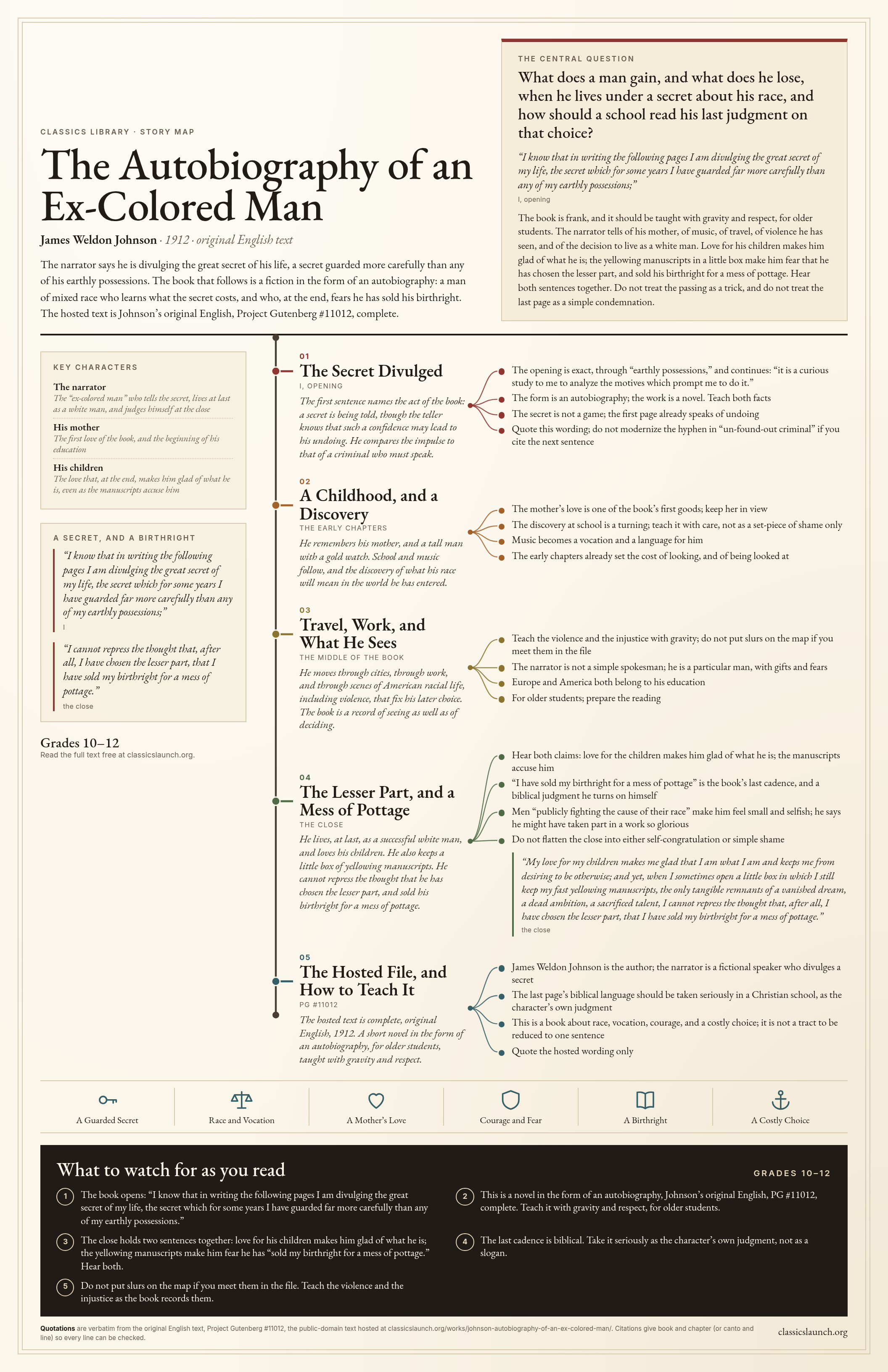
The narrator says he is divulging the great secret of his life, a secret guarded more carefully than any of his earthly possessions. The book that follows is a fiction in the form of an autobiography: a man of mixed race who learns what the secret costs, and who, at the end, fears he has sold his birthright. The hosted text is Johnson’s original English, Project Gutenberg #11012, complete.
The central question
What does a man gain, and what does he lose, when he lives under a secret about his race, and how should a school read his last judgment on that choice?
“I know that in writing the following pages I am divulging the great secret of my life, the secret which for some years I have guarded far more carefully than any of my earthly possessions;”
The book is frank, and it should be taught with gravity and respect, for older students. The narrator tells of his mother, of music, of travel, of violence he has seen, and of the decision to live as a white man. Love for his children makes him glad of what he is; the yellowing manuscripts in a little box make him fear that he has chosen the lesser part, and sold his birthright for a mess of pottage. Hear both sentences together. Do not treat the passing as a trick, and do not treat the last page as a simple condemnation.
- 01
The Secret Divulged
I, opening
The first sentence names the act of the book: a secret is being told, though the teller knows that such a confidence may lead to his undoing. He compares the impulse to that of a criminal who must speak.
- The opening is exact, through “earthly possessions,” and continues: “it is a curious study to me to analyze the motives which prompt me to do it.”
- The form is an autobiography; the work is a novel. Teach both facts
- The secret is not a game; the first page already speaks of undoing
- Quote this wording; do not modernize the hyphen in “un-found-out criminal” if you cite the next sentence
- 02
A Childhood, and a Discovery
The early chapters
He remembers his mother, and a tall man with a gold watch. School and music follow, and the discovery of what his race will mean in the world he has entered.
- The mother’s love is one of the book’s first goods; keep her in view
- The discovery at school is a turning; teach it with care, not as a set-piece of shame only
- Music becomes a vocation and a language for him
- The early chapters already set the cost of looking, and of being looked at
- 03
Travel, Work, and What He Sees
The middle of the book
He moves through cities, through work, and through scenes of American racial life, including violence, that fix his later choice. The book is a record of seeing as well as of deciding.
- Teach the violence and the injustice with gravity; do not put slurs on the map if you meet them in the file
- The narrator is not a simple spokesman; he is a particular man, with gifts and fears
- Europe and America both belong to his education
- For older students; prepare the reading
- 04
The Lesser Part, and a Mess of Pottage
The close
He lives, at last, as a successful white man, and loves his children. He also keeps a little box of yellowing manuscripts. He cannot repress the thought that he has chosen the lesser part, and sold his birthright for a mess of pottage.
- Hear both claims: love for the children makes him glad of what he is; the manuscripts accuse him
- “I have sold my birthright for a mess of pottage” is the book’s last cadence, and a biblical judgment he turns on himself
- Men “publicly fighting the cause of their race” make him feel small and selfish; he says he might have taken part in a work so glorious
- Do not flatten the close into either self-congratulation or simple shame
“My love for my children makes me glad that I am what I am and keeps me from desiring to be otherwise; and yet, when I sometimes open a little box in which I still keep my fast yellowing manuscripts, the only tangible remnants of a vanished dream, a dead ambition, a sacrificed talent, I cannot repress the thought that, after all, I have chosen the lesser part, that I have sold my birthright for a mess of pottage.”
- 05
The Hosted File, and How to Teach It
PG #11012
The hosted text is complete, original English, 1912. A short novel in the form of an autobiography, for older students, taught with gravity and respect.
- James Weldon Johnson is the author; the narrator is a fictional speaker who divulges a secret
- The last page’s biblical language should be taken seriously in a Christian school, as the character’s own judgment
- This is a book about race, vocation, courage, and a costly choice; it is not a tract to be reduced to one sentence
- Quote the hosted wording only
- A Guarded Secret
- Race and Vocation
- A Mother’s Love
- Courage and Fear
- A Birthright
- A Costly Choice
What to watch for as you read
Grades 10–12- The book opens: “I know that in writing the following pages I am divulging the great secret of my life, the secret which for some years I have guarded far more carefully than any of my earthly possessions.”
- This is a novel in the form of an autobiography, Johnson’s original English, PG #11012, complete. Teach it with gravity and respect, for older students.
- The close holds two sentences together: love for his children makes him glad of what he is; the yellowing manuscripts make him fear he has “sold my birthright for a mess of pottage.” Hear both.
- The last cadence is biblical. Take it seriously as the character’s own judgment, not as a slogan.
- Do not put slurs on the map if you meet them in the file. Teach the violence and the injustice as the book records them.
Every quotation is word for word from the original English text hosted in this library and is checked against that text each time the site is built. Citations give book and chapter (or canto and line).