Story maps · Grades 10–12
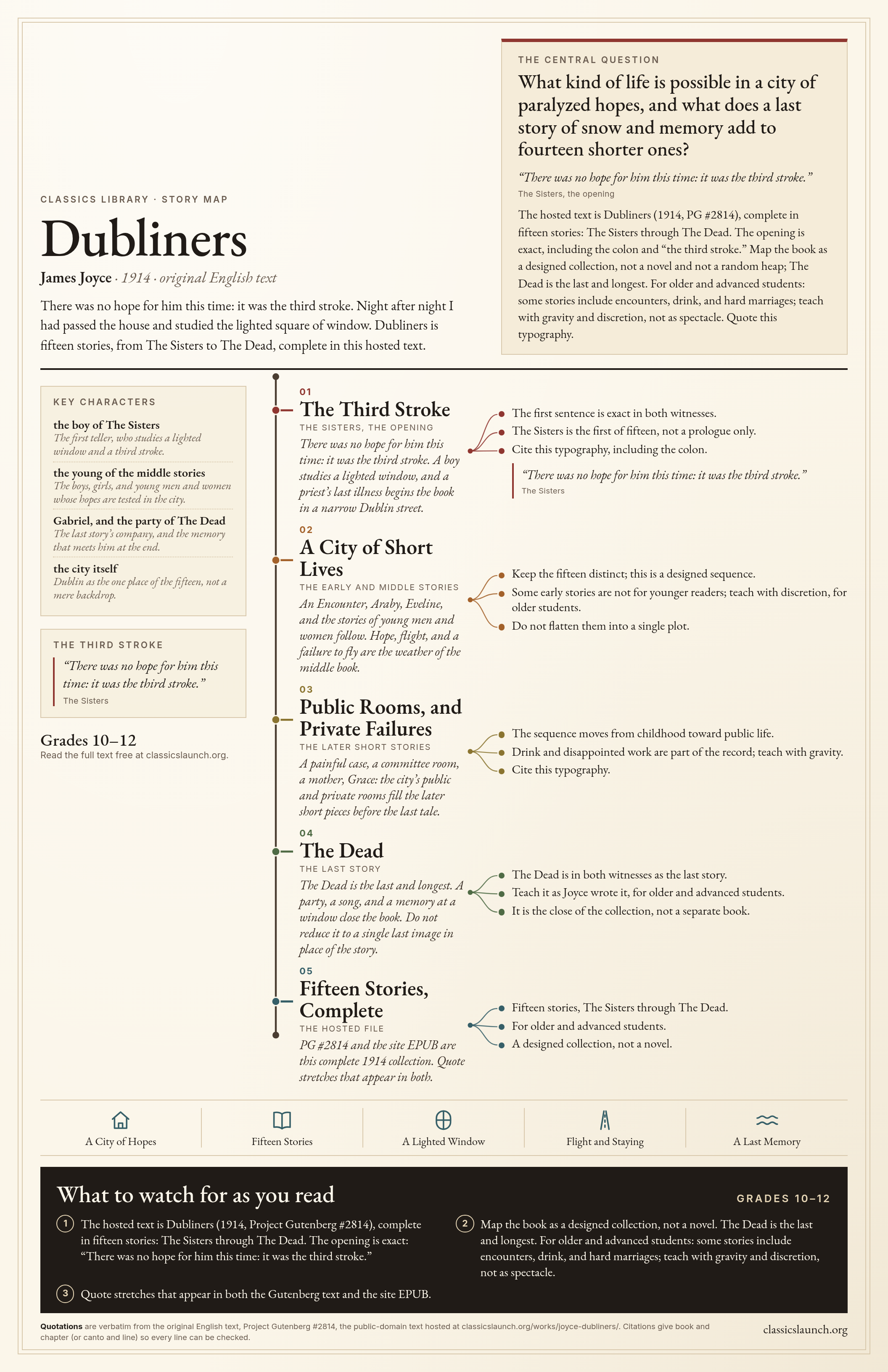
Dubliners: A Story Map
The PDF is one tabloid page (11 × 17 in). On letter paper, choose “Fit to page.”
There was no hope for him this time: it was the third stroke. Night after night I had passed the house and studied the lighted square of window. Dubliners is fifteen stories, from The Sisters to The Dead, complete in this hosted text.
The central question
What kind of life is possible in a city of paralyzed hopes, and what does a last story of snow and memory add to fourteen shorter ones?
“There was no hope for him this time: it was the third stroke.”
The hosted text is Dubliners (1914, PG #2814), complete in fifteen stories: The Sisters through The Dead. The opening is exact, including the colon and “the third stroke.” Map the book as a designed collection, not a novel and not a random heap; The Dead is the last and longest. For older and advanced students: some stories include encounters, drink, and hard marriages; teach with gravity and discretion, not as spectacle. Quote this typography.
- 01
The Third Stroke
The Sisters, the opening
There was no hope for him this time: it was the third stroke. A boy studies a lighted window, and a priest’s last illness begins the book in a narrow Dublin street.
- The first sentence is exact in both witnesses.
- The Sisters is the first of fifteen, not a prologue only.
- Cite this typography, including the colon.
“There was no hope for him this time: it was the third stroke.”
- 02
A City of Short Lives
The early and middle stories
An Encounter, Araby, Eveline, and the stories of young men and women follow. Hope, flight, and a failure to fly are the weather of the middle book.
- Keep the fifteen distinct; this is a designed sequence.
- Some early stories are not for younger readers; teach with discretion, for older students.
- Do not flatten them into a single plot.
- 03
Public Rooms, and Private Failures
The later short stories
A painful case, a committee room, a mother, Grace: the city’s public and private rooms fill the later short pieces before the last tale.
- The sequence moves from childhood toward public life.
- Drink and disappointed work are part of the record; teach with gravity.
- Cite this typography.
- 04
The Dead
The last story
The Dead is the last and longest. A party, a song, and a memory at a window close the book. Do not reduce it to a single last image in place of the story.
- The Dead is in both witnesses as the last story.
- Teach it as Joyce wrote it, for older and advanced students.
- It is the close of the collection, not a separate book.
- 05
Fifteen Stories, Complete
The hosted file
PG #2814 and the site EPUB are this complete 1914 collection. Quote stretches that appear in both.
- Fifteen stories, The Sisters through The Dead.
- For older and advanced students.
- A designed collection, not a novel.
- A City of Hopes
- Fifteen Stories
- A Lighted Window
- Flight and Staying
- A Last Memory
What to watch for as you read
Grades 10–12- The hosted text is Dubliners (1914, Project Gutenberg #2814), complete in fifteen stories: The Sisters through The Dead. The opening is exact: “There was no hope for him this time: it was the third stroke.”
- Map the book as a designed collection, not a novel. The Dead is the last and longest. For older and advanced students: some stories include encounters, drink, and hard marriages; teach with gravity and discretion, not as spectacle.
- Quote stretches that appear in both the Gutenberg text and the site EPUB.
Every quotation is word for word from the original English text hosted in this library and is checked against that text each time the site is built. Citations give book and chapter (or canto and line).