Story maps · Grades Adult/Advanced
Jude the Obscure: A Story Map
The PDF is one tabloid page (11 × 17 in). On letter paper, choose “Fit to page.”
Jude Fawley, a stonemason, looks from Marygreen toward the spires of Christminster and wants learning, ministry, and a life of the mind. The world he meets—marriage law, class, and a tragic household—will not grant the dream. Hardy’s last novel is divided into six parts named for places, and it is among his sternest.
The central question
What kills the letter of the law in this book—the universities, the marriage bond, or a despair that has learned to say the family is ‘too menny’?
“Done because we are too menny.”
Jude’s hunger for Christminster is real, and the colleges will not have a working man on his terms. His first marriage, to Arabella, is a trap of the body; his love for Sue is a meeting of minds that the law and her conscience cannot finally bless. When the children die, Sue breaks toward a harsh repentance and returns to Phillotson. Jude, quoting that ‘the letter killeth,’ cannot call her back. The book is not a tract against marriage as such; it is a cry against a hardness of institutions and of hearts that leaves no room for these particular lives.
- 01
At Marygreen
Part First
The boy Jude is promised books and a vision of the city by the schoolmaster Phillotson. He teaches himself, is tricked into marriage with Arabella, and is left with a failed start and a still-burning aim.
- The well-intentioned aunt and the village cannot feed a scholar’s hope.
- Arabella’s wiles, and the pig-killing, are a brutal education.
- The marriage is legal, early, and already a weight.
- 02
At Christminster
Part Second
Jude comes to the university city as a mason, not a student. He meets his cousin Sue Bridehead, bright and free in talk, and sees how far the colleges stand from men like him.
- The streets are beautiful; the doors are not open.
- Sue is not ordinary, and already half bound to Phillotson.
- Jude’s letters to the masters receive a practical, crushing reply.
- 03
At Melchester
Part Third
Sue goes to the training college. A night of impulsive flight ruins her standing. She marries Phillotson, the older schoolmaster, more from complication than from love.
- Jude, now aiming at the church, is himself not free.
- Sue’s marriage is a decision made under pressure and soon regretted.
- The cousins’ bond deepens past prudence.
- 04
At Shaston, then Aldbrickham
Parts Fourth and Fifth
Sue leaves Phillotson; he, with a painful integrity, lets her go. She and Jude try to live together, work, and raise children, including Little Father Time, the grave boy Arabella sends them. Society and employment close against them.
- Phillotson’s concession costs him his own place.
- They hesitate before a second marriage ceremony, and the hesitation is used against them.
- The household is tender and already marked.
- 05
At Christminster Again
Part Sixth
They return to the university city for a remembrances week. In a lodging the boy hangs the children and himself, leaving a note. Sue breaks, returns to Phillotson as to a penance, and Jude dies after a last, futile appeal.
- The note is in a child’s spelling: ‘too menny.’ It must be taught with gravity, not as a shock for its own sake.
- Sue’s turn is a religious terror as well as grief.
- Jude’s last words and last walk in the rain close the Christminster dream.
“We are acting by the letter; and ‘the letter killeth’!”
- Learning Denied
- The Letter of the Law
- Marriage and Conscience
- Class
- Despair
What to watch for as you read
Grades Adult/Advanced- The hosted text is the original English of Project Gutenberg #153. The novel is in six parts: At Marygreen, At Christminster, At Melchester, At Shaston, At Aldbrickham and Elsewhere, At Christminster Again.
- The boy’s note is italicized in the source and spelled as a child spells it: “Done because we are too menny.” Do not correct the spelling.
- Jude’s plea quotes Scripture in single marks in this text: “We are acting by the letter; and ‘the letter killeth’!”
- Part Sixth contains the deaths of the children. This map does not soften that fact; class discussion should be prepared and grave, and is not for the youngest readers.
- This title was chosen in place of The Portrait of a Lady. The site’s hosted Portrait text (PG #2833) is Volume 1 only (Chapters I–XXVII; the file’s own START/END markers say “VOLUME 1”). Volume II is not hosted. Do not map Portrait until the second volume is on the site.
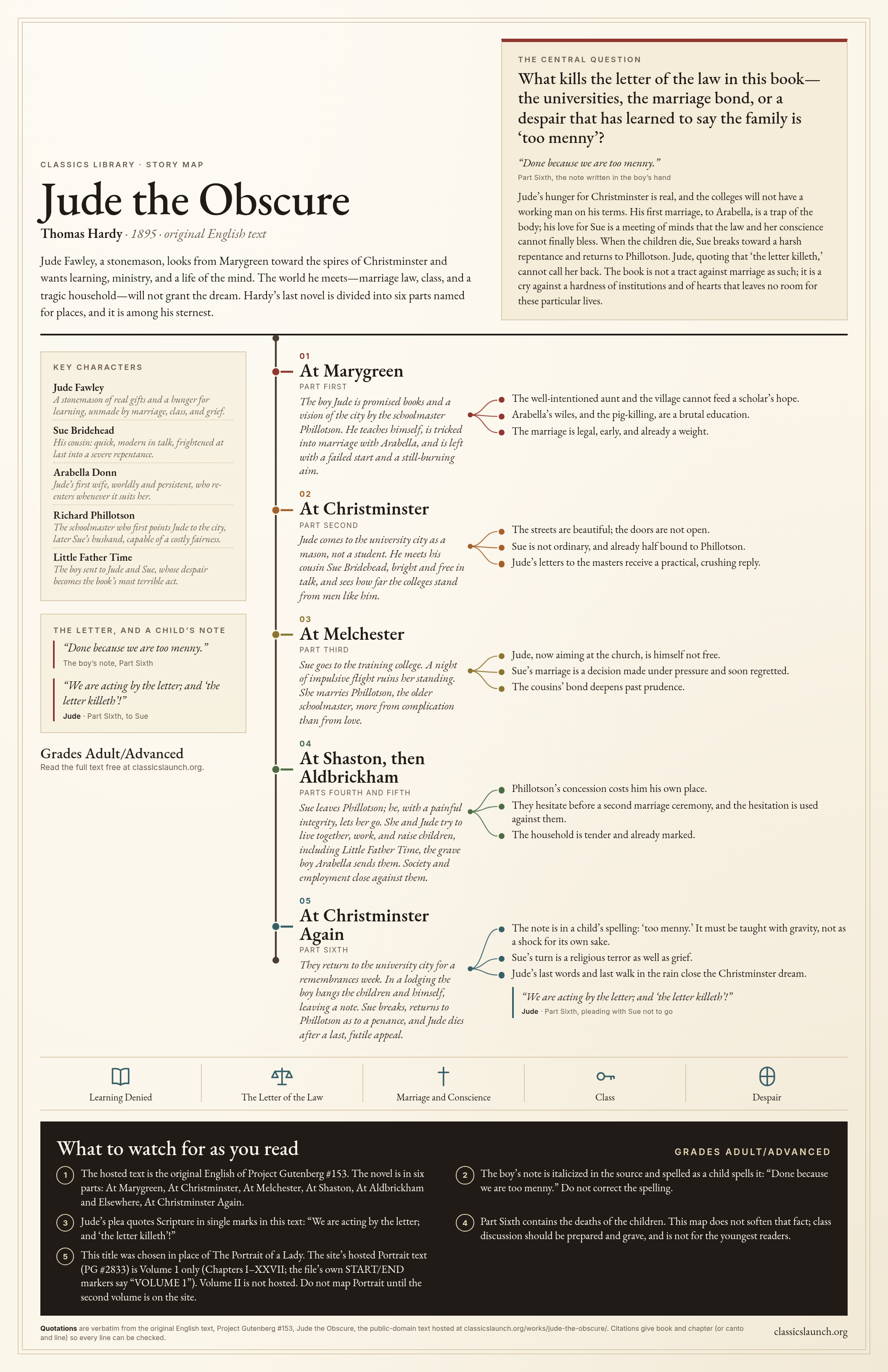
Every quotation is word for word from the original English text hosted in this library and is checked against that text each time the site is built. Citations give book and chapter (or canto and line).