Story maps · Grades 10–12
King John: A Story Map
The PDF is one tabloid page (11 × 17 in). On letter paper, choose “Fit to page.”
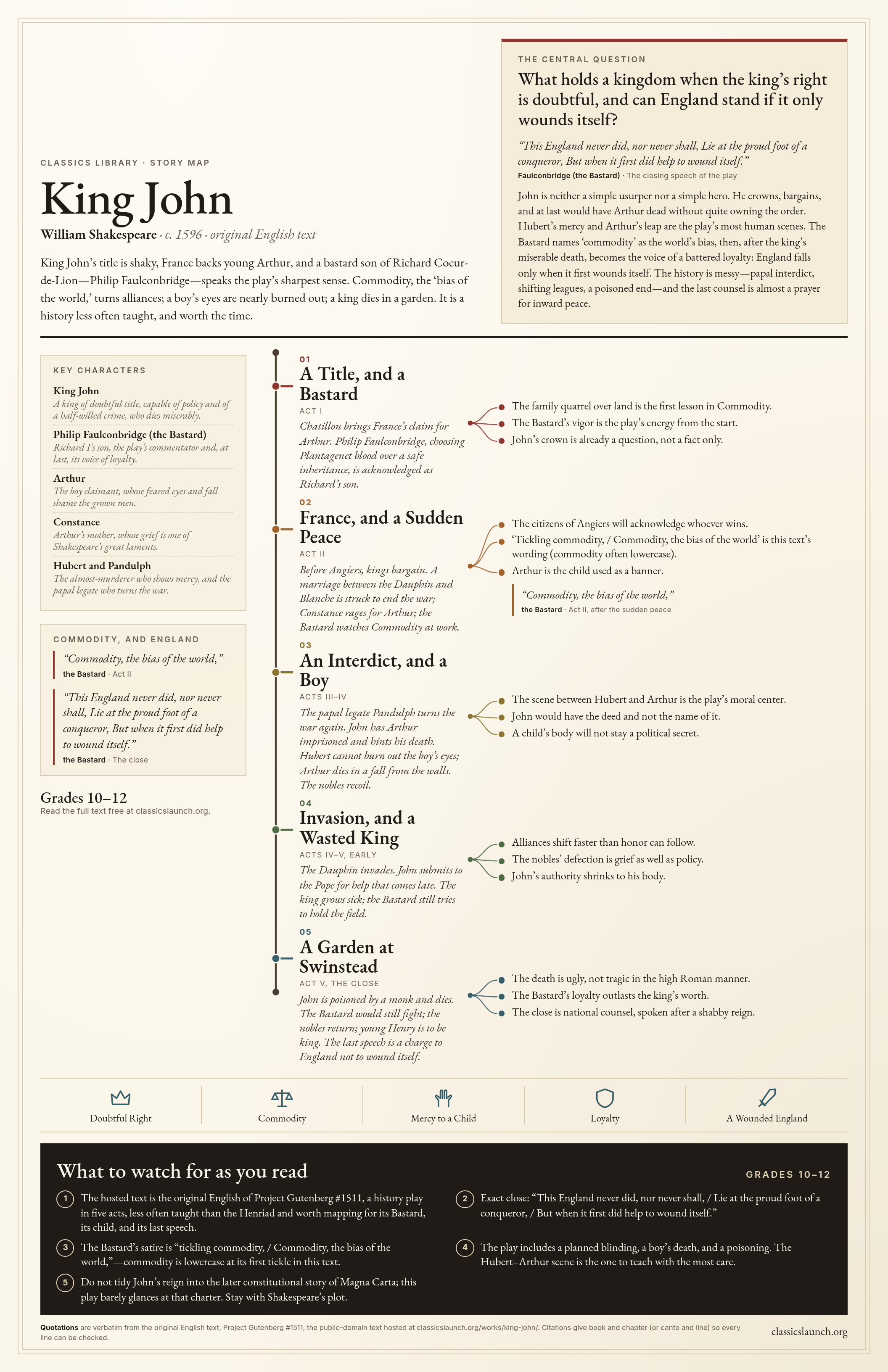
King John’s title is shaky, France backs young Arthur, and a bastard son of Richard Coeur-de-Lion—Philip Faulconbridge—speaks the play’s sharpest sense. Commodity, the ‘bias of the world,’ turns alliances; a boy’s eyes are nearly burned out; a king dies in a garden. It is a history less often taught, and worth the time.
The central question
What holds a kingdom when the king’s right is doubtful, and can England stand if it only wounds itself?
“This England never did, nor never shall, Lie at the proud foot of a conqueror, But when it first did help to wound itself.”
John is neither a simple usurper nor a simple hero. He crowns, bargains, and at last would have Arthur dead without quite owning the order. Hubert’s mercy and Arthur’s leap are the play’s most human scenes. The Bastard names ‘commodity’ as the world’s bias, then, after the king’s miserable death, becomes the voice of a battered loyalty: England falls only when it first wounds itself. The history is messy—papal interdict, shifting leagues, a poisoned end—and the last counsel is almost a prayer for inward peace.
- 01
A Title, and a Bastard
Act I
Chatillon brings France’s claim for Arthur. Philip Faulconbridge, choosing Plantagenet blood over a safe inheritance, is acknowledged as Richard’s son.
- The family quarrel over land is the first lesson in Commodity.
- The Bastard’s vigor is the play’s energy from the start.
- John’s crown is already a question, not a fact only.
- 02
France, and a Sudden Peace
Act II
Before Angiers, kings bargain. A marriage between the Dauphin and Blanche is struck to end the war; Constance rages for Arthur; the Bastard watches Commodity at work.
- The citizens of Angiers will acknowledge whoever wins.
- ‘Tickling commodity, / Commodity, the bias of the world’ is this text’s wording (commodity often lowercase).
- Arthur is the child used as a banner.
“Commodity, the bias of the world,”
- 03
An Interdict, and a Boy
Acts III–IV
The papal legate Pandulph turns the war again. John has Arthur imprisoned and hints his death. Hubert cannot burn out the boy’s eyes; Arthur dies in a fall from the walls. The nobles recoil.
- The scene between Hubert and Arthur is the play’s moral center.
- John would have the deed and not the name of it.
- A child’s body will not stay a political secret.
- 04
Invasion, and a Wasted King
Acts IV–V, early
The Dauphin invades. John submits to the Pope for help that comes late. The king grows sick; the Bastard still tries to hold the field.
- Alliances shift faster than honor can follow.
- The nobles’ defection is grief as well as policy.
- John’s authority shrinks to his body.
- 05
A Garden at Swinstead
Act V, the close
John is poisoned by a monk and dies. The Bastard would still fight; the nobles return; young Henry is to be king. The last speech is a charge to England not to wound itself.
- The death is ugly, not tragic in the high Roman manner.
- The Bastard’s loyalty outlasts the king’s worth.
- The close is national counsel, spoken after a shabby reign.
- Doubtful Right
- Commodity
- Mercy to a Child
- Loyalty
- A Wounded England
What to watch for as you read
Grades 10–12- The hosted text is the original English of Project Gutenberg #1511, a history play in five acts, less often taught than the Henriad and worth mapping for its Bastard, its child, and its last speech.
- Exact close: “This England never did, nor never shall, / Lie at the proud foot of a conqueror, / But when it first did help to wound itself.”
- The Bastard’s satire is “tickling commodity, / Commodity, the bias of the world,”—commodity is lowercase at its first tickle in this text.
- The play includes a planned blinding, a boy’s death, and a poisoning. The Hubert–Arthur scene is the one to teach with the most care.
- Do not tidy John’s reign into the later constitutional story of Magna Carta; this play barely glances at that charter. Stay with Shakespeare’s plot.
Every quotation is word for word from the original English text hosted in this library and is checked against that text each time the site is built. Citations give book and chapter (or canto and line).