Story maps · Grades 11–12
A Short Account of the Destruction of the Indies: A Story Map
The PDF is one tabloid page (11 × 17 in). On letter paper, choose “Fit to page.”
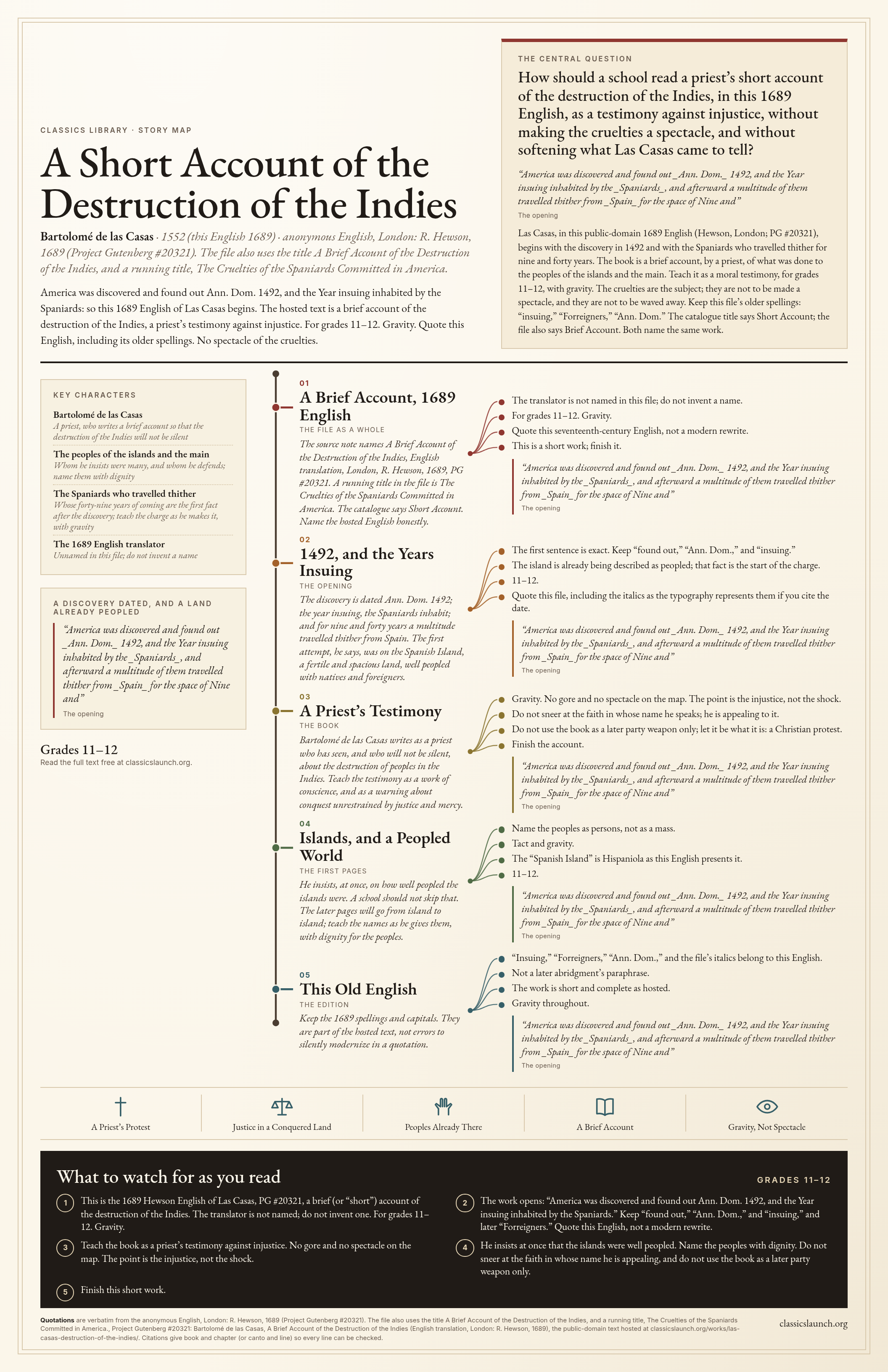
America was discovered and found out Ann. Dom. 1492, and the Year insuing inhabited by the Spaniards: so this 1689 English of Las Casas begins. The hosted text is a brief account of the destruction of the Indies, a priest’s testimony against injustice. For grades 11–12. Gravity. Quote this English, including its older spellings. No spectacle of the cruelties.
The central question
How should a school read a priest’s short account of the destruction of the Indies, in this 1689 English, as a testimony against injustice, without making the cruelties a spectacle, and without softening what Las Casas came to tell?
“America was discovered and found out _Ann. Dom._ 1492, and the Year insuing inhabited by the _Spaniards_, and afterward a multitude of them travelled thither from _Spain_ for the space of Nine and”
Las Casas, in this public-domain 1689 English (Hewson, London; PG #20321), begins with the discovery in 1492 and with the Spaniards who travelled thither for nine and forty years. The book is a brief account, by a priest, of what was done to the peoples of the islands and the main. Teach it as a moral testimony, for grades 11–12, with gravity. The cruelties are the subject; they are not to be made a spectacle, and they are not to be waved away. Keep this file’s older spellings: “insuing,” “Forreigners,” “Ann. Dom.” The catalogue title says Short Account; the file also says Brief Account. Both name the same work.
- 01
A Brief Account, 1689 English
The file as a whole
The source note names A Brief Account of the Destruction of the Indies, English translation, London, R. Hewson, 1689, PG #20321. A running title in the file is The Cruelties of the Spaniards Committed in America. The catalogue says Short Account. Name the hosted English honestly.
- The translator is not named in this file; do not invent a name.
- For grades 11–12. Gravity.
- Quote this seventeenth-century English, not a modern rewrite.
- This is a short work; finish it.
“America was discovered and found out _Ann. Dom._ 1492, and the Year insuing inhabited by the _Spaniards_, and afterward a multitude of them travelled thither from _Spain_ for the space of Nine and”
- 02
1492, and the Years Insuing
The opening
The discovery is dated Ann. Dom. 1492; the year insuing, the Spaniards inhabit; and for nine and forty years a multitude travelled thither from Spain. The first attempt, he says, was on the Spanish Island, a fertile and spacious land, well peopled with natives and foreigners.
- The first sentence is exact. Keep “found out,” “Ann. Dom.,” and “insuing.”
- The island is already being described as peopled; that fact is the start of the charge.
- 11–12.
- Quote this file, including the italics as the typography represents them if you cite the date.
“America was discovered and found out _Ann. Dom._ 1492, and the Year insuing inhabited by the _Spaniards_, and afterward a multitude of them travelled thither from _Spain_ for the space of Nine and”
- 03
A Priest’s Testimony
The book
Bartolomé de las Casas writes as a priest who has seen, and who will not be silent, about the destruction of peoples in the Indies. Teach the testimony as a work of conscience, and as a warning about conquest unrestrained by justice and mercy.
- Gravity. No gore and no spectacle on the map. The point is the injustice, not the shock.
- Do not sneer at the faith in whose name he speaks; he is appealing to it.
- Do not use the book as a later party weapon only; let it be what it is: a Christian protest.
- Finish the account.
“America was discovered and found out _Ann. Dom._ 1492, and the Year insuing inhabited by the _Spaniards_, and afterward a multitude of them travelled thither from _Spain_ for the space of Nine and”
- 04
Islands, and a Peopled World
The first pages
He insists, at once, on how well peopled the islands were. A school should not skip that. The later pages will go from island to island; teach the names as he gives them, with dignity for the peoples.
- Name the peoples as persons, not as a mass.
- Tact and gravity.
- The “Spanish Island” is Hispaniola as this English presents it.
- 11–12.
“America was discovered and found out _Ann. Dom._ 1492, and the Year insuing inhabited by the _Spaniards_, and afterward a multitude of them travelled thither from _Spain_ for the space of Nine and”
- 05
This Old English
The edition
Keep the 1689 spellings and capitals. They are part of the hosted text, not errors to silently modernize in a quotation.
- “Insuing,” “Forreigners,” “Ann. Dom.,” and the file’s italics belong to this English.
- Not a later abridgment’s paraphrase.
- The work is short and complete as hosted.
- Gravity throughout.
“America was discovered and found out _Ann. Dom._ 1492, and the Year insuing inhabited by the _Spaniards_, and afterward a multitude of them travelled thither from _Spain_ for the space of Nine and”
- A Priest’s Protest
- Justice in a Conquered Land
- Peoples Already There
- A Brief Account
- Gravity, Not Spectacle
What to watch for as you read
Grades 11–12- This is the 1689 Hewson English of Las Casas, PG #20321, a brief (or “short”) account of the destruction of the Indies. The translator is not named; do not invent one. For grades 11–12. Gravity.
- The work opens: “America was discovered and found out Ann. Dom. 1492, and the Year insuing inhabited by the Spaniards.” Keep “found out,” “Ann. Dom.,” and “insuing,” and later “Forreigners.” Quote this English, not a modern rewrite.
- Teach the book as a priest’s testimony against injustice. No gore and no spectacle on the map. The point is the injustice, not the shock.
- He insists at once that the islands were well peopled. Name the peoples with dignity. Do not sneer at the faith in whose name he is appealing, and do not use the book as a later party weapon only.
- Finish this short work.
Every quotation is word for word from the anonymous English, London: R. Hewson, 1689 (Project Gutenberg #20321). The file also uses the title A Brief Account of the Destruction of the Indies, and a running title, The Cruelties of the Spaniards Committed in America. hosted in this library and is checked against that text each time the site is built. Citations give book and chapter (or canto and line).