Story maps · Grades 10–12
A Hero of Our Time: A Story Map
The PDF is one tabloid page (11 × 17 in). On letter paper, choose “Fit to page.”
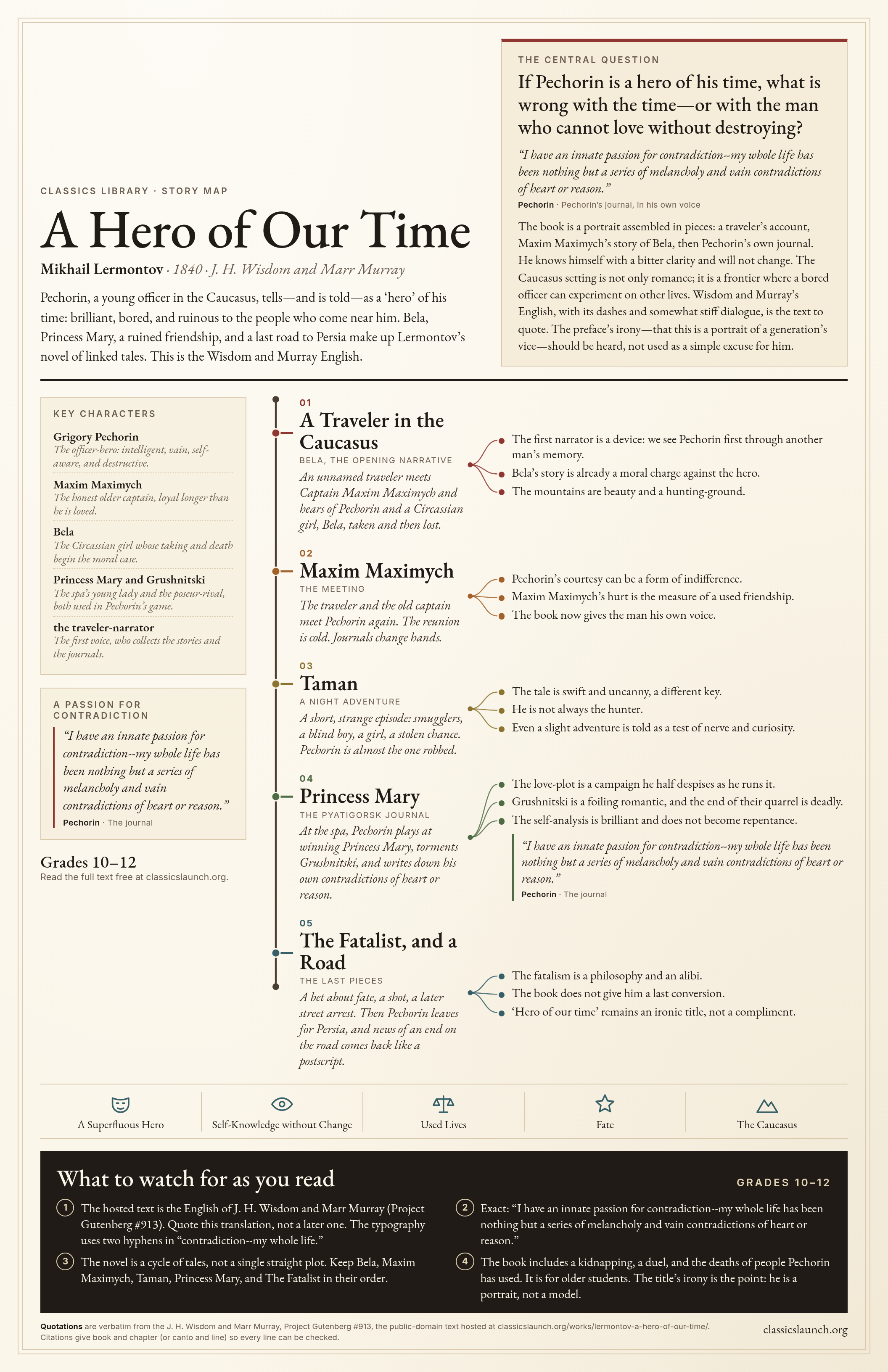
Pechorin, a young officer in the Caucasus, tells—and is told—as a ‘hero’ of his time: brilliant, bored, and ruinous to the people who come near him. Bela, Princess Mary, a ruined friendship, and a last road to Persia make up Lermontov’s novel of linked tales. This is the Wisdom and Murray English.
The central question
If Pechorin is a hero of his time, what is wrong with the time—or with the man who cannot love without destroying?
“I have an innate passion for contradiction--my whole life has been nothing but a series of melancholy and vain contradictions of heart or reason.”
The book is a portrait assembled in pieces: a traveler’s account, Maxim Maximych’s story of Bela, then Pechorin’s own journal. He knows himself with a bitter clarity and will not change. The Caucasus setting is not only romance; it is a frontier where a bored officer can experiment on other lives. Wisdom and Murray’s English, with its dashes and somewhat stiff dialogue, is the text to quote. The preface’s irony—that this is a portrait of a generation’s vice—should be heard, not used as a simple excuse for him.
- 01
A Traveler in the Caucasus
Bela, the opening narrative
An unnamed traveler meets Captain Maxim Maximych and hears of Pechorin and a Circassian girl, Bela, taken and then lost.
- The first narrator is a device: we see Pechorin first through another man’s memory.
- Bela’s story is already a moral charge against the hero.
- The mountains are beauty and a hunting-ground.
- 02
Maxim Maximych
The meeting
The traveler and the old captain meet Pechorin again. The reunion is cold. Journals change hands.
- Pechorin’s courtesy can be a form of indifference.
- Maxim Maximych’s hurt is the measure of a used friendship.
- The book now gives the man his own voice.
- 03
Taman
A night adventure
A short, strange episode: smugglers, a blind boy, a girl, a stolen chance. Pechorin is almost the one robbed.
- The tale is swift and uncanny, a different key.
- He is not always the hunter.
- Even a slight adventure is told as a test of nerve and curiosity.
- 04
Princess Mary
The Pyatigorsk journal
At the spa, Pechorin plays at winning Princess Mary, torments Grushnitski, and writes down his own contradictions of heart or reason.
- The love-plot is a campaign he half despises as he runs it.
- Grushnitski is a foiling romantic, and the end of their quarrel is deadly.
- The self-analysis is brilliant and does not become repentance.
“I have an innate passion for contradiction--my whole life has been nothing but a series of melancholy and vain contradictions of heart or reason.”
- 05
The Fatalist, and a Road
The last pieces
A bet about fate, a shot, a later street arrest. Then Pechorin leaves for Persia, and news of an end on the road comes back like a postscript.
- The fatalism is a philosophy and an alibi.
- The book does not give him a last conversion.
- ‘Hero of our time’ remains an ironic title, not a compliment.
- A Superfluous Hero
- Self-Knowledge without Change
- Used Lives
- Fate
- The Caucasus
What to watch for as you read
Grades 10–12- The hosted text is the English of J. H. Wisdom and Marr Murray (Project Gutenberg #913). Quote this translation, not a later one. The typography uses two hyphens in “contradiction--my whole life.”
- Exact: “I have an innate passion for contradiction--my whole life has been nothing but a series of melancholy and vain contradictions of heart or reason.”
- The novel is a cycle of tales, not a single straight plot. Keep Bela, Maxim Maximych, Taman, Princess Mary, and The Fatalist in their order.
- The book includes a kidnapping, a duel, and the deaths of people Pechorin has used. It is for older students. The title’s irony is the point: he is a portrait, not a model.
Every quotation is word for word from the J. H. Wisdom and Marr Murray hosted in this library and is checked against that text each time the site is built. Citations give book and chapter (or canto and line).