Story maps · Grades 11–12
Lord Jim: A Story Map
The PDF is one tabloid page (11 × 17 in). On letter paper, choose “Fit to page.”
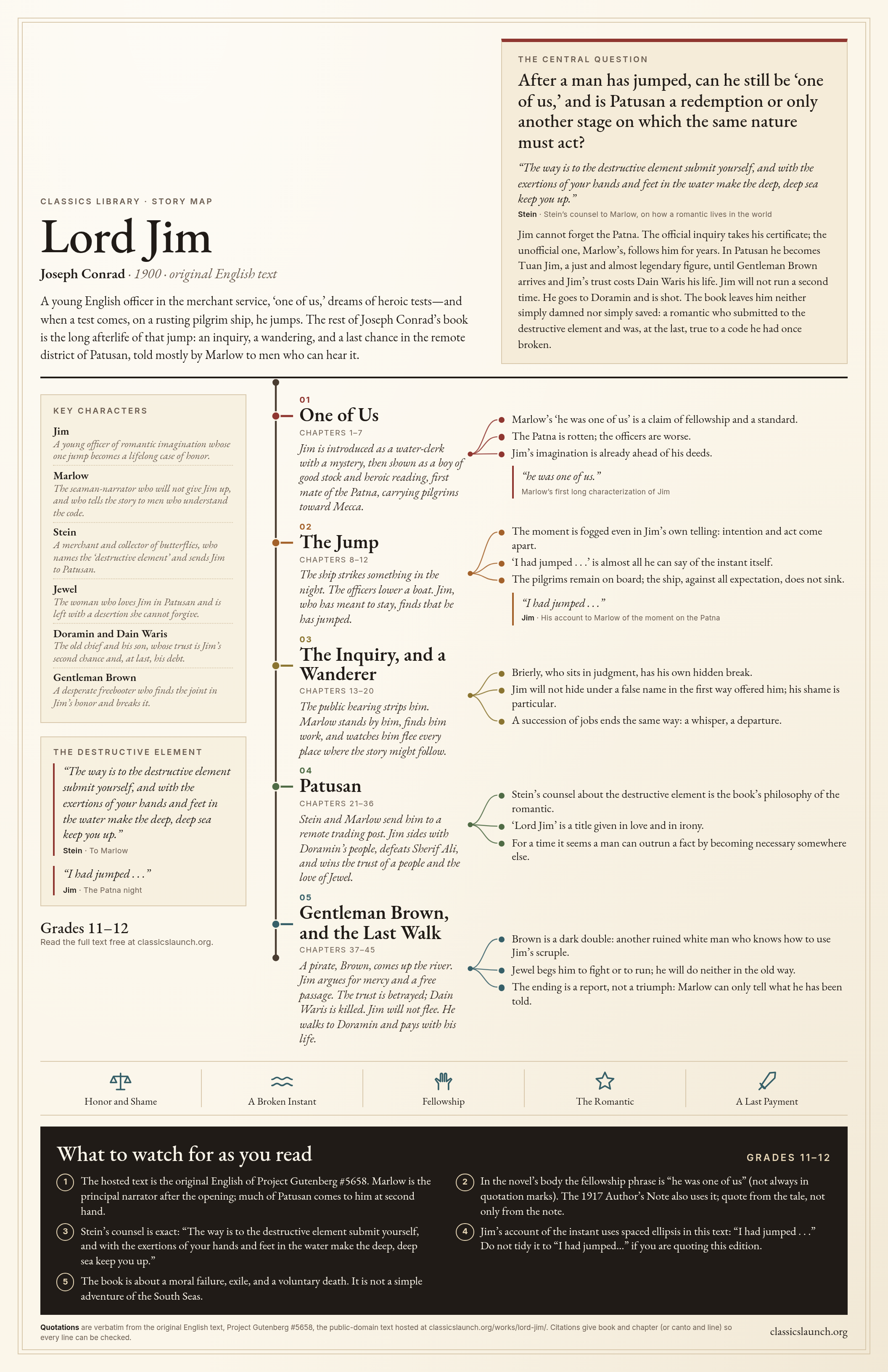
A young English officer in the merchant service, ‘one of us,’ dreams of heroic tests—and when a test comes, on a rusting pilgrim ship, he jumps. The rest of Joseph Conrad’s book is the long afterlife of that jump: an inquiry, a wandering, and a last chance in the remote district of Patusan, told mostly by Marlow to men who can hear it.
The central question
After a man has jumped, can he still be ‘one of us,’ and is Patusan a redemption or only another stage on which the same nature must act?
“The way is to the destructive element submit yourself, and with the exertions of your hands and feet in the water make the deep, deep sea keep you up.”
Jim cannot forget the Patna. The official inquiry takes his certificate; the unofficial one, Marlow’s, follows him for years. In Patusan he becomes Tuan Jim, a just and almost legendary figure, until Gentleman Brown arrives and Jim’s trust costs Dain Waris his life. Jim will not run a second time. He goes to Doramin and is shot. The book leaves him neither simply damned nor simply saved: a romantic who submitted to the destructive element and was, at the last, true to a code he had once broken.
- 01
One of Us
Chapters 1–7
Jim is introduced as a water-clerk with a mystery, then shown as a boy of good stock and heroic reading, first mate of the Patna, carrying pilgrims toward Mecca.
- Marlow’s ‘he was one of us’ is a claim of fellowship and a standard.
- The Patna is rotten; the officers are worse.
- Jim’s imagination is already ahead of his deeds.
“he was one of us.”
- 02
The Jump
Chapters 8–12
The ship strikes something in the night. The officers lower a boat. Jim, who has meant to stay, finds that he has jumped.
- The moment is fogged even in Jim’s own telling: intention and act come apart.
- ‘I had jumped . . .’ is almost all he can say of the instant itself.
- The pilgrims remain on board; the ship, against all expectation, does not sink.
“I had jumped . . .”
- 03
The Inquiry, and a Wanderer
Chapters 13–20
The public hearing strips him. Marlow stands by him, finds him work, and watches him flee every place where the story might follow.
- Brierly, who sits in judgment, has his own hidden break.
- Jim will not hide under a false name in the first way offered him; his shame is particular.
- A succession of jobs ends the same way: a whisper, a departure.
- 04
Patusan
Chapters 21–36
Stein and Marlow send him to a remote trading post. Jim sides with Doramin’s people, defeats Sherif Ali, and wins the trust of a people and the love of Jewel.
- Stein’s counsel about the destructive element is the book’s philosophy of the romantic.
- ‘Lord Jim’ is a title given in love and in irony.
- For a time it seems a man can outrun a fact by becoming necessary somewhere else.
- 05
Gentleman Brown, and the Last Walk
Chapters 37–45
A pirate, Brown, comes up the river. Jim argues for mercy and a free passage. The trust is betrayed; Dain Waris is killed. Jim will not flee. He walks to Doramin and pays with his life.
- Brown is a dark double: another ruined white man who knows how to use Jim’s scruple.
- Jewel begs him to fight or to run; he will do neither in the old way.
- The ending is a report, not a triumph: Marlow can only tell what he has been told.
- Honor and Shame
- A Broken Instant
- Fellowship
- The Romantic
- A Last Payment
What to watch for as you read
Grades 11–12- The hosted text is the original English of Project Gutenberg #5658. Marlow is the principal narrator after the opening; much of Patusan comes to him at second hand.
- In the novel’s body the fellowship phrase is “he was one of us” (not always in quotation marks). The 1917 Author’s Note also uses it; quote from the tale, not only from the note.
- Stein’s counsel is exact: “The way is to the destructive element submit yourself, and with the exertions of your hands and feet in the water make the deep, deep sea keep you up.”
- Jim’s account of the instant uses spaced ellipsis in this text: “I had jumped . . .” Do not tidy it to “I had jumped…” if you are quoting this edition.
- The book is about a moral failure, exile, and a voluntary death. It is not a simple adventure of the South Seas.
Every quotation is word for word from the original English text hosted in this library and is checked against that text each time the site is built. Citations give book and chapter (or canto and line).