Story maps · Grades 11–12
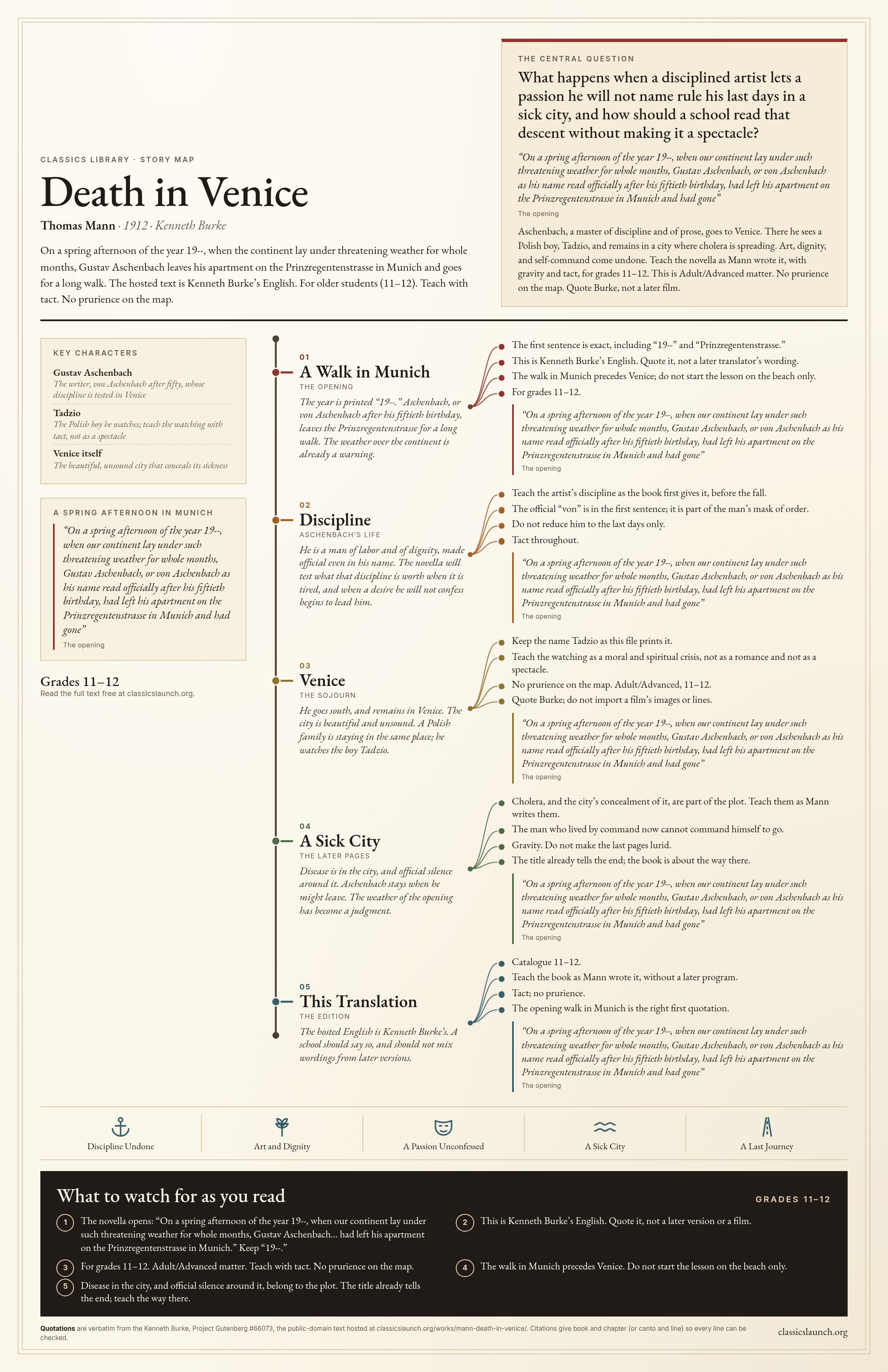
Death in Venice: A Story Map
The PDF is one tabloid page (11 × 17 in). On letter paper, choose “Fit to page.”
On a spring afternoon of the year 19--, when the continent lay under threatening weather for whole months, Gustav Aschenbach leaves his apartment on the Prinzregentenstrasse in Munich and goes for a long walk. The hosted text is Kenneth Burke’s English. For older students (11–12). Teach with tact. No prurience on the map.
The central question
What happens when a disciplined artist lets a passion he will not name rule his last days in a sick city, and how should a school read that descent without making it a spectacle?
“On a spring afternoon of the year 19--, when our continent lay under such threatening weather for whole months, Gustav Aschenbach, or von Aschenbach as his name read officially after his fiftieth birthday, had left his apartment on the Prinzregentenstrasse in Munich and had gone”
Aschenbach, a master of discipline and of prose, goes to Venice. There he sees a Polish boy, Tadzio, and remains in a city where cholera is spreading. Art, dignity, and self-command come undone. Teach the novella as Mann wrote it, with gravity and tact, for grades 11–12. This is Adult/Advanced matter. No prurience on the map. Quote Burke, not a later film.
- 01
A Walk in Munich
The opening
The year is printed “19--.” Aschenbach, or von Aschenbach after his fiftieth birthday, leaves the Prinzregentenstrasse for a long walk. The weather over the continent is already a warning.
- The first sentence is exact, including “19--” and “Prinzregentenstrasse.”
- This is Kenneth Burke’s English. Quote it, not a later translator’s wording.
- The walk in Munich precedes Venice; do not start the lesson on the beach only.
- For grades 11–12.
“On a spring afternoon of the year 19--, when our continent lay under such threatening weather for whole months, Gustav Aschenbach, or von Aschenbach as his name read officially after his fiftieth birthday, had left his apartment on the Prinzregentenstrasse in Munich and had gone”
- 02
Discipline
Aschenbach’s life
He is a man of labor and of dignity, made official even in his name. The novella will test what that discipline is worth when it is tired, and when a desire he will not confess begins to lead him.
- Teach the artist’s discipline as the book first gives it, before the fall.
- The official “von” is in the first sentence; it is part of the man’s mask of order.
- Do not reduce him to the last days only.
- Tact throughout.
“On a spring afternoon of the year 19--, when our continent lay under such threatening weather for whole months, Gustav Aschenbach, or von Aschenbach as his name read officially after his fiftieth birthday, had left his apartment on the Prinzregentenstrasse in Munich and had gone”
- 03
Venice
The sojourn
He goes south, and remains in Venice. The city is beautiful and unsound. A Polish family is staying in the same place; he watches the boy Tadzio.
- Keep the name Tadzio as this file prints it.
- Teach the watching as a moral and spiritual crisis, not as a romance and not as a spectacle.
- No prurience on the map. Adult/Advanced, 11–12.
- Quote Burke; do not import a film’s images or lines.
“On a spring afternoon of the year 19--, when our continent lay under such threatening weather for whole months, Gustav Aschenbach, or von Aschenbach as his name read officially after his fiftieth birthday, had left his apartment on the Prinzregentenstrasse in Munich and had gone”
- 04
A Sick City
The later pages
Disease is in the city, and official silence around it. Aschenbach stays when he might leave. The weather of the opening has become a judgment.
- Cholera, and the city’s concealment of it, are part of the plot. Teach them as Mann writes them.
- The man who lived by command now cannot command himself to go.
- Gravity. Do not make the last pages lurid.
- The title already tells the end; the book is about the way there.
“On a spring afternoon of the year 19--, when our continent lay under such threatening weather for whole months, Gustav Aschenbach, or von Aschenbach as his name read officially after his fiftieth birthday, had left his apartment on the Prinzregentenstrasse in Munich and had gone”
- 05
This Translation
The edition
The hosted English is Kenneth Burke’s. A school should say so, and should not mix wordings from later versions.
- Catalogue 11–12.
- Teach the book as Mann wrote it, without a later program.
- Tact; no prurience.
- The opening walk in Munich is the right first quotation.
“On a spring afternoon of the year 19--, when our continent lay under such threatening weather for whole months, Gustav Aschenbach, or von Aschenbach as his name read officially after his fiftieth birthday, had left his apartment on the Prinzregentenstrasse in Munich and had gone”
- Discipline Undone
- Art and Dignity
- A Passion Unconfessed
- A Sick City
- A Last Journey
What to watch for as you read
Grades 11–12- The novella opens: “On a spring afternoon of the year 19--, when our continent lay under such threatening weather for whole months, Gustav Aschenbach… had left his apartment on the Prinzregentenstrasse in Munich.” Keep “19--.”
- This is Kenneth Burke’s English. Quote it, not a later version or a film.
- For grades 11–12. Adult/Advanced matter. Teach with tact. No prurience on the map.
- The walk in Munich precedes Venice. Do not start the lesson on the beach only.
- Disease in the city, and official silence around it, belong to the plot. The title already tells the end; teach the way there.
Every quotation is word for word from the Kenneth Burke hosted in this library and is checked against that text each time the site is built. Citations give book and chapter (or canto and line).