Story maps · Grades 11–12
Mansfield Park: A Story Map
The PDF is one tabloid page (11 × 17 in). On letter paper, choose “Fit to page.”
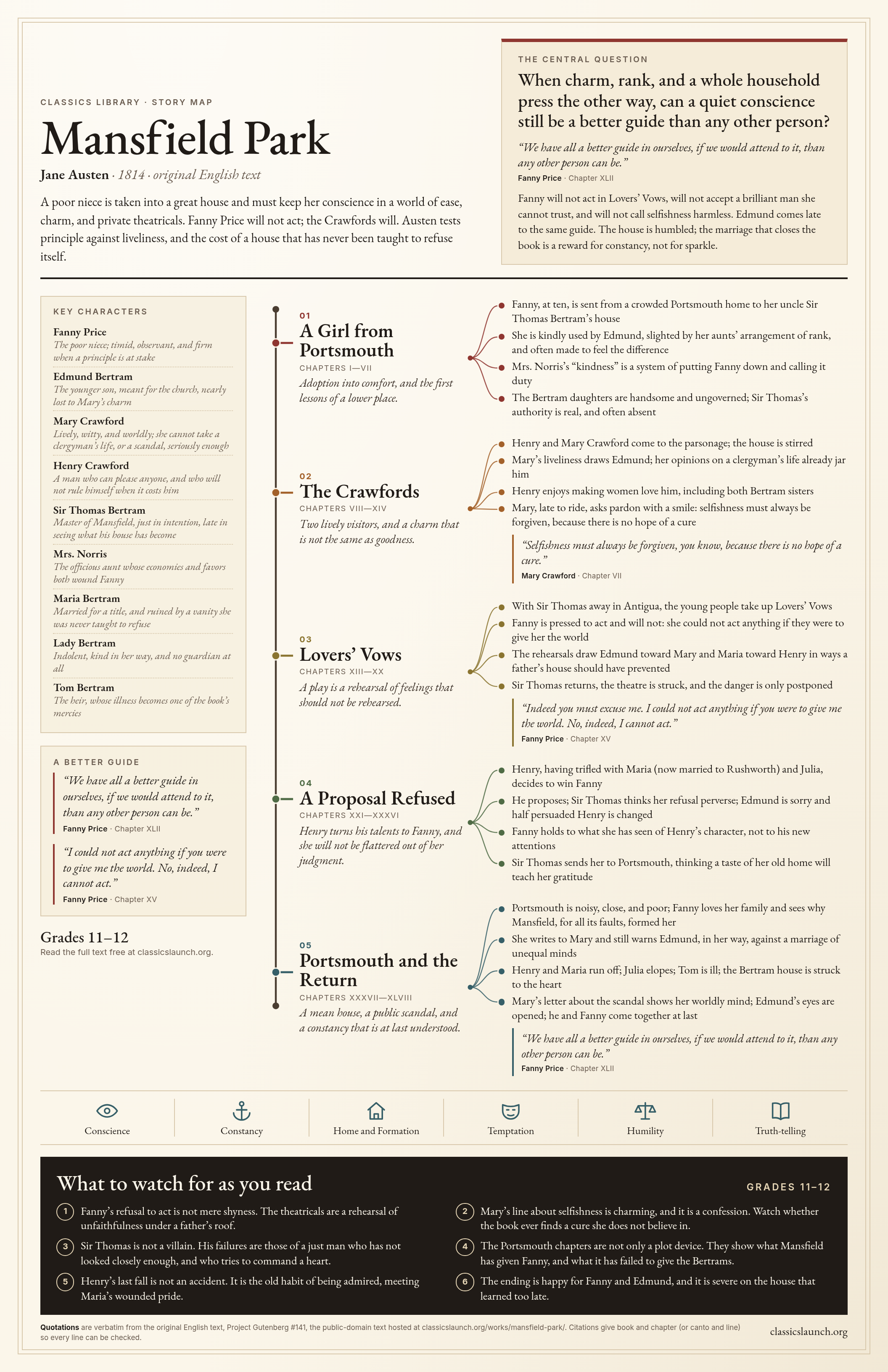
A poor niece is taken into a great house and must keep her conscience in a world of ease, charm, and private theatricals. Fanny Price will not act; the Crawfords will. Austen tests principle against liveliness, and the cost of a house that has never been taught to refuse itself.
The central question
When charm, rank, and a whole household press the other way, can a quiet conscience still be a better guide than any other person?
“We have all a better guide in ourselves, if we would attend to it, than any other person can be.”
Fanny will not act in Lovers’ Vows, will not accept a brilliant man she cannot trust, and will not call selfishness harmless. Edmund comes late to the same guide. The house is humbled; the marriage that closes the book is a reward for constancy, not for sparkle.
- 01
A Girl from Portsmouth
Chapters I—VII
Adoption into comfort, and the first lessons of a lower place.
- Fanny, at ten, is sent from a crowded Portsmouth home to her uncle Sir Thomas Bertram’s house
- She is kindly used by Edmund, slighted by her aunts’ arrangement of rank, and often made to feel the difference
- Mrs. Norris’s “kindness” is a system of putting Fanny down and calling it duty
- The Bertram daughters are handsome and ungoverned; Sir Thomas’s authority is real, and often absent
- 02
The Crawfords
Chapters VIII—XIV
Two lively visitors, and a charm that is not the same as goodness.
- Henry and Mary Crawford come to the parsonage; the house is stirred
- Mary’s liveliness draws Edmund; her opinions on a clergyman’s life already jar him
- Henry enjoys making women love him, including both Bertram sisters
- Mary, late to ride, asks pardon with a smile: selfishness must always be forgiven, because there is no hope of a cure
“Selfishness must always be forgiven, you know, because there is no hope of a cure.”
- 03
Lovers’ Vows
Chapters XIII—XX
A play is a rehearsal of feelings that should not be rehearsed.
- With Sir Thomas away in Antigua, the young people take up Lovers’ Vows
- Fanny is pressed to act and will not: she could not act anything if they were to give her the world
- The rehearsals draw Edmund toward Mary and Maria toward Henry in ways a father’s house should have prevented
- Sir Thomas returns, the theatre is struck, and the danger is only postponed
“Indeed you must excuse me. I could not act anything if you were to give me the world. No, indeed, I cannot act.”
- 04
A Proposal Refused
Chapters XXI—XXXVI
Henry turns his talents to Fanny, and she will not be flattered out of her judgment.
- Henry, having trifled with Maria (now married to Rushworth) and Julia, decides to win Fanny
- He proposes; Sir Thomas thinks her refusal perverse; Edmund is sorry and half persuaded Henry is changed
- Fanny holds to what she has seen of Henry’s character, not to his new attentions
- Sir Thomas sends her to Portsmouth, thinking a taste of her old home will teach her gratitude
- 05
Portsmouth and the Return
Chapters XXXVII—XLVIII
A mean house, a public scandal, and a constancy that is at last understood.
- Portsmouth is noisy, close, and poor; Fanny loves her family and sees why Mansfield, for all its faults, formed her
- She writes to Mary and still warns Edmund, in her way, against a marriage of unequal minds
- Henry and Maria run off; Julia elopes; Tom is ill; the Bertram house is struck to the heart
- Mary’s letter about the scandal shows her worldly mind; Edmund’s eyes are opened; he and Fanny come together at last
“We have all a better guide in ourselves, if we would attend to it, than any other person can be.”
- Conscience
- Constancy
- Home and Formation
- Temptation
- Humility
- Truth-telling
What to watch for as you read
Grades 11–12- Fanny’s refusal to act is not mere shyness. The theatricals are a rehearsal of unfaithfulness under a father’s roof.
- Mary’s line about selfishness is charming, and it is a confession. Watch whether the book ever finds a cure she does not believe in.
- Sir Thomas is not a villain. His failures are those of a just man who has not looked closely enough, and who tries to command a heart.
- The Portsmouth chapters are not only a plot device. They show what Mansfield has given Fanny, and what it has failed to give the Bertrams.
- Henry’s last fall is not an accident. It is the old habit of being admired, meeting Maria’s wounded pride.
- The ending is happy for Fanny and Edmund, and it is severe on the house that learned too late.
Every quotation is word for word from the original English text hosted in this library and is checked against that text each time the site is built. Citations give book and chapter (or canto and line).