Story maps · Grades 9–12
The Tragical History of Doctor Faustus: A Story Map
The PDF is one tabloid page (11 × 17 in). On letter paper, choose “Fit to page.”
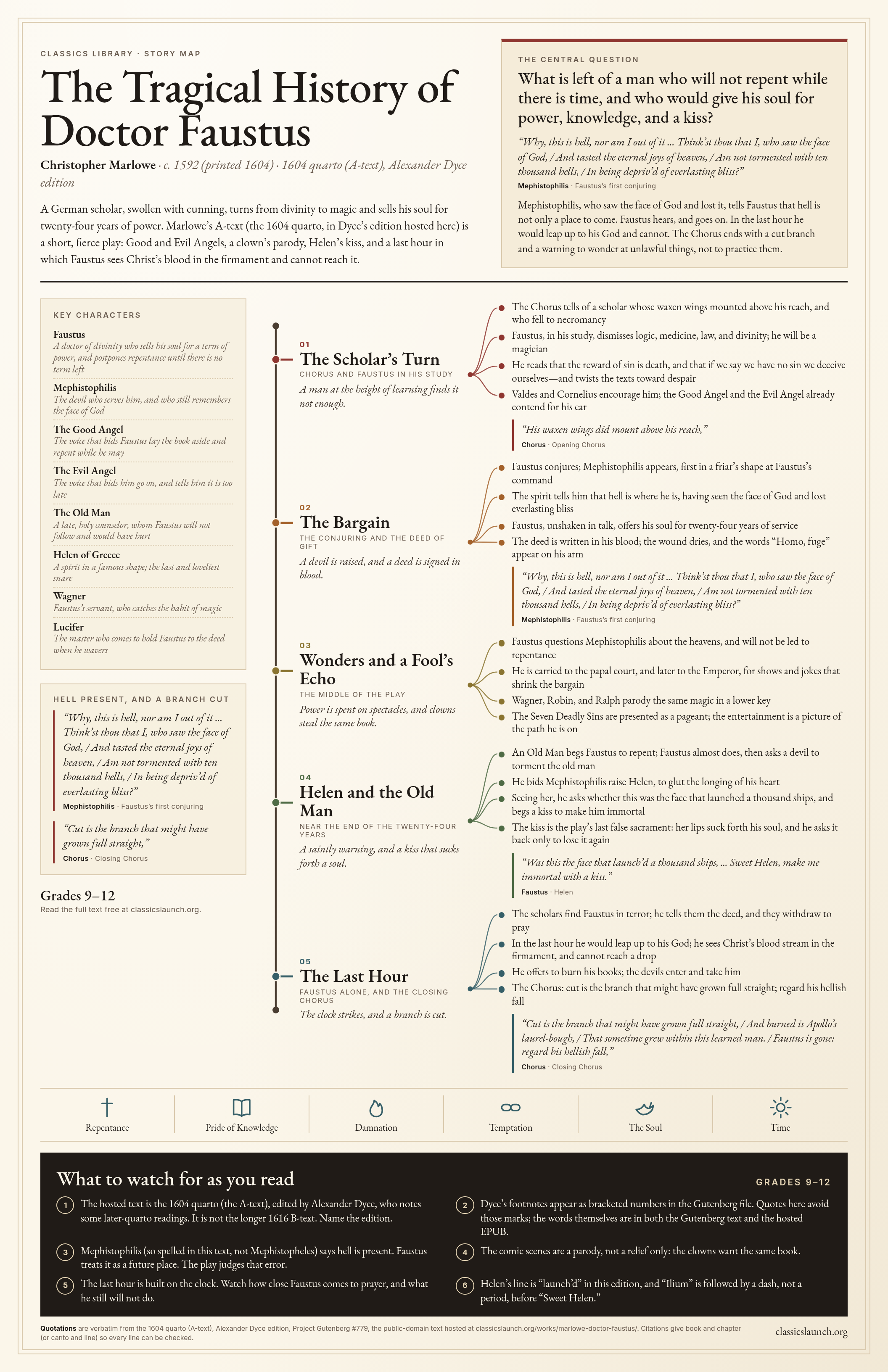
A German scholar, swollen with cunning, turns from divinity to magic and sells his soul for twenty-four years of power. Marlowe’s A-text (the 1604 quarto, in Dyce’s edition hosted here) is a short, fierce play: Good and Evil Angels, a clown’s parody, Helen’s kiss, and a last hour in which Faustus sees Christ’s blood in the firmament and cannot reach it.
The central question
What is left of a man who will not repent while there is time, and who would give his soul for power, knowledge, and a kiss?
“Why, this is hell, nor am I out of it ... Think’st thou that I, who saw the face of God, / And tasted the eternal joys of heaven, / Am not tormented with ten thousand hells, / In being depriv’d of everlasting bliss?”
Mephistophilis, who saw the face of God and lost it, tells Faustus that hell is not only a place to come. Faustus hears, and goes on. In the last hour he would leap up to his God and cannot. The Chorus ends with a cut branch and a warning to wonder at unlawful things, not to practice them.
- 01
The Scholar’s Turn
Chorus and Faustus in his study
A man at the height of learning finds it not enough.
- The Chorus tells of a scholar whose waxen wings mounted above his reach, and who fell to necromancy
- Faustus, in his study, dismisses logic, medicine, law, and divinity; he will be a magician
- He reads that the reward of sin is death, and that if we say we have no sin we deceive ourselves—and twists the texts toward despair
- Valdes and Cornelius encourage him; the Good Angel and the Evil Angel already contend for his ear
“His waxen wings did mount above his reach,”
- 02
The Bargain
The conjuring and the deed of gift
A devil is raised, and a deed is signed in blood.
- Faustus conjures; Mephistophilis appears, first in a friar’s shape at Faustus’s command
- The spirit tells him that hell is where he is, having seen the face of God and lost everlasting bliss
- Faustus, unshaken in talk, offers his soul for twenty-four years of service
- The deed is written in his blood; the wound dries, and the words “Homo, fuge” appear on his arm
“Why, this is hell, nor am I out of it ... Think’st thou that I, who saw the face of God, / And tasted the eternal joys of heaven, / Am not tormented with ten thousand hells, / In being depriv’d of everlasting bliss?”
- 03
Wonders and a Fool’s Echo
The middle of the play
Power is spent on spectacles, and clowns steal the same book.
- Faustus questions Mephistophilis about the heavens, and will not be led to repentance
- He is carried to the papal court, and later to the Emperor, for shows and jokes that shrink the bargain
- Wagner, Robin, and Ralph parody the same magic in a lower key
- The Seven Deadly Sins are presented as a pageant; the entertainment is a picture of the path he is on
- 04
Helen and the Old Man
Near the end of the twenty-four years
A saintly warning, and a kiss that sucks forth a soul.
- An Old Man begs Faustus to repent; Faustus almost does, then asks a devil to torment the old man
- He bids Mephistophilis raise Helen, to glut the longing of his heart
- Seeing her, he asks whether this was the face that launched a thousand ships, and begs a kiss to make him immortal
- The kiss is the play’s last false sacrament: her lips suck forth his soul, and he asks it back only to lose it again
“Was this the face that launch’d a thousand ships, ... Sweet Helen, make me immortal with a kiss.”
- 05
The Last Hour
Faustus alone, and the closing Chorus
The clock strikes, and a branch is cut.
- The scholars find Faustus in terror; he tells them the deed, and they withdraw to pray
- In the last hour he would leap up to his God; he sees Christ’s blood stream in the firmament, and cannot reach a drop
- He offers to burn his books; the devils enter and take him
- The Chorus: cut is the branch that might have grown full straight; regard his hellish fall
“Cut is the branch that might have grown full straight, / And burned is Apollo’s laurel-bough, / That sometime grew within this learned man. / Faustus is gone: regard his hellish fall,”
- Repentance
- Pride of Knowledge
- Damnation
- Temptation
- The Soul
- Time
What to watch for as you read
Grades 9–12- The hosted text is the 1604 quarto (the A-text), edited by Alexander Dyce, who notes some later-quarto readings. It is not the longer 1616 B-text. Name the edition.
- Dyce’s footnotes appear as bracketed numbers in the Gutenberg file. Quotes here avoid those marks; the words themselves are in both the Gutenberg text and the hosted EPUB.
- Mephistophilis (so spelled in this text, not Mephistopheles) says hell is present. Faustus treats it as a future place. The play judges that error.
- The comic scenes are a parody, not a relief only: the clowns want the same book.
- The last hour is built on the clock. Watch how close Faustus comes to prayer, and what he still will not do.
- Helen’s line is “launch’d” in this edition, and “Ilium” is followed by a dash, not a period, before “Sweet Helen.”
Every quotation is word for word from the 1604 quarto (A-text), Alexander Dyce edition hosted in this library and is checked against that text each time the site is built. Citations give book and chapter (or canto and line).