Story maps · Grades 11–12
Edward the Second: A Story Map
The PDF is one tabloid page (11 × 17 in). On letter paper, choose “Fit to page.”
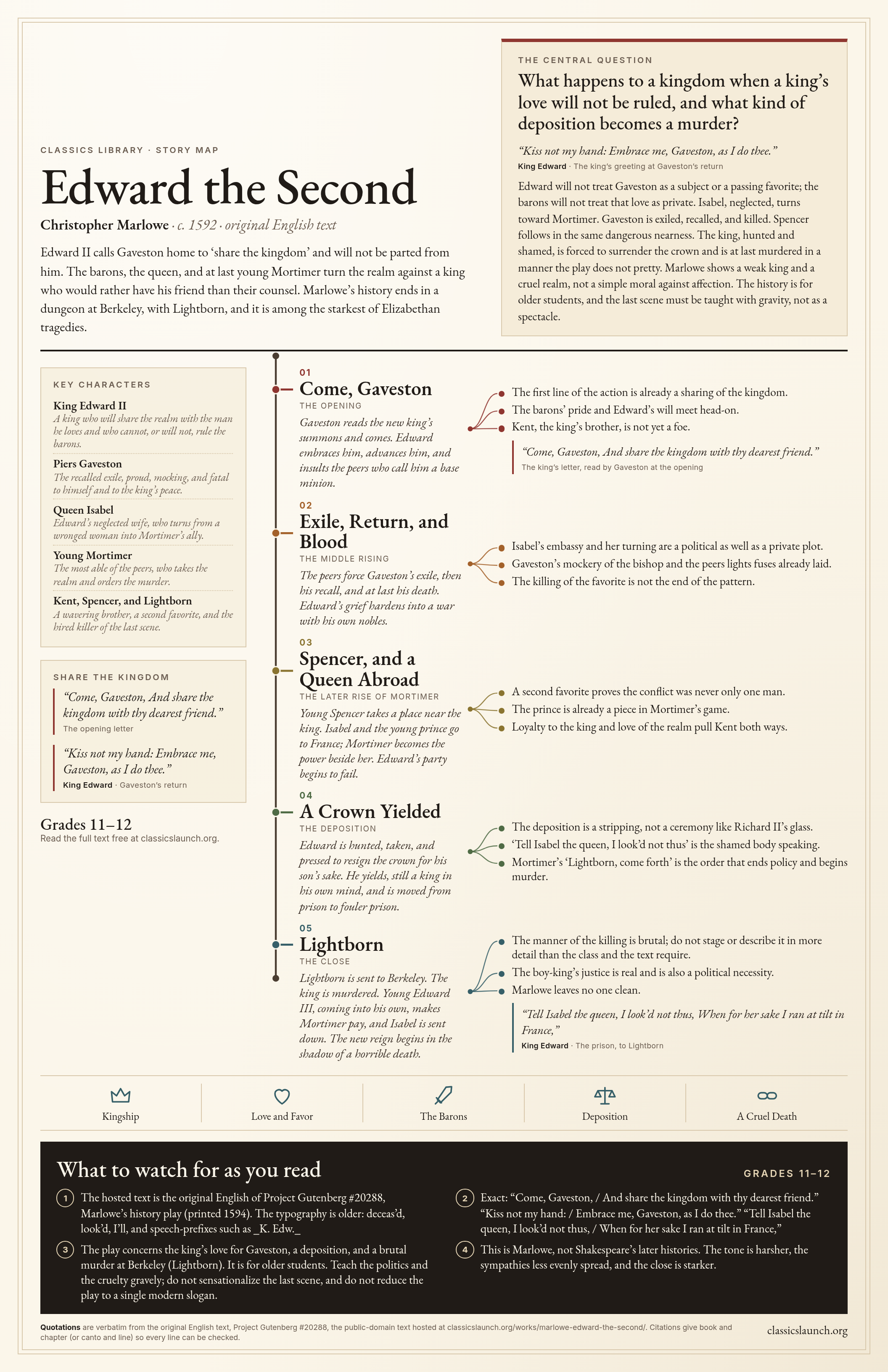
Edward II calls Gaveston home to ‘share the kingdom’ and will not be parted from him. The barons, the queen, and at last young Mortimer turn the realm against a king who would rather have his friend than their counsel. Marlowe’s history ends in a dungeon at Berkeley, with Lightborn, and it is among the starkest of Elizabethan tragedies.
The central question
What happens to a kingdom when a king’s love will not be ruled, and what kind of deposition becomes a murder?
“Kiss not my hand: Embrace me, Gaveston, as I do thee.”
Edward will not treat Gaveston as a subject or a passing favorite; the barons will not treat that love as private. Isabel, neglected, turns toward Mortimer. Gaveston is exiled, recalled, and killed. Spencer follows in the same dangerous nearness. The king, hunted and shamed, is forced to surrender the crown and is at last murdered in a manner the play does not pretty. Marlowe shows a weak king and a cruel realm, not a simple moral against affection. The history is for older students, and the last scene must be taught with gravity, not as a spectacle.
- 01
Come, Gaveston
The opening
Gaveston reads the new king’s summons and comes. Edward embraces him, advances him, and insults the peers who call him a base minion.
- The first line of the action is already a sharing of the kingdom.
- The barons’ pride and Edward’s will meet head-on.
- Kent, the king’s brother, is not yet a foe.
“Come, Gaveston, And share the kingdom with thy dearest friend.”
- 02
Exile, Return, and Blood
The middle rising
The peers force Gaveston’s exile, then his recall, and at last his death. Edward’s grief hardens into a war with his own nobles.
- Isabel’s embassy and her turning are a political as well as a private plot.
- Gaveston’s mockery of the bishop and the peers lights fuses already laid.
- The killing of the favorite is not the end of the pattern.
- 03
Spencer, and a Queen Abroad
The later rise of Mortimer
Young Spencer takes a place near the king. Isabel and the young prince go to France; Mortimer becomes the power beside her. Edward’s party begins to fail.
- A second favorite proves the conflict was never only one man.
- The prince is already a piece in Mortimer’s game.
- Loyalty to the king and love of the realm pull Kent both ways.
- 04
A Crown Yielded
The deposition
Edward is hunted, taken, and pressed to resign the crown for his son’s sake. He yields, still a king in his own mind, and is moved from prison to fouler prison.
- The deposition is a stripping, not a ceremony like Richard II’s glass.
- ‘Tell Isabel the queen, I look’d not thus’ is the shamed body speaking.
- Mortimer’s ‘Lightborn, come forth’ is the order that ends policy and begins murder.
- 05
Lightborn
The close
Lightborn is sent to Berkeley. The king is murdered. Young Edward III, coming into his own, makes Mortimer pay, and Isabel is sent down. The new reign begins in the shadow of a horrible death.
- The manner of the killing is brutal; do not stage or describe it in more detail than the class and the text require.
- The boy-king’s justice is real and is also a political necessity.
- Marlowe leaves no one clean.
“Tell Isabel the queen, I look’d not thus, When for her sake I ran at tilt in France,”
- Kingship
- Love and Favor
- The Barons
- Deposition
- A Cruel Death
What to watch for as you read
Grades 11–12- The hosted text is the original English of Project Gutenberg #20288, Marlowe’s history play (printed 1594). The typography is older: deceas’d, look’d, I’ll, and speech-prefixes such as _K. Edw._
- Exact: “Come, Gaveston, / And share the kingdom with thy dearest friend.” “Kiss not my hand: / Embrace me, Gaveston, as I do thee.” “Tell Isabel the queen, I look’d not thus, / When for her sake I ran at tilt in France,”
- The play concerns the king’s love for Gaveston, a deposition, and a brutal murder at Berkeley (Lightborn). It is for older students. Teach the politics and the cruelty gravely; do not sensationalize the last scene, and do not reduce the play to a single modern slogan.
- This is Marlowe, not Shakespeare’s later histories. The tone is harsher, the sympathies less evenly spread, and the close is starker.
Every quotation is word for word from the original English text hosted in this library and is checked against that text each time the site is built. Citations give book and chapter (or canto and line).