Story maps · Grades 11–12
The Jew of Malta: A Story Map
The PDF is one tabloid page (11 × 17 in). On letter paper, choose “Fit to page.”
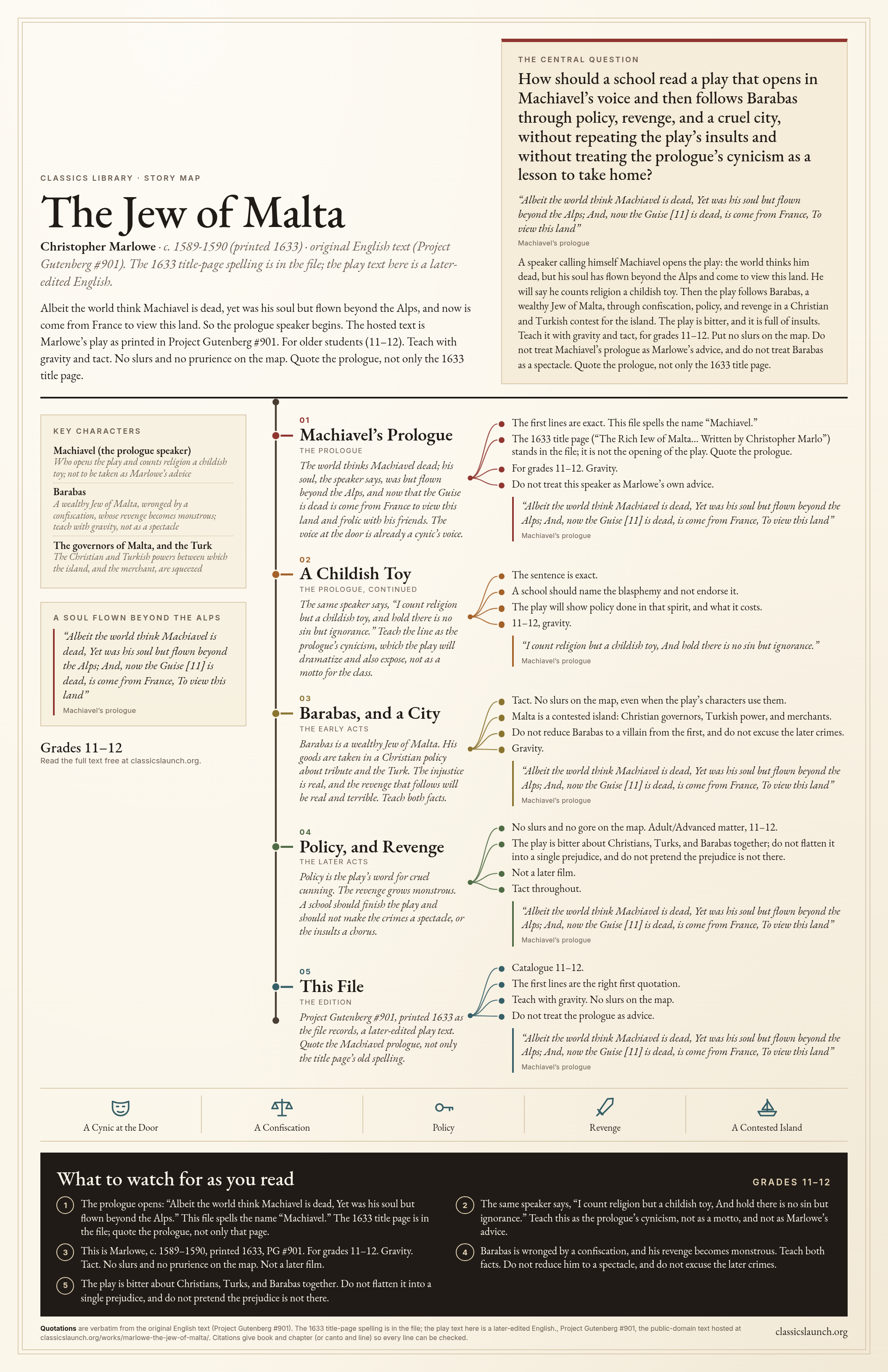
Albeit the world think Machiavel is dead, yet was his soul but flown beyond the Alps, and now is come from France to view this land. So the prologue speaker begins. The hosted text is Marlowe’s play as printed in Project Gutenberg #901. For older students (11–12). Teach with gravity and tact. No slurs and no prurience on the map. Quote the prologue, not only the 1633 title page.
The central question
How should a school read a play that opens in Machiavel’s voice and then follows Barabas through policy, revenge, and a cruel city, without repeating the play’s insults and without treating the prologue’s cynicism as a lesson to take home?
“Albeit the world think Machiavel is dead, Yet was his soul but flown beyond the Alps; And, now the Guise [11] is dead, is come from France, To view this land”
A speaker calling himself Machiavel opens the play: the world thinks him dead, but his soul has flown beyond the Alps and come to view this land. He will say he counts religion a childish toy. Then the play follows Barabas, a wealthy Jew of Malta, through confiscation, policy, and revenge in a Christian and Turkish contest for the island. The play is bitter, and it is full of insults. Teach it with gravity and tact, for grades 11–12. Put no slurs on the map. Do not treat Machiavel’s prologue as Marlowe’s advice, and do not treat Barabas as a spectacle. Quote the prologue, not only the 1633 title page.
- 01
Machiavel’s Prologue
The prologue
The world thinks Machiavel dead; his soul, the speaker says, was but flown beyond the Alps, and now that the Guise is dead is come from France to view this land and frolic with his friends. The voice at the door is already a cynic’s voice.
- The first lines are exact. This file spells the name “Machiavel.”
- The 1633 title page (“The Rich Iew of Malta… Written by Christopher Marlo”) stands in the file; it is not the opening of the play. Quote the prologue.
- For grades 11–12. Gravity.
- Do not treat this speaker as Marlowe’s own advice.
“Albeit the world think Machiavel is dead, Yet was his soul but flown beyond the Alps; And, now the Guise [11] is dead, is come from France, To view this land”
- 02
A Childish Toy
The prologue, continued
The same speaker says, “I count religion but a childish toy, and hold there is no sin but ignorance.” Teach the line as the prologue’s cynicism, which the play will dramatize and also expose, not as a motto for the class.
- The sentence is exact.
- A school should name the blasphemy and not endorse it.
- The play will show policy done in that spirit, and what it costs.
- 11–12, gravity.
“I count religion but a childish toy, And hold there is no sin but ignorance.”
- 03
Barabas, and a City
The early acts
Barabas is a wealthy Jew of Malta. His goods are taken in a Christian policy about tribute and the Turk. The injustice is real, and the revenge that follows will be real and terrible. Teach both facts.
- Tact. No slurs on the map, even when the play’s characters use them.
- Malta is a contested island: Christian governors, Turkish power, and merchants.
- Do not reduce Barabas to a villain from the first, and do not excuse the later crimes.
- Gravity.
“Albeit the world think Machiavel is dead, Yet was his soul but flown beyond the Alps; And, now the Guise [11] is dead, is come from France, To view this land”
- 04
Policy, and Revenge
The later acts
Policy is the play’s word for cruel cunning. The revenge grows monstrous. A school should finish the play and should not make the crimes a spectacle, or the insults a chorus.
- No slurs and no gore on the map. Adult/Advanced matter, 11–12.
- The play is bitter about Christians, Turks, and Barabas together; do not flatten it into a single prejudice, and do not pretend the prejudice is not there.
- Not a later film.
- Tact throughout.
“Albeit the world think Machiavel is dead, Yet was his soul but flown beyond the Alps; And, now the Guise [11] is dead, is come from France, To view this land”
- 05
This File
The edition
Project Gutenberg #901, printed 1633 as the file records, a later-edited play text. Quote the Machiavel prologue, not only the title page’s old spelling.
- Catalogue 11–12.
- The first lines are the right first quotation.
- Teach with gravity. No slurs on the map.
- Do not treat the prologue as advice.
“Albeit the world think Machiavel is dead, Yet was his soul but flown beyond the Alps; And, now the Guise [11] is dead, is come from France, To view this land”
- A Cynic at the Door
- A Confiscation
- Policy
- Revenge
- A Contested Island
What to watch for as you read
Grades 11–12- The prologue opens: “Albeit the world think Machiavel is dead, Yet was his soul but flown beyond the Alps.” This file spells the name “Machiavel.” The 1633 title page is in the file; quote the prologue, not only that page.
- The same speaker says, “I count religion but a childish toy, And hold there is no sin but ignorance.” Teach this as the prologue’s cynicism, not as a motto, and not as Marlowe’s advice.
- This is Marlowe, c. 1589–1590, printed 1633, PG #901. For grades 11–12. Gravity. Tact. No slurs and no prurience on the map. Not a later film.
- Barabas is wronged by a confiscation, and his revenge becomes monstrous. Teach both facts. Do not reduce him to a spectacle, and do not excuse the later crimes.
- The play is bitter about Christians, Turks, and Barabas together. Do not flatten it into a single prejudice, and do not pretend the prejudice is not there.
Every quotation is word for word from the original English text (Project Gutenberg #901). The 1633 title-page spelling is in the file; the play text here is a later-edited English. hosted in this library and is checked against that text each time the site is built. Citations give book and chapter (or canto and line).