Story maps · Grades 11–12
Metamorphoses: A Story Map
The PDF is one tabloid page (11 × 17 in). On letter paper, choose “Fit to page.”
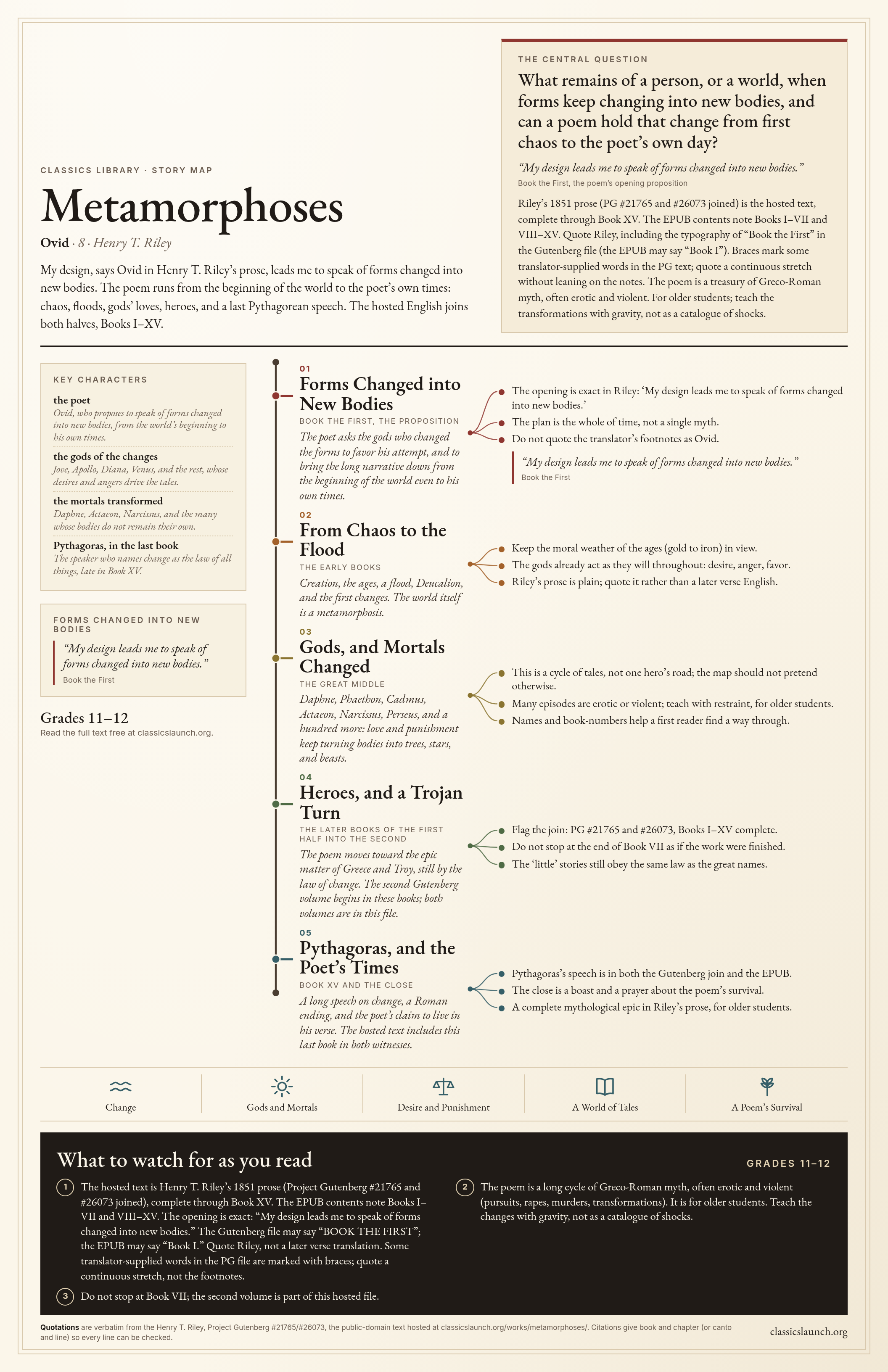
My design, says Ovid in Henry T. Riley’s prose, leads me to speak of forms changed into new bodies. The poem runs from the beginning of the world to the poet’s own times: chaos, floods, gods’ loves, heroes, and a last Pythagorean speech. The hosted English joins both halves, Books I–XV.
The central question
What remains of a person, or a world, when forms keep changing into new bodies, and can a poem hold that change from first chaos to the poet’s own day?
“My design leads me to speak of forms changed into new bodies.”
Riley’s 1851 prose (PG #21765 and #26073 joined) is the hosted text, complete through Book XV. The EPUB contents note Books I–VII and VIII–XV. Quote Riley, including the typography of “Book the First” in the Gutenberg file (the EPUB may say “Book I”). Braces mark some translator-supplied words in the PG text; quote a continuous stretch without leaning on the notes. The poem is a treasury of Greco-Roman myth, often erotic and violent. For older students; teach the transformations with gravity, not as a catalogue of shocks.
- 01
Forms Changed into New Bodies
Book the First, the proposition
The poet asks the gods who changed the forms to favor his attempt, and to bring the long narrative down from the beginning of the world even to his own times.
- The opening is exact in Riley: ‘My design leads me to speak of forms changed into new bodies.’
- The plan is the whole of time, not a single myth.
- Do not quote the translator’s footnotes as Ovid.
“My design leads me to speak of forms changed into new bodies.”
- 02
From Chaos to the Flood
The early books
Creation, the ages, a flood, Deucalion, and the first changes. The world itself is a metamorphosis.
- Keep the moral weather of the ages (gold to iron) in view.
- The gods already act as they will throughout: desire, anger, favor.
- Riley’s prose is plain; quote it rather than a later verse English.
- 03
Gods, and Mortals Changed
The great middle
Daphne, Phaethon, Cadmus, Actaeon, Narcissus, Perseus, and a hundred more: love and punishment keep turning bodies into trees, stars, and beasts.
- This is a cycle of tales, not one hero’s road; the map should not pretend otherwise.
- Many episodes are erotic or violent; teach with restraint, for older students.
- Names and book-numbers help a first reader find a way through.
- 04
Heroes, and a Trojan Turn
The later books of the first half into the second
The poem moves toward the epic matter of Greece and Troy, still by the law of change. The second Gutenberg volume begins in these books; both volumes are in this file.
- Flag the join: PG #21765 and #26073, Books I–XV complete.
- Do not stop at the end of Book VII as if the work were finished.
- The ‘little’ stories still obey the same law as the great names.
- 05
Pythagoras, and the Poet’s Times
Book XV and the close
A long speech on change, a Roman ending, and the poet’s claim to live in his verse. The hosted text includes this last book in both witnesses.
- Pythagoras’s speech is in both the Gutenberg join and the EPUB.
- The close is a boast and a prayer about the poem’s survival.
- A complete mythological epic in Riley’s prose, for older students.
- Change
- Gods and Mortals
- Desire and Punishment
- A World of Tales
- A Poem’s Survival
What to watch for as you read
Grades 11–12- The hosted text is Henry T. Riley’s 1851 prose (Project Gutenberg #21765 and #26073 joined), complete through Book XV. The EPUB contents note Books I–VII and VIII–XV. The opening is exact: “My design leads me to speak of forms changed into new bodies.” The Gutenberg file may say “BOOK THE FIRST”; the EPUB may say “Book I.” Quote Riley, not a later verse translation. Some translator-supplied words in the PG file are marked with braces; quote a continuous stretch, not the footnotes.
- The poem is a long cycle of Greco-Roman myth, often erotic and violent (pursuits, rapes, murders, transformations). It is for older students. Teach the changes with gravity, not as a catalogue of shocks.
- Do not stop at Book VII; the second volume is part of this hosted file.
Every quotation is word for word from the Henry T. Riley hosted in this library and is checked against that text each time the site is built. Citations give book and chapter (or canto and line).