Story maps · Grades 10–12
The Shorter Poems and Samson Agonistes (Beeching’s Milton): A Story Map
The PDF is one tabloid page (11 × 17 in). On letter paper, choose “Fit to page.”
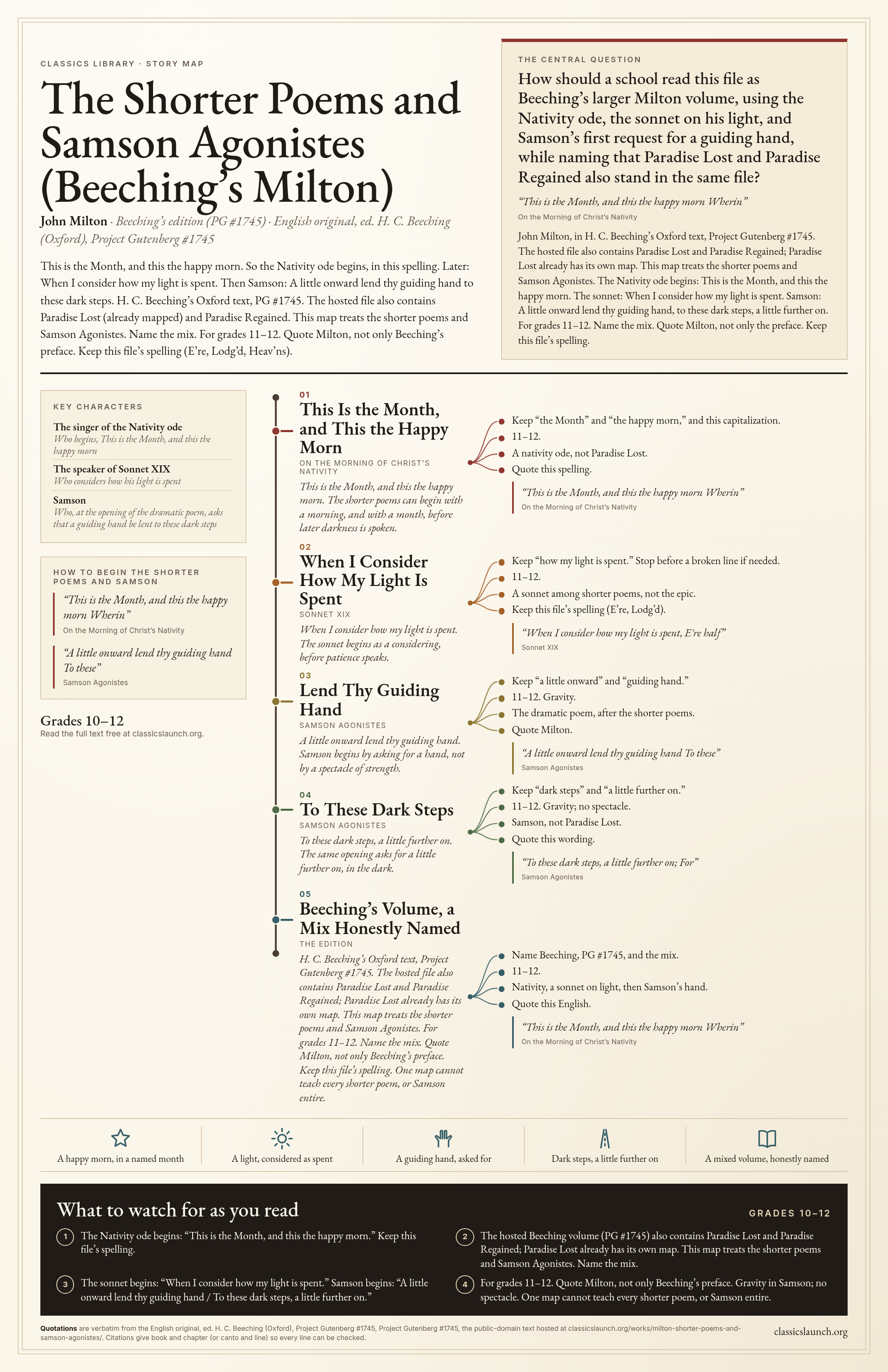
This is the Month, and this the happy morn. So the Nativity ode begins, in this spelling. Later: When I consider how my light is spent. Then Samson: A little onward lend thy guiding hand to these dark steps. H. C. Beeching’s Oxford text, PG #1745. The hosted file also contains Paradise Lost (already mapped) and Paradise Regained. This map treats the shorter poems and Samson Agonistes. Name the mix. For grades 11–12. Quote Milton, not only Beeching’s preface. Keep this file’s spelling (E’re, Lodg’d, Heav’ns).
The central question
How should a school read this file as Beeching’s larger Milton volume, using the Nativity ode, the sonnet on his light, and Samson’s first request for a guiding hand, while naming that Paradise Lost and Paradise Regained also stand in the same file?
“This is the Month, and this the happy morn Wherin”
John Milton, in H. C. Beeching’s Oxford text, Project Gutenberg #1745. The hosted file also contains Paradise Lost and Paradise Regained; Paradise Lost already has its own map. This map treats the shorter poems and Samson Agonistes. The Nativity ode begins: This is the Month, and this the happy morn. The sonnet: When I consider how my light is spent. Samson: A little onward lend thy guiding hand, to these dark steps, a little further on. For grades 11–12. Name the mix. Quote Milton, not only the preface. Keep this file’s spelling.
- 01
This Is the Month, and This the Happy Morn
On the Morning of Christ’s Nativity
This is the Month, and this the happy morn. The shorter poems can begin with a morning, and with a month, before later darkness is spoken.
- Keep “the Month” and “the happy morn,” and this capitalization.
- 11–12.
- A nativity ode, not Paradise Lost.
- Quote this spelling.
“This is the Month, and this the happy morn Wherin”
- 02
When I Consider How My Light Is Spent
Sonnet XIX
When I consider how my light is spent. The sonnet begins as a considering, before patience speaks.
- Keep “how my light is spent.” Stop before a broken line if needed.
- 11–12.
- A sonnet among shorter poems, not the epic.
- Keep this file’s spelling (E’re, Lodg’d).
“When I consider how my light is spent, E're half”
- 03
Lend Thy Guiding Hand
Samson Agonistes
A little onward lend thy guiding hand. Samson begins by asking for a hand, not by a spectacle of strength.
- Keep “a little onward” and “guiding hand.”
- 11–12. Gravity.
- The dramatic poem, after the shorter poems.
- Quote Milton.
“A little onward lend thy guiding hand To these”
- 04
To These Dark Steps
Samson Agonistes
To these dark steps, a little further on. The same opening asks for a little further on, in the dark.
- Keep “dark steps” and “a little further on.”
- 11–12. Gravity; no spectacle.
- Samson, not Paradise Lost.
- Quote this wording.
“To these dark steps, a little further on; For”
- 05
Beeching’s Volume, a Mix Honestly Named
The edition
H. C. Beeching’s Oxford text, Project Gutenberg #1745. The hosted file also contains Paradise Lost and Paradise Regained; Paradise Lost already has its own map. This map treats the shorter poems and Samson Agonistes. For grades 11–12. Name the mix. Quote Milton, not only Beeching’s preface. Keep this file’s spelling. One map cannot teach every shorter poem, or Samson entire.
- Name Beeching, PG #1745, and the mix.
- 11–12.
- Nativity, a sonnet on light, then Samson’s hand.
- Quote this English.
“This is the Month, and this the happy morn Wherin”
- A happy morn, in a named month
- A light, considered as spent
- A guiding hand, asked for
- Dark steps, a little further on
- A mixed volume, honestly named
What to watch for as you read
Grades 10–12- The Nativity ode begins: “This is the Month, and this the happy morn.” Keep this file’s spelling.
- The hosted Beeching volume (PG #1745) also contains Paradise Lost and Paradise Regained; Paradise Lost already has its own map. This map treats the shorter poems and Samson Agonistes. Name the mix.
- The sonnet begins: “When I consider how my light is spent.” Samson begins: “A little onward lend thy guiding hand / To these dark steps, a little further on.”
- For grades 11–12. Quote Milton, not only Beeching’s preface. Gravity in Samson; no spectacle. One map cannot teach every shorter poem, or Samson entire.
Every quotation is word for word from the English original, ed. H. C. Beeching (Oxford), Project Gutenberg #1745 hosted in this library and is checked against that text each time the site is built. Citations give book and chapter (or canto and line).