Story maps · Grades 9–12
The Miser and The Would-Be Gentleman: A Story Map
The PDF is one tabloid page (11 × 17 in). On letter paper, choose “Fit to page.”
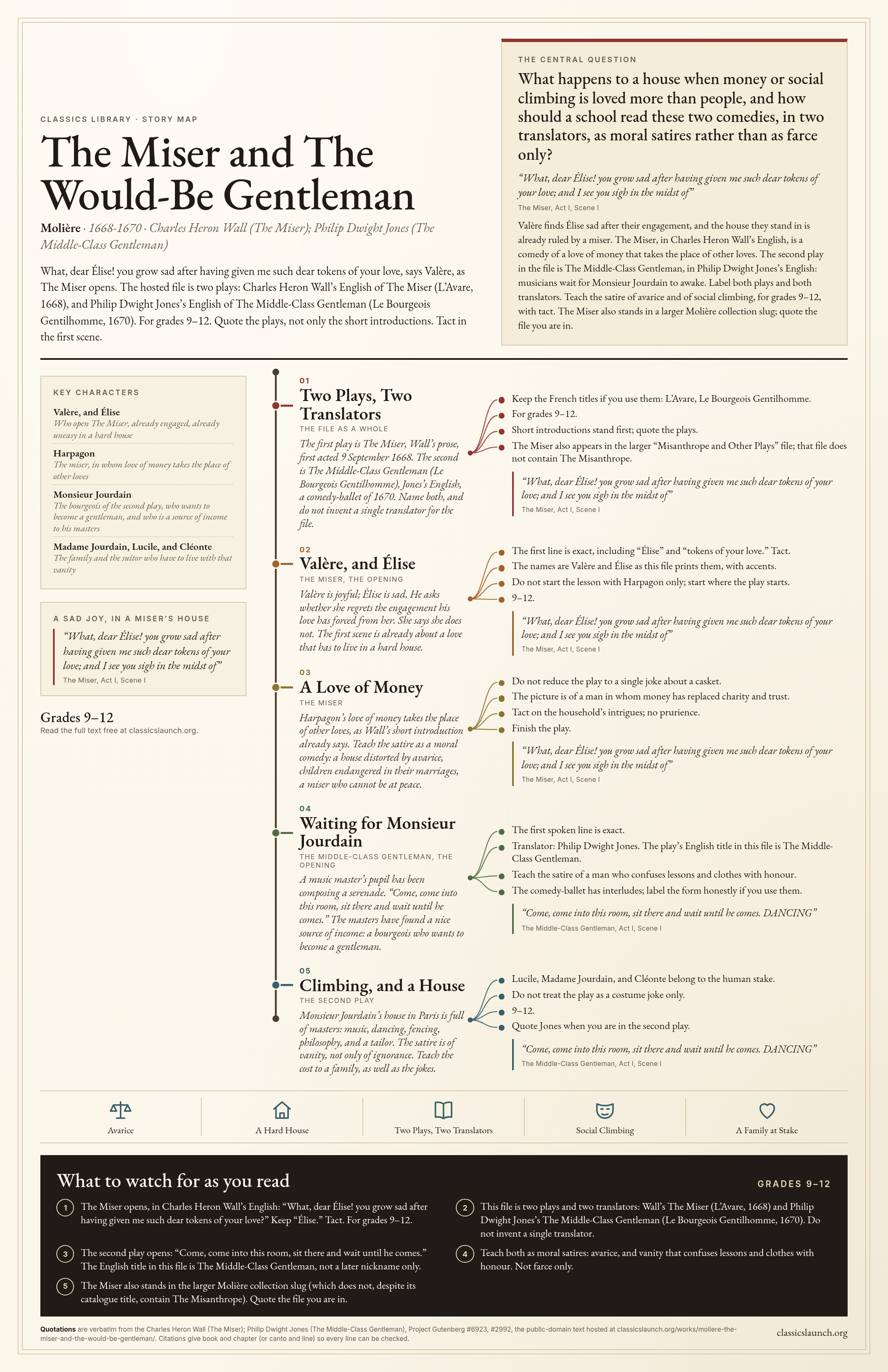
What, dear Élise! you grow sad after having given me such dear tokens of your love, says Valère, as The Miser opens. The hosted file is two plays: Charles Heron Wall’s English of The Miser (L’Avare, 1668), and Philip Dwight Jones’s English of The Middle-Class Gentleman (Le Bourgeois Gentilhomme, 1670). For grades 9–12. Quote the plays, not only the short introductions. Tact in the first scene.
The central question
What happens to a house when money or social climbing is loved more than people, and how should a school read these two comedies, in two translators, as moral satires rather than as farce only?
“What, dear Élise! you grow sad after having given me such dear tokens of your love; and I see you sigh in the midst of”
Valère finds Élise sad after their engagement, and the house they stand in is already ruled by a miser. The Miser, in Charles Heron Wall’s English, is a comedy of a love of money that takes the place of other loves. The second play in the file is The Middle-Class Gentleman, in Philip Dwight Jones’s English: musicians wait for Monsieur Jourdain to awake. Label both plays and both translators. Teach the satire of avarice and of social climbing, for grades 9–12, with tact. The Miser also stands in a larger Molière collection slug; quote the file you are in.
- 01
Two Plays, Two Translators
The file as a whole
The first play is The Miser, Wall’s prose, first acted 9 September 1668. The second is The Middle-Class Gentleman (Le Bourgeois Gentilhomme), Jones’s English, a comedy-ballet of 1670. Name both, and do not invent a single translator for the file.
- Keep the French titles if you use them: L’Avare, Le Bourgeois Gentilhomme.
- For grades 9–12.
- Short introductions stand first; quote the plays.
- The Miser also appears in the larger “Misanthrope and Other Plays” file; that file does not contain The Misanthrope.
“What, dear Élise! you grow sad after having given me such dear tokens of your love; and I see you sigh in the midst of”
- 02
Valère, and Élise
The Miser, the opening
Valère is joyful; Élise is sad. He asks whether she regrets the engagement his love has forced from her. She says she does not. The first scene is already about a love that has to live in a hard house.
- The first line is exact, including “Élise” and “tokens of your love.” Tact.
- The names are Valère and Élise as this file prints them, with accents.
- Do not start the lesson with Harpagon only; start where the play starts.
- 9–12.
“What, dear Élise! you grow sad after having given me such dear tokens of your love; and I see you sigh in the midst of”
- 03
A Love of Money
The Miser
Harpagon’s love of money takes the place of other loves, as Wall’s short introduction already says. Teach the satire as a moral comedy: a house distorted by avarice, children endangered in their marriages, a miser who cannot be at peace.
- Do not reduce the play to a single joke about a casket.
- The picture is of a man in whom money has replaced charity and trust.
- Tact on the household’s intrigues; no prurience.
- Finish the play.
“What, dear Élise! you grow sad after having given me such dear tokens of your love; and I see you sigh in the midst of”
- 04
Waiting for Monsieur Jourdain
The Middle-Class Gentleman, the opening
A music master’s pupil has been composing a serenade. “Come, come into this room, sit there and wait until he comes.” The masters have found a nice source of income: a bourgeois who wants to become a gentleman.
- The first spoken line is exact.
- Translator: Philip Dwight Jones. The play’s English title in this file is The Middle-Class Gentleman.
- Teach the satire of a man who confuses lessons and clothes with honour.
- The comedy-ballet has interludes; label the form honestly if you use them.
“Come, come into this room, sit there and wait until he comes. DANCING”
- 05
Climbing, and a House
The second play
Monsieur Jourdain’s house in Paris is full of masters: music, dancing, fencing, philosophy, and a tailor. The satire is of vanity, not only of ignorance. Teach the cost to a family, as well as the jokes.
- Lucile, Madame Jourdain, and Cléonte belong to the human stake.
- Do not treat the play as a costume joke only.
- 9–12.
- Quote Jones when you are in the second play.
“Come, come into this room, sit there and wait until he comes. DANCING”
- Avarice
- A Hard House
- Two Plays, Two Translators
- Social Climbing
- A Family at Stake
What to watch for as you read
Grades 9–12- The Miser opens, in Charles Heron Wall’s English: “What, dear Élise! you grow sad after having given me such dear tokens of your love?” Keep “Élise.” Tact. For grades 9–12.
- This file is two plays and two translators: Wall’s The Miser (L’Avare, 1668) and Philip Dwight Jones’s The Middle-Class Gentleman (Le Bourgeois Gentilhomme, 1670). Do not invent a single translator.
- The second play opens: “Come, come into this room, sit there and wait until he comes.” The English title in this file is The Middle-Class Gentleman, not a later nickname only.
- Teach both as moral satires: avarice, and vanity that confuses lessons and clothes with honour. Not farce only.
- The Miser also stands in the larger Molière collection slug (which does not, despite its catalogue title, contain The Misanthrope). Quote the file you are in.
Every quotation is word for word from the Charles Heron Wall (The Miser); Philip Dwight Jones (The Middle-Class Gentleman) hosted in this library and is checked against that text each time the site is built. Citations give book and chapter (or canto and line).