Story maps · Grades 8–12
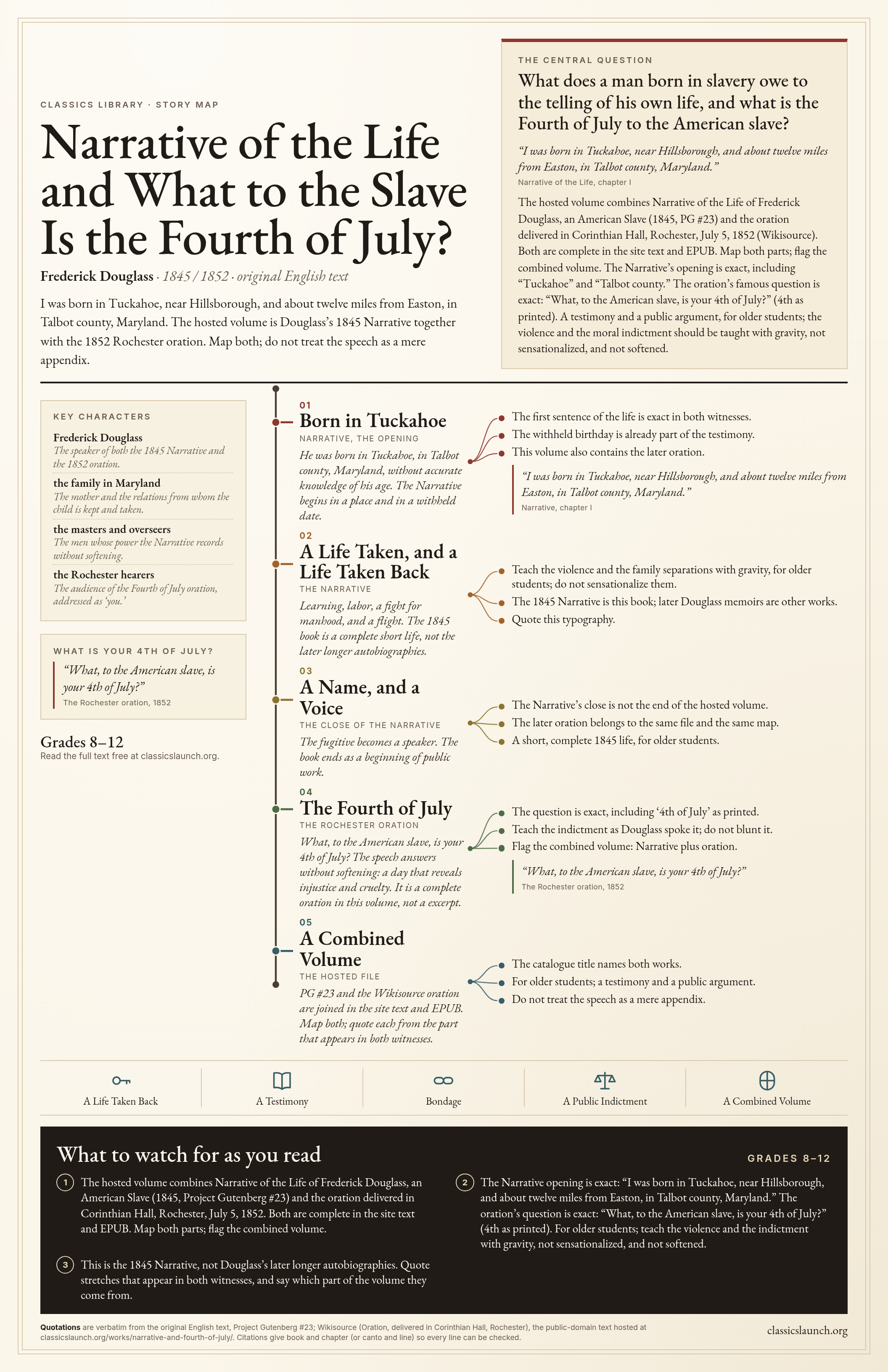
Narrative of the Life and What to the Slave Is the Fourth of July?: A Story Map
The PDF is one tabloid page (11 × 17 in). On letter paper, choose “Fit to page.”
I was born in Tuckahoe, near Hillsborough, and about twelve miles from Easton, in Talbot county, Maryland. The hosted volume is Douglass’s 1845 Narrative together with the 1852 Rochester oration. Map both; do not treat the speech as a mere appendix.
The central question
What does a man born in slavery owe to the telling of his own life, and what is the Fourth of July to the American slave?
“I was born in Tuckahoe, near Hillsborough, and about twelve miles from Easton, in Talbot county, Maryland.”
The hosted volume combines Narrative of the Life of Frederick Douglass, an American Slave (1845, PG #23) and the oration delivered in Corinthian Hall, Rochester, July 5, 1852 (Wikisource). Both are complete in the site text and EPUB. Map both parts; flag the combined volume. The Narrative’s opening is exact, including “Tuckahoe” and “Talbot county.” The oration’s famous question is exact: “What, to the American slave, is your 4th of July?” (4th as printed). A testimony and a public argument, for older students; the violence and the moral indictment should be taught with gravity, not sensationalized, and not softened.
- 01
Born in Tuckahoe
Narrative, the opening
He was born in Tuckahoe, in Talbot county, Maryland, without accurate knowledge of his age. The Narrative begins in a place and in a withheld date.
- The first sentence of the life is exact in both witnesses.
- The withheld birthday is already part of the testimony.
- This volume also contains the later oration.
“I was born in Tuckahoe, near Hillsborough, and about twelve miles from Easton, in Talbot county, Maryland.”
- 02
A Life Taken, and a Life Taken Back
The Narrative
Learning, labor, a fight for manhood, and a flight. The 1845 book is a complete short life, not the later longer autobiographies.
- Teach the violence and the family separations with gravity, for older students; do not sensationalize them.
- The 1845 Narrative is this book; later Douglass memoirs are other works.
- Quote this typography.
- 03
A Name, and a Voice
The close of the Narrative
The fugitive becomes a speaker. The book ends as a beginning of public work.
- The Narrative’s close is not the end of the hosted volume.
- The later oration belongs to the same file and the same map.
- A short, complete 1845 life, for older students.
- 04
The Fourth of July
The Rochester oration
What, to the American slave, is your 4th of July? The speech answers without softening: a day that reveals injustice and cruelty. It is a complete oration in this volume, not a excerpt.
- The question is exact, including ‘4th of July’ as printed.
- Teach the indictment as Douglass spoke it; do not blunt it.
- Flag the combined volume: Narrative plus oration.
“What, to the American slave, is your 4th of July?”
- 05
A Combined Volume
The hosted file
PG #23 and the Wikisource oration are joined in the site text and EPUB. Map both; quote each from the part that appears in both witnesses.
- The catalogue title names both works.
- For older students; a testimony and a public argument.
- Do not treat the speech as a mere appendix.
- A Life Taken Back
- A Testimony
- Bondage
- A Public Indictment
- A Combined Volume
What to watch for as you read
Grades 8–12- The hosted volume combines Narrative of the Life of Frederick Douglass, an American Slave (1845, Project Gutenberg #23) and the oration delivered in Corinthian Hall, Rochester, July 5, 1852. Both are complete in the site text and EPUB. Map both parts; flag the combined volume.
- The Narrative opening is exact: “I was born in Tuckahoe, near Hillsborough, and about twelve miles from Easton, in Talbot county, Maryland.” The oration’s question is exact: “What, to the American slave, is your 4th of July?” (4th as printed). For older students; teach the violence and the indictment with gravity, not sensationalized, and not softened.
- This is the 1845 Narrative, not Douglass’s later longer autobiographies. Quote stretches that appear in both witnesses, and say which part of the volume they come from.
Every quotation is word for word from the original English text hosted in this library and is checked against that text each time the site is built. Citations give book and chapter (or canto and line).