Story maps · Grades 9–12
Ninety-Three: A Story Map
The PDF is one tabloid page (11 × 17 in). On letter paper, choose “Fit to page.”
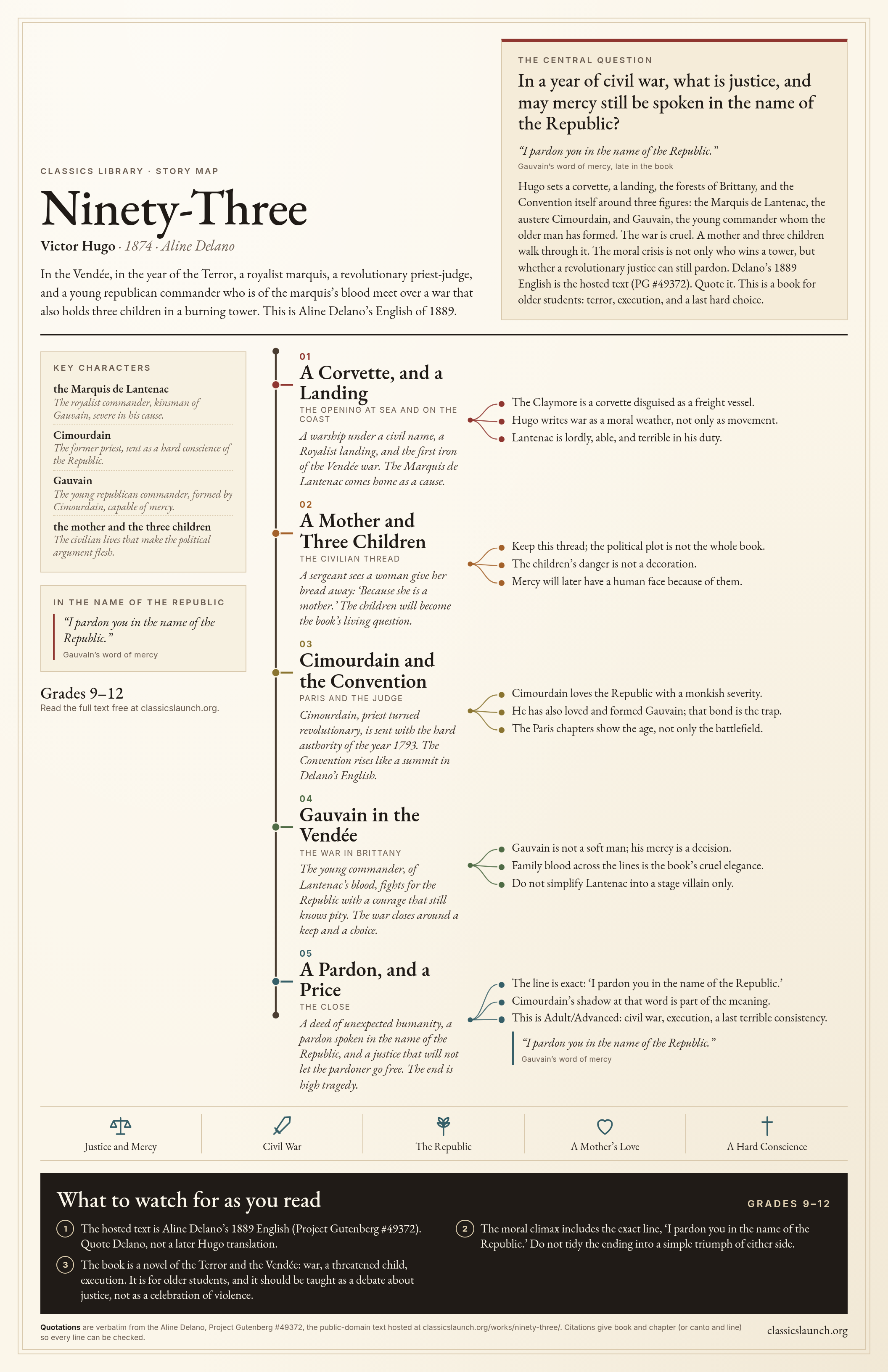
In the Vendée, in the year of the Terror, a royalist marquis, a revolutionary priest-judge, and a young republican commander who is of the marquis’s blood meet over a war that also holds three children in a burning tower. This is Aline Delano’s English of 1889.
The central question
In a year of civil war, what is justice, and may mercy still be spoken in the name of the Republic?
“I pardon you in the name of the Republic.”
Hugo sets a corvette, a landing, the forests of Brittany, and the Convention itself around three figures: the Marquis de Lantenac, the austere Cimourdain, and Gauvain, the young commander whom the older man has formed. The war is cruel. A mother and three children walk through it. The moral crisis is not only who wins a tower, but whether a revolutionary justice can still pardon. Delano’s 1889 English is the hosted text (PG #49372). Quote it. This is a book for older students: terror, execution, and a last hard choice.
- 01
A Corvette, and a Landing
The opening at sea and on the coast
A warship under a civil name, a Royalist landing, and the first iron of the Vendée war. The Marquis de Lantenac comes home as a cause.
- The Claymore is a corvette disguised as a freight vessel.
- Hugo writes war as a moral weather, not only as movement.
- Lantenac is lordly, able, and terrible in his duty.
- 02
A Mother and Three Children
The civilian thread
A sergeant sees a woman give her bread away: ‘Because she is a mother.’ The children will become the book’s living question.
- Keep this thread; the political plot is not the whole book.
- The children’s danger is not a decoration.
- Mercy will later have a human face because of them.
- 03
Cimourdain and the Convention
Paris and the judge
Cimourdain, priest turned revolutionary, is sent with the hard authority of the year 1793. The Convention rises like a summit in Delano’s English.
- Cimourdain loves the Republic with a monkish severity.
- He has also loved and formed Gauvain; that bond is the trap.
- The Paris chapters show the age, not only the battlefield.
- 04
Gauvain in the Vendée
The war in Brittany
The young commander, of Lantenac’s blood, fights for the Republic with a courage that still knows pity. The war closes around a keep and a choice.
- Gauvain is not a soft man; his mercy is a decision.
- Family blood across the lines is the book’s cruel elegance.
- Do not simplify Lantenac into a stage villain only.
- 05
A Pardon, and a Price
The close
A deed of unexpected humanity, a pardon spoken in the name of the Republic, and a justice that will not let the pardoner go free. The end is high tragedy.
- The line is exact: ‘I pardon you in the name of the Republic.’
- Cimourdain’s shadow at that word is part of the meaning.
- This is Adult/Advanced: civil war, execution, a last terrible consistency.
“I pardon you in the name of the Republic.”
- Justice and Mercy
- Civil War
- The Republic
- A Mother’s Love
- A Hard Conscience
What to watch for as you read
Grades 9–12- The hosted text is Aline Delano’s 1889 English (Project Gutenberg #49372). Quote Delano, not a later Hugo translation.
- The moral climax includes the exact line, ‘I pardon you in the name of the Republic.’ Do not tidy the ending into a simple triumph of either side.
- The book is a novel of the Terror and the Vendée: war, a threatened child, execution. It is for older students, and it should be taught as a debate about justice, not as a celebration of violence.
Every quotation is word for word from the Aline Delano hosted in this library and is checked against that text each time the site is built. Citations give book and chapter (or canto and line).