Story maps · Grades 9–12
North and South: A Story Map
The PDF is one tabloid page (11 × 17 in). On letter paper, choose “Fit to page.”
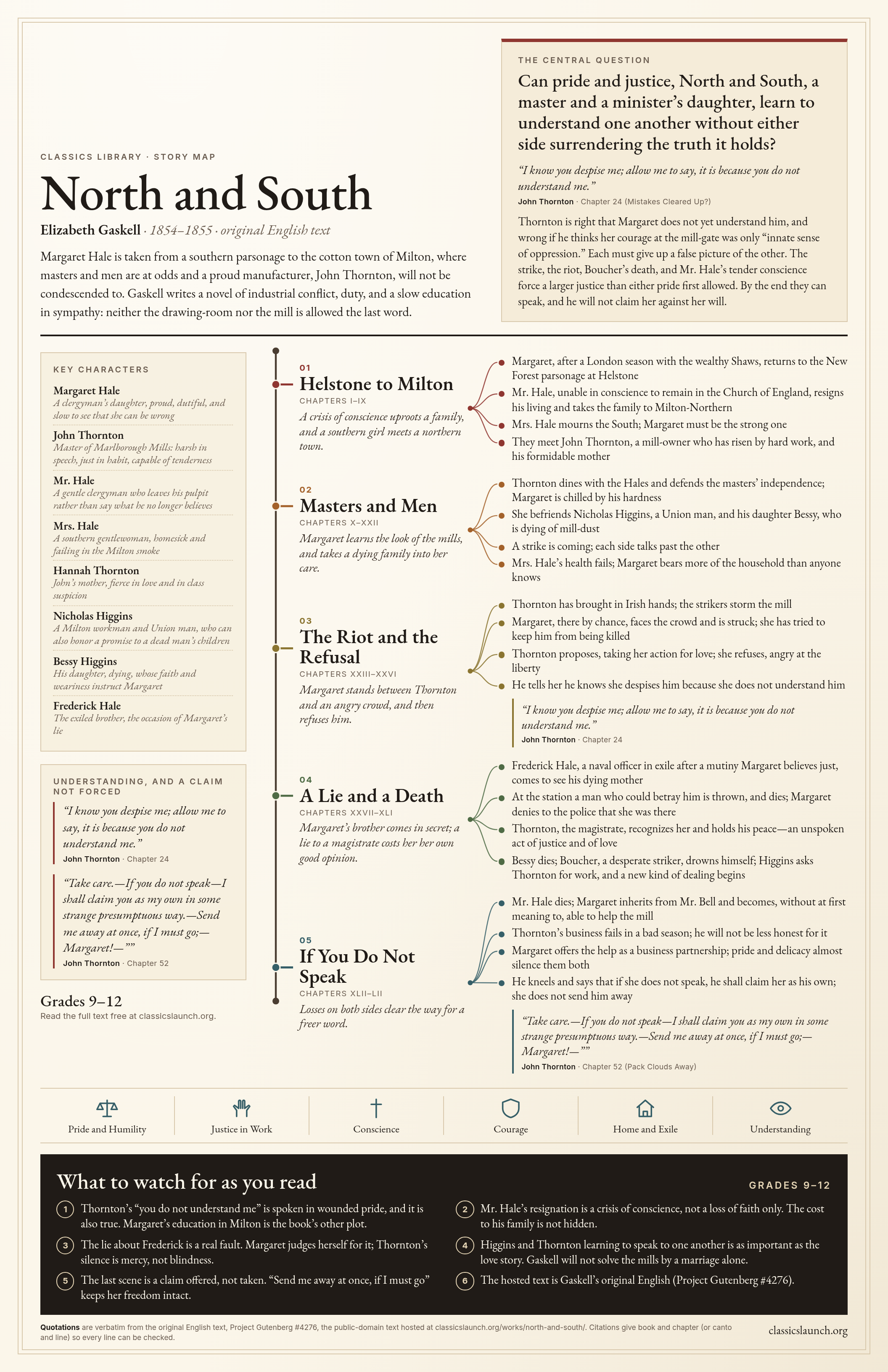
Margaret Hale is taken from a southern parsonage to the cotton town of Milton, where masters and men are at odds and a proud manufacturer, John Thornton, will not be condescended to. Gaskell writes a novel of industrial conflict, duty, and a slow education in sympathy: neither the drawing-room nor the mill is allowed the last word.
The central question
Can pride and justice, North and South, a master and a minister’s daughter, learn to understand one another without either side surrendering the truth it holds?
“I know you despise me; allow me to say, it is because you do not understand me.”
Thornton is right that Margaret does not yet understand him, and wrong if he thinks her courage at the mill-gate was only “innate sense of oppression.” Each must give up a false picture of the other. The strike, the riot, Boucher’s death, and Mr. Hale’s tender conscience force a larger justice than either pride first allowed. By the end they can speak, and he will not claim her against her will.
- 01
Helstone to Milton
Chapters I–IX
A crisis of conscience uproots a family, and a southern girl meets a northern town.
- Margaret, after a London season with the wealthy Shaws, returns to the New Forest parsonage at Helstone
- Mr. Hale, unable in conscience to remain in the Church of England, resigns his living and takes the family to Milton-Northern
- Mrs. Hale mourns the South; Margaret must be the strong one
- They meet John Thornton, a mill-owner who has risen by hard work, and his formidable mother
- 02
Masters and Men
Chapters X–XXII
Margaret learns the look of the mills, and takes a dying family into her care.
- Thornton dines with the Hales and defends the masters’ independence; Margaret is chilled by his hardness
- She befriends Nicholas Higgins, a Union man, and his daughter Bessy, who is dying of mill-dust
- A strike is coming; each side talks past the other
- Mrs. Hale’s health fails; Margaret bears more of the household than anyone knows
- 03
The Riot and the Refusal
Chapters XXIII–XXVI
Margaret stands between Thornton and an angry crowd, and then refuses him.
- Thornton has brought in Irish hands; the strikers storm the mill
- Margaret, there by chance, faces the crowd and is struck; she has tried to keep him from being killed
- Thornton proposes, taking her action for love; she refuses, angry at the liberty
- He tells her he knows she despises him because she does not understand him
“I know you despise me; allow me to say, it is because you do not understand me.”
- 04
A Lie and a Death
Chapters XXVII–XLI
Margaret’s brother comes in secret; a lie to a magistrate costs her her own good opinion.
- Frederick Hale, a naval officer in exile after a mutiny Margaret believes just, comes to see his dying mother
- At the station a man who could betray him is thrown, and dies; Margaret denies to the police that she was there
- Thornton, the magistrate, recognizes her and holds his peace—an unspoken act of justice and of love
- Bessy dies; Boucher, a desperate striker, drowns himself; Higgins asks Thornton for work, and a new kind of dealing begins
- 05
If You Do Not Speak
Chapters XLII–LII
Losses on both sides clear the way for a freer word.
- Mr. Hale dies; Margaret inherits from Mr. Bell and becomes, without at first meaning to, able to help the mill
- Thornton’s business fails in a bad season; he will not be less honest for it
- Margaret offers the help as a business partnership; pride and delicacy almost silence them both
- He kneels and says that if she does not speak, he shall claim her as his own; she does not send him away
“Take care.—If you do not speak—I shall claim you as my own in some strange presumptuous way.—Send me away at once, if I must go;—Margaret!—””
- Pride and Humility
- Justice in Work
- Conscience
- Courage
- Home and Exile
- Understanding
What to watch for as you read
Grades 9–12- Thornton’s “you do not understand me” is spoken in wounded pride, and it is also true. Margaret’s education in Milton is the book’s other plot.
- Mr. Hale’s resignation is a crisis of conscience, not a loss of faith only. The cost to his family is not hidden.
- The lie about Frederick is a real fault. Margaret judges herself for it; Thornton’s silence is mercy, not blindness.
- Higgins and Thornton learning to speak to one another is as important as the love story. Gaskell will not solve the mills by a marriage alone.
- The last scene is a claim offered, not taken. “Send me away at once, if I must go” keeps her freedom intact.
- The hosted text is Gaskell’s original English (Project Gutenberg #4276).
Every quotation is word for word from the original English text hosted in this library and is checked against that text each time the site is built. Citations give book and chapter (or canto and line).