Story maps · Grades 9–12
Northanger Abbey: A Story Map
The PDF is one tabloid page (11 × 17 in). On letter paper, choose “Fit to page.”
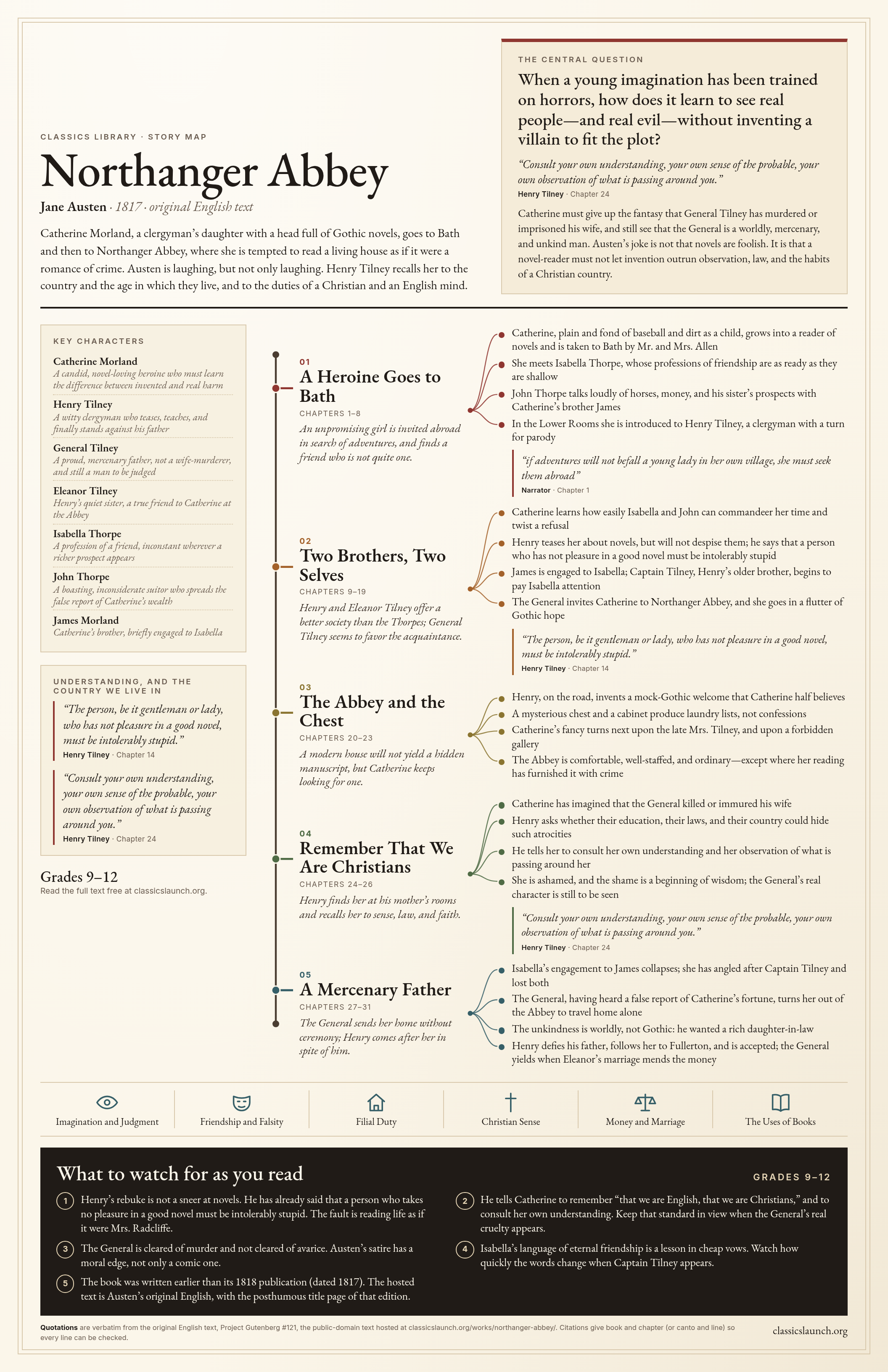
Catherine Morland, a clergyman’s daughter with a head full of Gothic novels, goes to Bath and then to Northanger Abbey, where she is tempted to read a living house as if it were a romance of crime. Austen is laughing, but not only laughing. Henry Tilney recalls her to the country and the age in which they live, and to the duties of a Christian and an English mind.
The central question
When a young imagination has been trained on horrors, how does it learn to see real people—and real evil—without inventing a villain to fit the plot?
“Consult your own understanding, your own sense of the probable, your own observation of what is passing around you.”
Catherine must give up the fantasy that General Tilney has murdered or imprisoned his wife, and still see that the General is a worldly, mercenary, and unkind man. Austen’s joke is not that novels are foolish. It is that a novel-reader must not let invention outrun observation, law, and the habits of a Christian country.
- 01
A Heroine Goes to Bath
Chapters 1–8
An unpromising girl is invited abroad in search of adventures, and finds a friend who is not quite one.
- Catherine, plain and fond of baseball and dirt as a child, grows into a reader of novels and is taken to Bath by Mr. and Mrs. Allen
- She meets Isabella Thorpe, whose professions of friendship are as ready as they are shallow
- John Thorpe talks loudly of horses, money, and his sister’s prospects with Catherine’s brother James
- In the Lower Rooms she is introduced to Henry Tilney, a clergyman with a turn for parody
“if adventures will not befall a young lady in her own village, she must seek them abroad”
- 02
Two Brothers, Two Selves
Chapters 9–19
Henry and Eleanor Tilney offer a better society than the Thorpes; General Tilney seems to favor the acquaintance.
- Catherine learns how easily Isabella and John can commandeer her time and twist a refusal
- Henry teases her about novels, but will not despise them; he says that a person who has not pleasure in a good novel must be intolerably stupid
- James is engaged to Isabella; Captain Tilney, Henry’s older brother, begins to pay Isabella attention
- The General invites Catherine to Northanger Abbey, and she goes in a flutter of Gothic hope
“The person, be it gentleman or lady, who has not pleasure in a good novel, must be intolerably stupid.”
- 03
The Abbey and the Chest
Chapters 20–23
A modern house will not yield a hidden manuscript, but Catherine keeps looking for one.
- Henry, on the road, invents a mock-Gothic welcome that Catherine half believes
- A mysterious chest and a cabinet produce laundry lists, not confessions
- Catherine’s fancy turns next upon the late Mrs. Tilney, and upon a forbidden gallery
- The Abbey is comfortable, well-staffed, and ordinary—except where her reading has furnished it with crime
- 04
Remember That We Are Christians
Chapters 24–26
Henry finds her at his mother’s rooms and recalls her to sense, law, and faith.
- Catherine has imagined that the General killed or immured his wife
- Henry asks whether their education, their laws, and their country could hide such atrocities
- He tells her to consult her own understanding and her observation of what is passing around her
- She is ashamed, and the shame is a beginning of wisdom; the General’s real character is still to be seen
“Consult your own understanding, your own sense of the probable, your own observation of what is passing around you.”
- 05
A Mercenary Father
Chapters 27–31
The General sends her home without ceremony; Henry comes after her in spite of him.
- Isabella’s engagement to James collapses; she has angled after Captain Tilney and lost both
- The General, having heard a false report of Catherine’s fortune, turns her out of the Abbey to travel home alone
- The unkindness is worldly, not Gothic: he wanted a rich daughter-in-law
- Henry defies his father, follows her to Fullerton, and is accepted; the General yields when Eleanor’s marriage mends the money
- Imagination and Judgment
- Friendship and Falsity
- Filial Duty
- Christian Sense
- Money and Marriage
- The Uses of Books
What to watch for as you read
Grades 9–12- Henry’s rebuke is not a sneer at novels. He has already said that a person who takes no pleasure in a good novel must be intolerably stupid. The fault is reading life as if it were Mrs. Radcliffe.
- He tells Catherine to remember “that we are English, that we are Christians,” and to consult her own understanding. Keep that standard in view when the General’s real cruelty appears.
- The General is cleared of murder and not cleared of avarice. Austen’s satire has a moral edge, not only a comic one.
- Isabella’s language of eternal friendship is a lesson in cheap vows. Watch how quickly the words change when Captain Tilney appears.
- The book was written earlier than its 1818 publication (dated 1817). The hosted text is Austen’s original English, with the posthumous title page of that edition.
Every quotation is word for word from the original English text hosted in this library and is checked against that text each time the site is built. Citations give book and chapter (or canto and line).