Story maps · Grades 11–12
Orlando: A Biography: A Story Map
The PDF is one tabloid page (11 × 17 in). On letter paper, choose “Fit to page.”
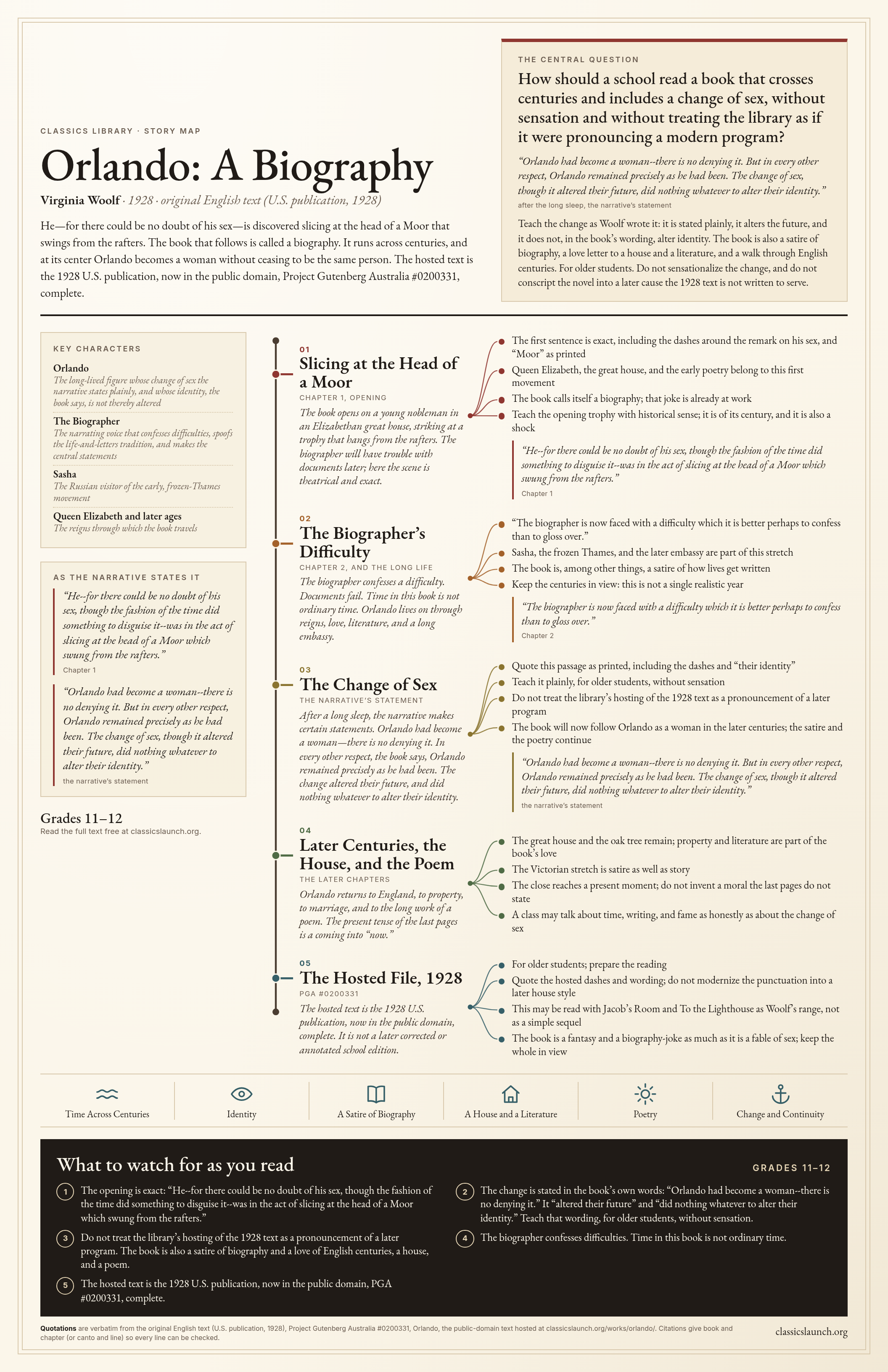
He—for there could be no doubt of his sex—is discovered slicing at the head of a Moor that swings from the rafters. The book that follows is called a biography. It runs across centuries, and at its center Orlando becomes a woman without ceasing to be the same person. The hosted text is the 1928 U.S. publication, now in the public domain, Project Gutenberg Australia #0200331, complete.
The central question
How should a school read a book that crosses centuries and includes a change of sex, without sensation and without treating the library as if it were pronouncing a modern program?
“Orlando had become a woman--there is no denying it. But in every other respect, Orlando remained precisely as he had been. The change of sex, though it altered their future, did nothing whatever to alter their identity.”
Teach the change as Woolf wrote it: it is stated plainly, it alters the future, and it does not, in the book’s wording, alter identity. The book is also a satire of biography, a love letter to a house and a literature, and a walk through English centuries. For older students. Do not sensationalize the change, and do not conscript the novel into a later cause the 1928 text is not written to serve.
- 01
Slicing at the Head of a Moor
Chapter 1, opening
The book opens on a young nobleman in an Elizabethan great house, striking at a trophy that hangs from the rafters. The biographer will have trouble with documents later; here the scene is theatrical and exact.
- The first sentence is exact, including the dashes around the remark on his sex, and “Moor” as printed
- Queen Elizabeth, the great house, and the early poetry belong to this first movement
- The book calls itself a biography; that joke is already at work
- Teach the opening trophy with historical sense; it is of its century, and it is also a shock
“He--for there could be no doubt of his sex, though the fashion of the time did something to disguise it--was in the act of slicing at the head of a Moor which swung from the rafters.”
- 02
The Biographer’s Difficulty
Chapter 2, and the long life
The biographer confesses a difficulty. Documents fail. Time in this book is not ordinary time. Orlando lives on through reigns, love, literature, and a long embassy.
- “The biographer is now faced with a difficulty which it is better perhaps to confess than to gloss over.”
- Sasha, the frozen Thames, and the later embassy are part of this stretch
- The book is, among other things, a satire of how lives get written
- Keep the centuries in view: this is not a single realistic year
“The biographer is now faced with a difficulty which it is better perhaps to confess than to gloss over.”
- 03
The Change of Sex
The narrative’s statement
After a long sleep, the narrative makes certain statements. Orlando had become a woman—there is no denying it. In every other respect, the book says, Orlando remained precisely as he had been. The change altered their future, and did nothing whatever to alter their identity.
- Quote this passage as printed, including the dashes and “their identity”
- Teach it plainly, for older students, without sensation
- Do not treat the library’s hosting of the 1928 text as a pronouncement of a later program
- The book will now follow Orlando as a woman in the later centuries; the satire and the poetry continue
“Orlando had become a woman--there is no denying it. But in every other respect, Orlando remained precisely as he had been. The change of sex, though it altered their future, did nothing whatever to alter their identity.”
- 04
Later Centuries, the House, and the Poem
The later chapters
Orlando returns to England, to property, to marriage, and to the long work of a poem. The present tense of the last pages is a coming into “now.”
- The great house and the oak tree remain; property and literature are part of the book’s love
- The Victorian stretch is satire as well as story
- The close reaches a present moment; do not invent a moral the last pages do not state
- A class may talk about time, writing, and fame as honestly as about the change of sex
- 05
The Hosted File, 1928
PGA #0200331
The hosted text is the 1928 U.S. publication, now in the public domain, complete. It is not a later corrected or annotated school edition.
- For older students; prepare the reading
- Quote the hosted dashes and wording; do not modernize the punctuation into a later house style
- This may be read with Jacob’s Room and To the Lighthouse as Woolf’s range, not as a simple sequel
- The book is a fantasy and a biography-joke as much as it is a fable of sex; keep the whole in view
- Time Across Centuries
- Identity
- A Satire of Biography
- A House and a Literature
- Poetry
- Change and Continuity
What to watch for as you read
Grades 11–12- The opening is exact: “He--for there could be no doubt of his sex, though the fashion of the time did something to disguise it--was in the act of slicing at the head of a Moor which swung from the rafters.”
- The change is stated in the book’s own words: “Orlando had become a woman--there is no denying it.” It “altered their future” and “did nothing whatever to alter their identity.” Teach that wording, for older students, without sensation.
- Do not treat the library’s hosting of the 1928 text as a pronouncement of a later program. The book is also a satire of biography and a love of English centuries, a house, and a poem.
- The biographer confesses difficulties. Time in this book is not ordinary time.
- The hosted text is the 1928 U.S. publication, now in the public domain, PGA #0200331, complete.
Every quotation is word for word from the original English text (U.S. publication, 1928) hosted in this library and is checked against that text each time the site is built. Citations give book and chapter (or canto and line).