Story maps · Grades 9–12
Journeys in Diverse Places: A Story Map
The PDF is one tabloid page (11 × 17 in). On letter paper, choose “Fit to page.”
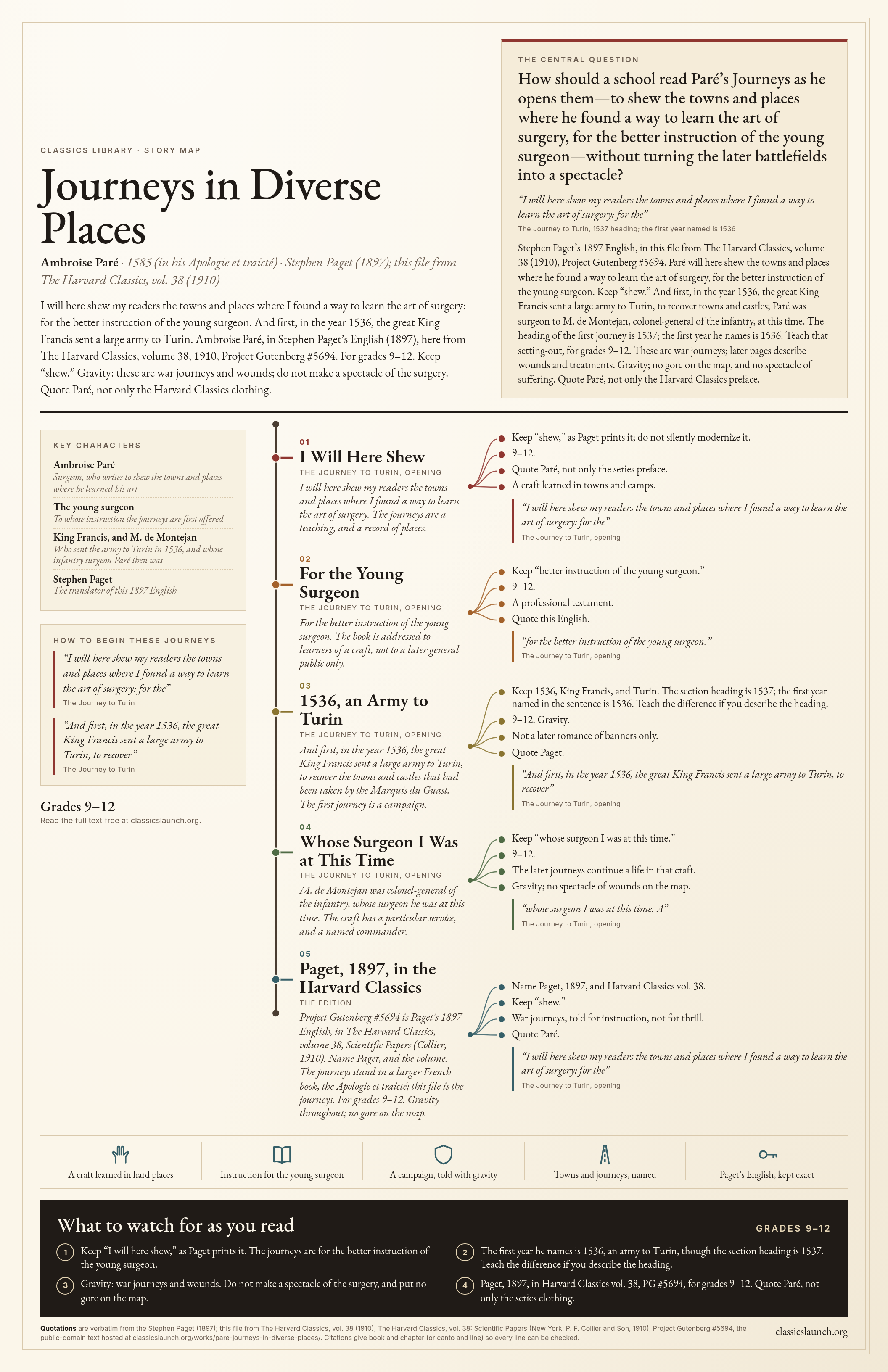
I will here shew my readers the towns and places where I found a way to learn the art of surgery: for the better instruction of the young surgeon. And first, in the year 1536, the great King Francis sent a large army to Turin. Ambroise Paré, in Stephen Paget’s English (1897), here from The Harvard Classics, volume 38, 1910, Project Gutenberg #5694. For grades 9–12. Keep “shew.” Gravity: these are war journeys and wounds; do not make a spectacle of the surgery. Quote Paré, not only the Harvard Classics clothing.
The central question
How should a school read Paré’s Journeys as he opens them—to shew the towns and places where he found a way to learn the art of surgery, for the better instruction of the young surgeon—without turning the later battlefields into a spectacle?
“I will here shew my readers the towns and places where I found a way to learn the art of surgery: for the”
Stephen Paget’s 1897 English, in this file from The Harvard Classics, volume 38 (1910), Project Gutenberg #5694. Paré will here shew the towns and places where he found a way to learn the art of surgery, for the better instruction of the young surgeon. Keep “shew.” And first, in the year 1536, the great King Francis sent a large army to Turin, to recover towns and castles; Paré was surgeon to M. de Montejan, colonel-general of the infantry, at this time. The heading of the first journey is 1537; the first year he names is 1536. Teach that setting-out, for grades 9–12. These are war journeys; later pages describe wounds and treatments. Gravity; no gore on the map, and no spectacle of suffering. Quote Paré, not only the Harvard Classics preface.
- 01
I Will Here Shew
The Journey to Turin, opening
I will here shew my readers the towns and places where I found a way to learn the art of surgery. The journeys are a teaching, and a record of places.
- Keep “shew,” as Paget prints it; do not silently modernize it.
- 9–12.
- Quote Paré, not only the series preface.
- A craft learned in towns and camps.
“I will here shew my readers the towns and places where I found a way to learn the art of surgery: for the”
- 02
For the Young Surgeon
The Journey to Turin, opening
For the better instruction of the young surgeon. The book is addressed to learners of a craft, not to a later general public only.
- Keep “better instruction of the young surgeon.”
- 9–12.
- A professional testament.
- Quote this English.
“for the better instruction of the young surgeon.”
- 03
1536, an Army to Turin
The Journey to Turin, opening
And first, in the year 1536, the great King Francis sent a large army to Turin, to recover the towns and castles that had been taken by the Marquis du Guast. The first journey is a campaign.
- Keep 1536, King Francis, and Turin. The section heading is 1537; the first year named in the sentence is 1536. Teach the difference if you describe the heading.
- 9–12. Gravity.
- Not a later romance of banners only.
- Quote Paget.
“And first, in the year 1536, the great King Francis sent a large army to Turin, to recover”
- 04
Whose Surgeon I Was at This Time
The Journey to Turin, opening
M. de Montejan was colonel-general of the infantry, whose surgeon he was at this time. The craft has a particular service, and a named commander.
- Keep “whose surgeon I was at this time.”
- 9–12.
- The later journeys continue a life in that craft.
- Gravity; no spectacle of wounds on the map.
“whose surgeon I was at this time. A”
- 05
Paget, 1897, in the Harvard Classics
The edition
Project Gutenberg #5694 is Paget’s 1897 English, in The Harvard Classics, volume 38, Scientific Papers (Collier, 1910). Name Paget, and the volume. The journeys stand in a larger French book, the Apologie et traicté; this file is the journeys. For grades 9–12. Gravity throughout; no gore on the map.
- Name Paget, 1897, and Harvard Classics vol. 38.
- Keep “shew.”
- War journeys, told for instruction, not for thrill.
- Quote Paré.
“I will here shew my readers the towns and places where I found a way to learn the art of surgery: for the”
- A craft learned in hard places
- Instruction for the young surgeon
- A campaign, told with gravity
- Towns and journeys, named
- Paget’s English, kept exact
What to watch for as you read
Grades 9–12- Keep “I will here shew,” as Paget prints it. The journeys are for the better instruction of the young surgeon.
- The first year he names is 1536, an army to Turin, though the section heading is 1537. Teach the difference if you describe the heading.
- Gravity: war journeys and wounds. Do not make a spectacle of the surgery, and put no gore on the map.
- Paget, 1897, in Harvard Classics vol. 38, PG #5694, for grades 9–12. Quote Paré, not only the series clothing.
Every quotation is word for word from the Stephen Paget (1897); this file from The Harvard Classics, vol. 38 (1910) hosted in this library and is checked against that text each time the site is built. Citations give book and chapter (or canto and line).