Story maps · Grades 11–12
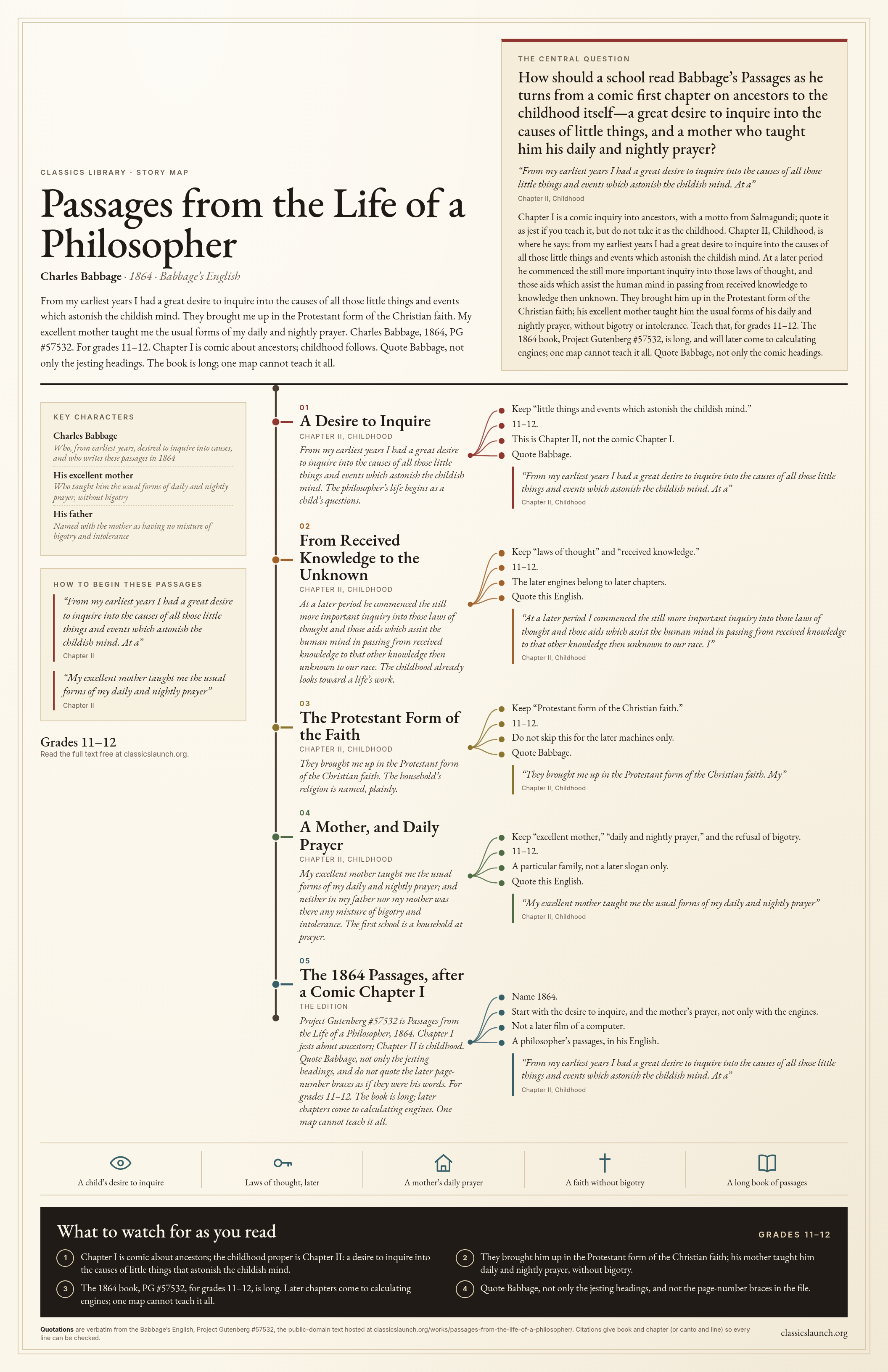
Passages from the Life of a Philosopher: A Story Map
The PDF is one tabloid page (11 × 17 in). On letter paper, choose “Fit to page.”
From my earliest years I had a great desire to inquire into the causes of all those little things and events which astonish the childish mind. They brought me up in the Protestant form of the Christian faith. My excellent mother taught me the usual forms of my daily and nightly prayer. Charles Babbage, 1864, PG #57532. For grades 11–12. Chapter I is comic about ancestors; childhood follows. Quote Babbage, not only the jesting headings. The book is long; one map cannot teach it all.
The central question
How should a school read Babbage’s Passages as he turns from a comic first chapter on ancestors to the childhood itself—a great desire to inquire into the causes of little things, and a mother who taught him his daily and nightly prayer?
“From my earliest years I had a great desire to inquire into the causes of all those little things and events which astonish the childish mind. At a”
Chapter I is a comic inquiry into ancestors, with a motto from Salmagundi; quote it as jest if you teach it, but do not take it as the childhood. Chapter II, Childhood, is where he says: from my earliest years I had a great desire to inquire into the causes of all those little things and events which astonish the childish mind. At a later period he commenced the still more important inquiry into those laws of thought, and those aids which assist the human mind in passing from received knowledge to knowledge then unknown. They brought him up in the Protestant form of the Christian faith; his excellent mother taught him the usual forms of his daily and nightly prayer, without bigotry or intolerance. Teach that, for grades 11–12. The 1864 book, Project Gutenberg #57532, is long, and will later come to calculating engines; one map cannot teach it all. Quote Babbage, not only the comic headings.
- 01
A Desire to Inquire
Chapter II, Childhood
From my earliest years I had a great desire to inquire into the causes of all those little things and events which astonish the childish mind. The philosopher’s life begins as a child’s questions.
- Keep “little things and events which astonish the childish mind.”
- 11–12.
- This is Chapter II, not the comic Chapter I.
- Quote Babbage.
“From my earliest years I had a great desire to inquire into the causes of all those little things and events which astonish the childish mind. At a”
- 02
From Received Knowledge to the Unknown
Chapter II, Childhood
At a later period he commenced the still more important inquiry into those laws of thought and those aids which assist the human mind in passing from received knowledge to that other knowledge then unknown to our race. The childhood already looks toward a life’s work.
- Keep “laws of thought” and “received knowledge.”
- 11–12.
- The later engines belong to later chapters.
- Quote this English.
“At a later period I commenced the still more important inquiry into those laws of thought and those aids which assist the human mind in passing from received knowledge to that other knowledge then unknown to our race. I”
- 03
The Protestant Form of the Faith
Chapter II, Childhood
They brought me up in the Protestant form of the Christian faith. The household’s religion is named, plainly.
- Keep “Protestant form of the Christian faith.”
- 11–12.
- Do not skip this for the later machines only.
- Quote Babbage.
“They brought me up in the Protestant form of the Christian faith. My”
- 04
A Mother, and Daily Prayer
Chapter II, Childhood
My excellent mother taught me the usual forms of my daily and nightly prayer; and neither in my father nor my mother was there any mixture of bigotry and intolerance. The first school is a household at prayer.
- Keep “excellent mother,” “daily and nightly prayer,” and the refusal of bigotry.
- 11–12.
- A particular family, not a later slogan only.
- Quote this English.
“My excellent mother taught me the usual forms of my daily and nightly prayer”
- 05
The 1864 Passages, after a Comic Chapter I
The edition
Project Gutenberg #57532 is Passages from the Life of a Philosopher, 1864. Chapter I jests about ancestors; Chapter II is childhood. Quote Babbage, not only the jesting headings, and do not quote the later page-number braces as if they were his words. For grades 11–12. The book is long; later chapters come to calculating engines. One map cannot teach it all.
- Name 1864.
- Start with the desire to inquire, and the mother’s prayer, not only with the engines.
- Not a later film of a computer.
- A philosopher’s passages, in his English.
“From my earliest years I had a great desire to inquire into the causes of all those little things and events which astonish the childish mind. At a”
- A child’s desire to inquire
- Laws of thought, later
- A mother’s daily prayer
- A faith without bigotry
- A long book of passages
What to watch for as you read
Grades 11–12- Chapter I is comic about ancestors; the childhood proper is Chapter II: a desire to inquire into the causes of little things that astonish the childish mind.
- They brought him up in the Protestant form of the Christian faith; his mother taught him daily and nightly prayer, without bigotry.
- The 1864 book, PG #57532, for grades 11–12, is long. Later chapters come to calculating engines; one map cannot teach it all.
- Quote Babbage, not only the jesting headings, and not the page-number braces in the file.
Every quotation is word for word from the Babbage’s English hosted in this library and is checked against that text each time the site is built. Citations give book and chapter (or canto and line).