Story maps · Grades 10–12
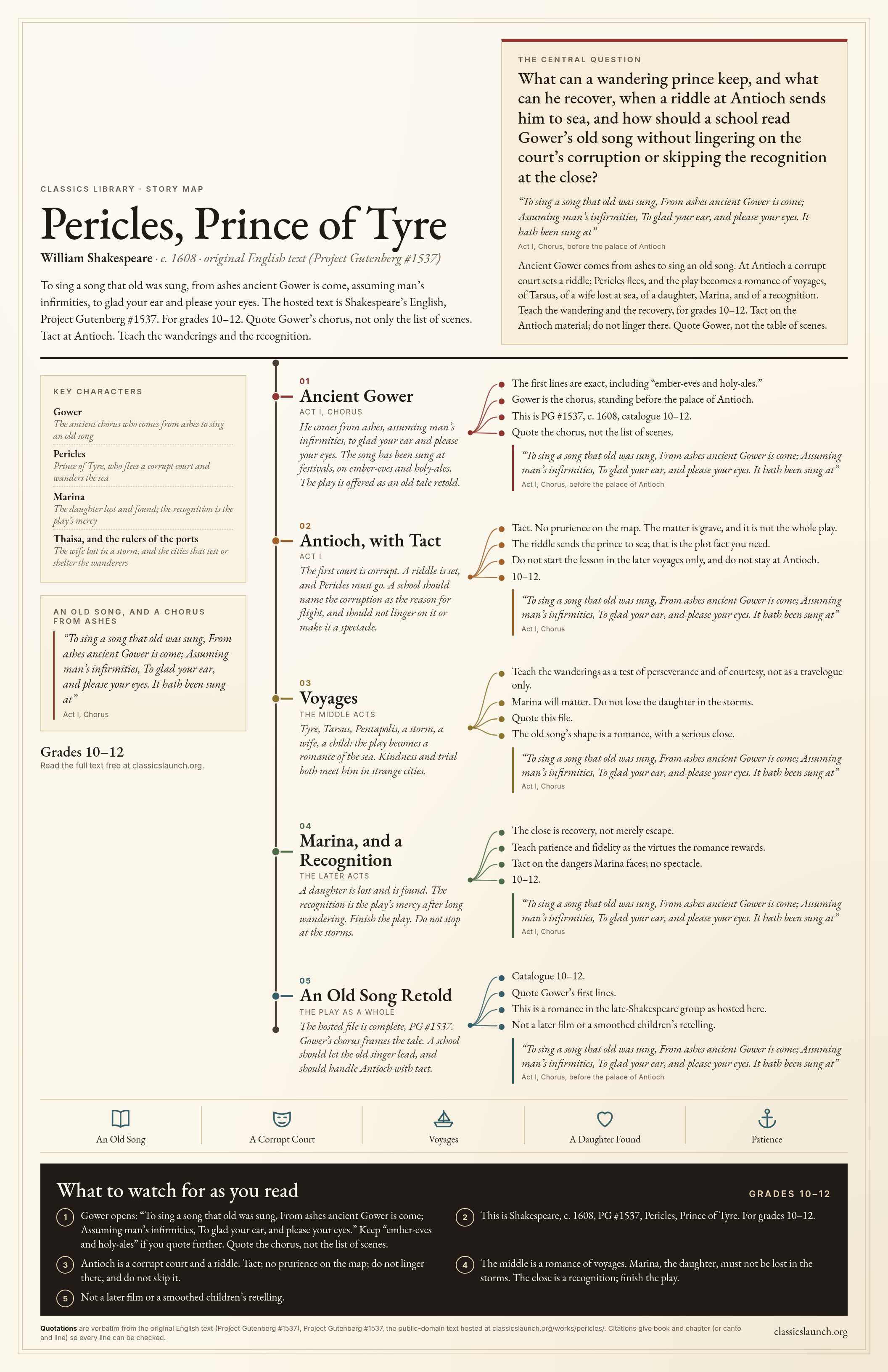
Pericles, Prince of Tyre: A Story Map
The PDF is one tabloid page (11 × 17 in). On letter paper, choose “Fit to page.”
To sing a song that old was sung, from ashes ancient Gower is come, assuming man’s infirmities, to glad your ear and please your eyes. The hosted text is Shakespeare’s English, Project Gutenberg #1537. For grades 10–12. Quote Gower’s chorus, not only the list of scenes. Tact at Antioch. Teach the wanderings and the recognition.
The central question
What can a wandering prince keep, and what can he recover, when a riddle at Antioch sends him to sea, and how should a school read Gower’s old song without lingering on the court’s corruption or skipping the recognition at the close?
“To sing a song that old was sung, From ashes ancient Gower is come; Assuming man’s infirmities, To glad your ear, and please your eyes. It hath been sung at”
Ancient Gower comes from ashes to sing an old song. At Antioch a corrupt court sets a riddle; Pericles flees, and the play becomes a romance of voyages, of Tarsus, of a wife lost at sea, of a daughter, Marina, and of a recognition. Teach the wandering and the recovery, for grades 10–12. Tact on the Antioch material; do not linger there. Quote Gower, not the table of scenes.
- 01
Ancient Gower
Act I, Chorus
He comes from ashes, assuming man’s infirmities, to glad your ear and please your eyes. The song has been sung at festivals, on ember-eves and holy-ales. The play is offered as an old tale retold.
- The first lines are exact, including “ember-eves and holy-ales.”
- Gower is the chorus, standing before the palace of Antioch.
- This is PG #1537, c. 1608, catalogue 10–12.
- Quote the chorus, not the list of scenes.
“To sing a song that old was sung, From ashes ancient Gower is come; Assuming man’s infirmities, To glad your ear, and please your eyes. It hath been sung at”
- 02
Antioch, with Tact
Act I
The first court is corrupt. A riddle is set, and Pericles must go. A school should name the corruption as the reason for flight, and should not linger on it or make it a spectacle.
- Tact. No prurience on the map. The matter is grave, and it is not the whole play.
- The riddle sends the prince to sea; that is the plot fact you need.
- Do not start the lesson in the later voyages only, and do not stay at Antioch.
- 10–12.
“To sing a song that old was sung, From ashes ancient Gower is come; Assuming man’s infirmities, To glad your ear, and please your eyes. It hath been sung at”
- 03
Voyages
The middle acts
Tyre, Tarsus, Pentapolis, a storm, a wife, a child: the play becomes a romance of the sea. Kindness and trial both meet him in strange cities.
- Teach the wanderings as a test of perseverance and of courtesy, not as a travelogue only.
- Marina will matter. Do not lose the daughter in the storms.
- Quote this file.
- The old song’s shape is a romance, with a serious close.
“To sing a song that old was sung, From ashes ancient Gower is come; Assuming man’s infirmities, To glad your ear, and please your eyes. It hath been sung at”
- 04
Marina, and a Recognition
The later acts
A daughter is lost and is found. The recognition is the play’s mercy after long wandering. Finish the play. Do not stop at the storms.
- The close is recovery, not merely escape.
- Teach patience and fidelity as the virtues the romance rewards.
- Tact on the dangers Marina faces; no spectacle.
- 10–12.
“To sing a song that old was sung, From ashes ancient Gower is come; Assuming man’s infirmities, To glad your ear, and please your eyes. It hath been sung at”
- 05
An Old Song Retold
The play as a whole
The hosted file is complete, PG #1537. Gower’s chorus frames the tale. A school should let the old singer lead, and should handle Antioch with tact.
- Catalogue 10–12.
- Quote Gower’s first lines.
- This is a romance in the late-Shakespeare group as hosted here.
- Not a later film or a smoothed children’s retelling.
“To sing a song that old was sung, From ashes ancient Gower is come; Assuming man’s infirmities, To glad your ear, and please your eyes. It hath been sung at”
- An Old Song
- A Corrupt Court
- Voyages
- A Daughter Found
- Patience
What to watch for as you read
Grades 10–12- Gower opens: “To sing a song that old was sung, From ashes ancient Gower is come; Assuming man’s infirmities, To glad your ear, and please your eyes.” Keep “ember-eves and holy-ales” if you quote further. Quote the chorus, not the list of scenes.
- This is Shakespeare, c. 1608, PG #1537, Pericles, Prince of Tyre. For grades 10–12.
- Antioch is a corrupt court and a riddle. Tact; no prurience on the map; do not linger there, and do not skip it.
- The middle is a romance of voyages. Marina, the daughter, must not be lost in the storms. The close is a recognition; finish the play.
- Not a later film or a smoothed children’s retelling.
Every quotation is word for word from the original English text (Project Gutenberg #1537) hosted in this library and is checked against that text each time the site is built. Citations give book and chapter (or canto and line).