Story maps · Grades 10–12
Phantastes: A Faerie Romance for Men and Women: A Story Map
The PDF is one tabloid page (11 × 17 in). On letter paper, choose “Fit to page.”
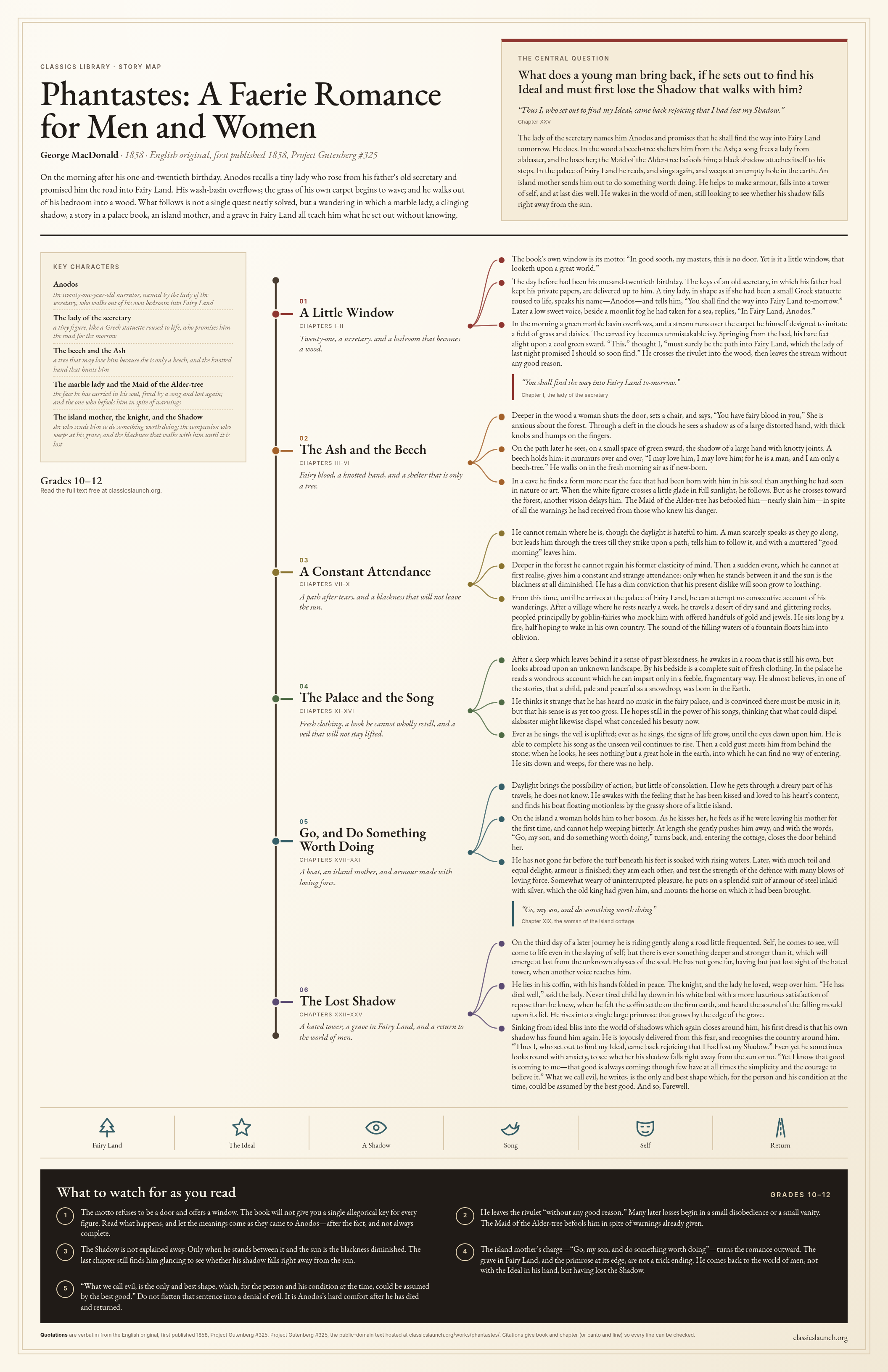
On the morning after his one-and-twentieth birthday, Anodos recalls a tiny lady who rose from his father's old secretary and promised him the road into Fairy Land. His wash-basin overflows; the grass of his own carpet begins to wave; and he walks out of his bedroom into a wood. What follows is not a single quest neatly solved, but a wandering in which a marble lady, a clinging shadow, a story in a palace book, an island mother, and a grave in Fairy Land all teach him what he set out without knowing.
The central question
What does a young man bring back, if he sets out to find his Ideal and must first lose the Shadow that walks with him?
“Thus I, who set out to find my Ideal, came back rejoicing that I had lost my Shadow.”
The lady of the secretary names him Anodos and promises that he shall find the way into Fairy Land tomorrow. He does. In the wood a beech-tree shelters him from the Ash; a song frees a lady from alabaster, and he loses her; the Maid of the Alder-tree befools him; a black shadow attaches itself to his steps. In the palace of Fairy Land he reads, and sings again, and weeps at an empty hole in the earth. An island mother sends him out to do something worth doing. He helps to make armour, falls into a tower of self, and at last dies well. He wakes in the world of men, still looking to see whether his shadow falls right away from the sun.
- 01
A Little Window
Chapters I–II
Twenty-one, a secretary, and a bedroom that becomes a wood.
- The book's own window is its motto: “In good sooth, my masters, this is no door. Yet is it a little window, that looketh upon a great world.”
- The day before had been his one-and-twentieth birthday. The keys of an old secretary, in which his father had kept his private papers, are delivered up to him. A tiny lady, in shape as if she had been a small Greek statuette roused to life, speaks his name—Anodos—and tells him, “You shall find the way into Fairy Land to-morrow.” Later a low sweet voice, beside a moonlit fog he had taken for a sea, replies, “In Fairy Land, Anodos.”
- In the morning a green marble basin overflows, and a stream runs over the carpet he himself designed to imitate a field of grass and daisies. The carved ivy becomes unmistakable ivy. Springing from the bed, his bare feet alight upon a cool green sward. “This,” thought I, “must surely be the path into Fairy Land, which the lady of last night promised I should so soon find.” He crosses the rivulet into the wood, then leaves the stream without any good reason.
“You shall find the way into Fairy Land to-morrow.”
- 02
The Ash and the Beech
Chapters III–VI
Fairy blood, a knotted hand, and a shelter that is only a tree.
- Deeper in the wood a woman shuts the door, sets a chair, and says, “You have fairy blood in you,” She is anxious about the forest. Through a cleft in the clouds he sees a shadow as of a large distorted hand, with thick knobs and humps on the fingers.
- On the path later he sees, on a small space of green sward, the shadow of a large hand with knotty joints. A beech holds him: it murmurs over and over, “I may love him, I may love him; for he is a man, and I am only a beech-tree.” He walks on in the fresh morning air as if new-born.
- In a cave he finds a form more near the face that had been born with him in his soul than anything he had seen in nature or art. When the white figure crosses a little glade in full sunlight, he follows. But as he crosses toward the forest, another vision delays him. The Maid of the Alder-tree has befooled him—nearly slain him—in spite of all the warnings he had received from those who knew his danger.
- 03
A Constant Attendance
Chapters VII–X
A path after tears, and a blackness that will not leave the sun.
- He cannot remain where he is, though the daylight is hateful to him. A man scarcely speaks as they go along, but leads him through the trees till they strike upon a path, tells him to follow it, and with a muttered “good morning” leaves him.
- Deeper in the forest he cannot regain his former elasticity of mind. Then a sudden event, which he cannot at first realise, gives him a constant and strange attendance: only when he stands between it and the sun is the blackness at all diminished. He has a dim conviction that his present dislike will soon grow to loathing.
- From this time, until he arrives at the palace of Fairy Land, he can attempt no consecutive account of his wanderings. After a village where he rests nearly a week, he travels a desert of dry sand and glittering rocks, peopled principally by goblin-fairies who mock him with offered handfuls of gold and jewels. He sits long by a fire, half hoping to wake in his own country. The sound of the falling waters of a fountain floats him into oblivion.
- 04
The Palace and the Song
Chapters XI–XVI
Fresh clothing, a book he cannot wholly retell, and a veil that will not stay lifted.
- After a sleep which leaves behind it a sense of past blessedness, he awakes in a room that is still his own, but looks abroad upon an unknown landscape. By his bedside is a complete suit of fresh clothing. In the palace he reads a wondrous account which he can impart only in a feeble, fragmentary way. He almost believes, in one of the stories, that a child, pale and peaceful as a snowdrop, was born in the Earth.
- He thinks it strange that he has heard no music in the fairy palace, and is convinced there must be music in it, but that his sense is as yet too gross. He hopes still in the power of his songs, thinking that what could dispel alabaster might likewise dispel what concealed his beauty now.
- Ever as he sings, the veil is uplifted; ever as he sings, the signs of life grow, until the eyes dawn upon him. He is able to complete his song as the unseen veil continues to rise. Then a cold gust meets him from behind the stone; when he looks, he sees nothing but a great hole in the earth, into which he can find no way of entering. He sits down and weeps, for there was no help.
- 05
Go, and Do Something Worth Doing
Chapters XVII–XXI
A boat, an island mother, and armour made with loving force.
- Daylight brings the possibility of action, but little of consolation. How he gets through a dreary part of his travels, he does not know. He awakes with the feeling that he has been kissed and loved to his heart’s content, and finds his boat floating motionless by the grassy shore of a little island.
- On the island a woman holds him to her bosom. As he kisses her, he feels as if he were leaving his mother for the first time, and cannot help weeping bitterly. At length she gently pushes him away, and with the words, “Go, my son, and do something worth doing,” turns back, and, entering the cottage, closes the door behind her.
- He has not gone far before the turf beneath his feet is soaked with rising waters. Later, with much toil and equal delight, armour is finished; they arm each other, and test the strength of the defence with many blows of loving force. Somewhat weary of uninterrupted pleasure, he puts on a splendid suit of armour of steel inlaid with silver, which the old king had given him, and mounts the horse on which it had been brought.
“Go, my son, and do something worth doing”
- 06
The Lost Shadow
Chapters XXII–XXV
A hated tower, a grave in Fairy Land, and a return to the world of men.
- On the third day of a later journey he is riding gently along a road little frequented. Self, he comes to see, will come to life even in the slaying of self; but there is ever something deeper and stronger than it, which will emerge at last from the unknown abysses of the soul. He has not gone far, having but just lost sight of the hated tower, when another voice reaches him.
- He lies in his coffin, with his hands folded in peace. The knight, and the lady he loved, weep over him. “He has died well,” said the lady. Never tired child lay down in his white bed with a more luxurious satisfaction of repose than he knew, when he felt the coffin settle on the firm earth, and heard the sound of the falling mould upon its lid. He rises into a single large primrose that grows by the edge of the grave.
- Sinking from ideal bliss into the world of shadows which again closes around him, his first dread is that his own shadow has found him again. He is joyously delivered from this fear, and recognises the country around him. “Thus I, who set out to find my Ideal, came back rejoicing that I had lost my Shadow.” Even yet he sometimes looks round with anxiety, to see whether his shadow falls right away from the sun or no. “Yet I know that good is coming to me—that good is always coming; though few have at all times the simplicity and the courage to believe it.” What we call evil, he writes, is the only and best shape which, for the person and his condition at the time, could be assumed by the best good. And so, Farewell.
- Fairy Land
- The Ideal
- A Shadow
- Song
- Self
- Return
What to watch for as you read
Grades 10–12- The motto refuses to be a door and offers a window. The book will not give you a single allegorical key for every figure. Read what happens, and let the meanings come as they came to Anodos—after the fact, and not always complete.
- He leaves the rivulet “without any good reason.” Many later losses begin in a small disobedience or a small vanity. The Maid of the Alder-tree befools him in spite of warnings already given.
- The Shadow is not explained away. Only when he stands between it and the sun is the blackness diminished. The last chapter still finds him glancing to see whether his shadow falls right away from the sun.
- The island mother’s charge—“Go, my son, and do something worth doing”—turns the romance outward. The grave in Fairy Land, and the primrose at its edge, are not a trick ending. He comes back to the world of men, not with the Ideal in his hand, but having lost the Shadow.
- “What we call evil, is the only and best shape, which, for the person and his condition at the time, could be assumed by the best good.” Do not flatten that sentence into a denial of evil. It is Anodos’s hard comfort after he has died and returned.
Every quotation is word for word from the English original, first published 1858, Project Gutenberg #325 hosted in this library and is checked against that text each time the site is built. Citations give book and chapter (or canto and line).