Story maps · Grades 11–12
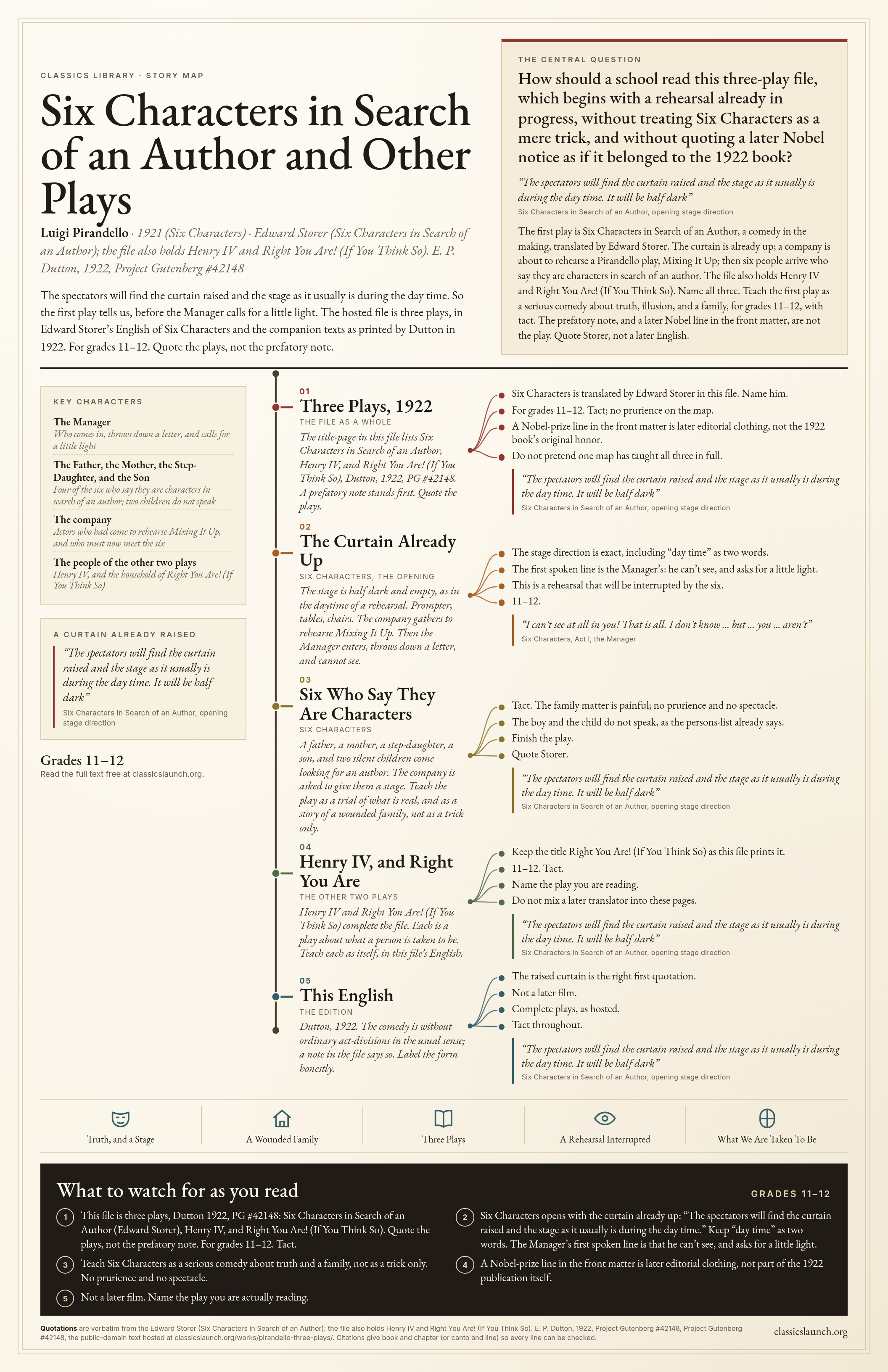
Six Characters in Search of an Author and Other Plays: A Story Map
The PDF is one tabloid page (11 × 17 in). On letter paper, choose “Fit to page.”
The spectators will find the curtain raised and the stage as it usually is during the day time. So the first play tells us, before the Manager calls for a little light. The hosted file is three plays, in Edward Storer’s English of Six Characters and the companion texts as printed by Dutton in 1922. For grades 11–12. Quote the plays, not the prefatory note.
The central question
How should a school read this three-play file, which begins with a rehearsal already in progress, without treating Six Characters as a mere trick, and without quoting a later Nobel notice as if it belonged to the 1922 book?
“The spectators will find the curtain raised and the stage as it usually is during the day time. It will be half dark”
The first play is Six Characters in Search of an Author, a comedy in the making, translated by Edward Storer. The curtain is already up; a company is about to rehearse a Pirandello play, Mixing It Up; then six people arrive who say they are characters in search of an author. The file also holds Henry IV and Right You Are! (If You Think So). Name all three. Teach the first play as a serious comedy about truth, illusion, and a family, for grades 11–12, with tact. The prefatory note, and a later Nobel line in the front matter, are not the play. Quote Storer, not a later English.
- 01
Three Plays, 1922
The file as a whole
The title-page in this file lists Six Characters in Search of an Author, Henry IV, and Right You Are! (If You Think So), Dutton, 1922, PG #42148. A prefatory note stands first. Quote the plays.
- Six Characters is translated by Edward Storer in this file. Name him.
- For grades 11–12. Tact; no prurience on the map.
- A Nobel-prize line in the front matter is later editorial clothing, not the 1922 book’s original honor.
- Do not pretend one map has taught all three in full.
“The spectators will find the curtain raised and the stage as it usually is during the day time. It will be half dark”
- 02
The Curtain Already Up
Six Characters, the opening
The stage is half dark and empty, as in the daytime of a rehearsal. Prompter, tables, chairs. The company gathers to rehearse Mixing It Up. Then the Manager enters, throws down a letter, and cannot see.
- The stage direction is exact, including “day time” as two words.
- The first spoken line is the Manager’s: he can’t see, and asks for a little light.
- This is a rehearsal that will be interrupted by the six.
- 11–12.
“I can't see at all in you! That is all. I don't know ... but ... you ... aren't”
- 03
Six Who Say They Are Characters
Six Characters
A father, a mother, a step-daughter, a son, and two silent children come looking for an author. The company is asked to give them a stage. Teach the play as a trial of what is real, and as a story of a wounded family, not as a trick only.
- Tact. The family matter is painful; no prurience and no spectacle.
- The boy and the child do not speak, as the persons-list already says.
- Finish the play.
- Quote Storer.
“The spectators will find the curtain raised and the stage as it usually is during the day time. It will be half dark”
- 04
Henry IV, and Right You Are
The other two plays
Henry IV and Right You Are! (If You Think So) complete the file. Each is a play about what a person is taken to be. Teach each as itself, in this file’s English.
- Keep the title Right You Are! (If You Think So) as this file prints it.
- 11–12. Tact.
- Name the play you are reading.
- Do not mix a later translator into these pages.
“The spectators will find the curtain raised and the stage as it usually is during the day time. It will be half dark”
- 05
This English
The edition
Dutton, 1922. The comedy is without ordinary act-divisions in the usual sense; a note in the file says so. Label the form honestly.
- The raised curtain is the right first quotation.
- Not a later film.
- Complete plays, as hosted.
- Tact throughout.
“The spectators will find the curtain raised and the stage as it usually is during the day time. It will be half dark”
- Truth, and a Stage
- A Wounded Family
- Three Plays
- A Rehearsal Interrupted
- What We Are Taken To Be
What to watch for as you read
Grades 11–12- This file is three plays, Dutton 1922, PG #42148: Six Characters in Search of an Author (Edward Storer), Henry IV, and Right You Are! (If You Think So). Quote the plays, not the prefatory note. For grades 11–12. Tact.
- Six Characters opens with the curtain already up: “The spectators will find the curtain raised and the stage as it usually is during the day time.” Keep “day time” as two words. The Manager’s first spoken line is that he can’t see, and asks for a little light.
- Teach Six Characters as a serious comedy about truth and a family, not as a trick only. No prurience and no spectacle.
- A Nobel-prize line in the front matter is later editorial clothing, not part of the 1922 publication itself.
- Not a later film. Name the play you are actually reading.
Every quotation is word for word from the Edward Storer (Six Characters in Search of an Author); the file also holds Henry IV and Right You Are! (If You Think So). E. P. Dutton, 1922, Project Gutenberg #42148 hosted in this library and is checked against that text each time the site is built. Citations give book and chapter (or canto and line).