Story maps · Grades 10–12
Amphitryon, or Jupiter in Disguise: A Story Map
The PDF is one tabloid page (11 × 17 in). On letter paper, choose “Fit to page.”
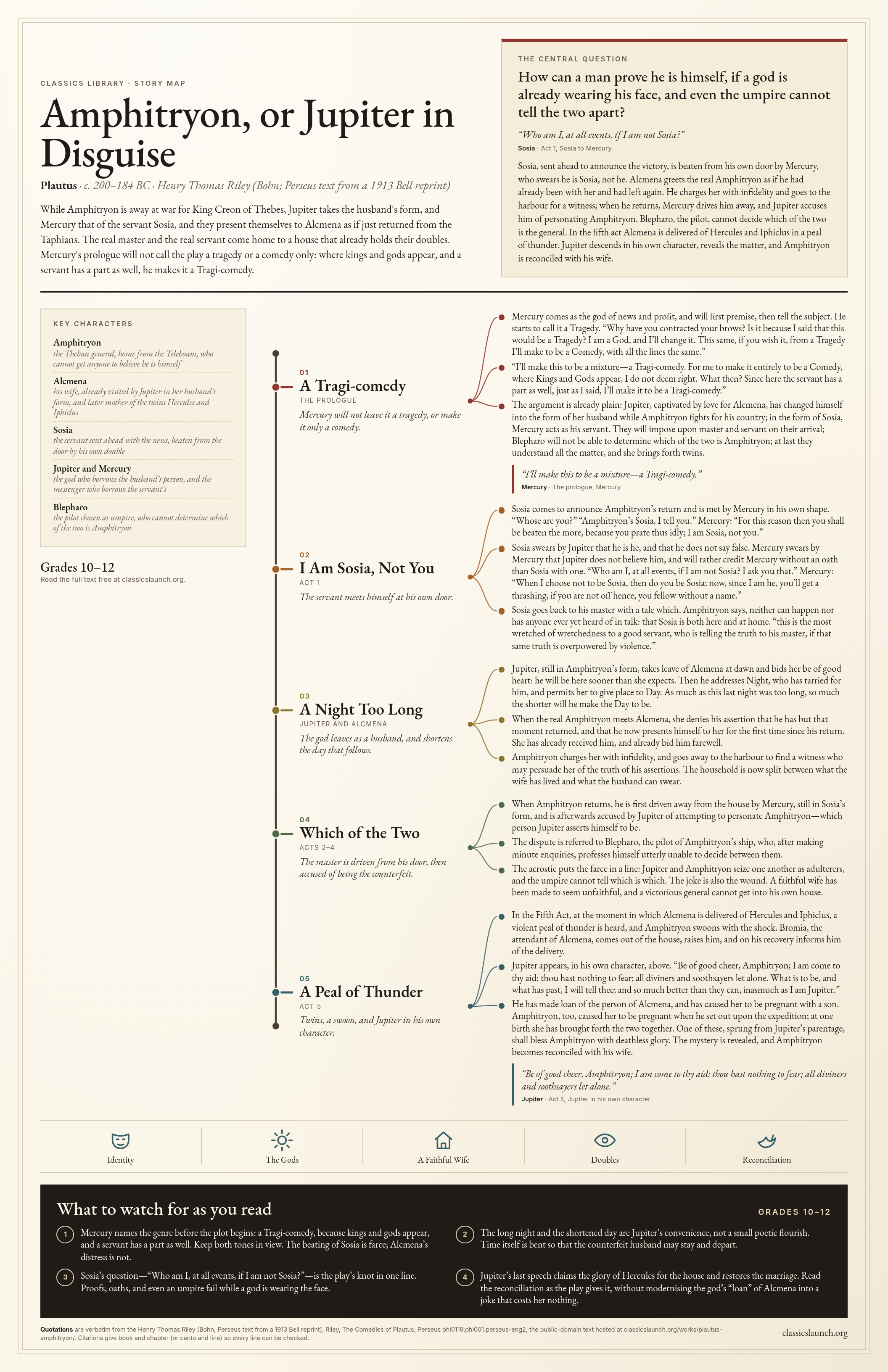
While Amphitryon is away at war for King Creon of Thebes, Jupiter takes the husband's form, and Mercury that of the servant Sosia, and they present themselves to Alcmena as if just returned from the Taphians. The real master and the real servant come home to a house that already holds their doubles. Mercury's prologue will not call the play a tragedy or a comedy only: where kings and gods appear, and a servant has a part as well, he makes it a Tragi-comedy.
The central question
How can a man prove he is himself, if a god is already wearing his face, and even the umpire cannot tell the two apart?
“Who am I, at all events, if I am not Sosia?”
Sosia, sent ahead to announce the victory, is beaten from his own door by Mercury, who swears he is Sosia, not he. Alcmena greets the real Amphitryon as if he had already been with her and had left again. He charges her with infidelity and goes to the harbour for a witness; when he returns, Mercury drives him away, and Jupiter accuses him of personating Amphitryon. Blepharo, the pilot, cannot decide which of the two is the general. In the fifth act Alcmena is delivered of Hercules and Iphiclus in a peal of thunder. Jupiter descends in his own character, reveals the matter, and Amphitryon is reconciled with his wife.
- 01
A Tragi-comedy
The prologue
Mercury will not leave it a tragedy, or make it only a comedy.
- Mercury comes as the god of news and profit, and will first premise, then tell the subject. He starts to call it a Tragedy. “Why have you contracted your brows? Is it because I said that this would be a Tragedy? I am a God, and I’ll change it. This same, if you wish it, from a Tragedy I’ll make to be a Comedy, with all the lines the same.”
- “I’ll make this to be a mixture—a Tragi-comedy. For me to make it entirely to be a Comedy, where Kings and Gods appear, I do not deem right. What then? Since here the servant has a part as well, just as I said, I’ll make it to be a Tragi-comedy.”
- The argument is already plain: Jupiter, captivated by love for Alcmena, has changed himself into the form of her husband while Amphitryon fights for his country; in the form of Sosia, Mercury acts as his servant. They will impose upon master and servant on their arrival; Blepharo will not be able to determine which of the two is Amphitryon; at last they understand all the matter, and she brings forth twins.
“I’ll make this to be a mixture—a Tragi-comedy.”
- 02
I Am Sosia, Not You
Act 1
The servant meets himself at his own door.
- Sosia comes to announce Amphitryon’s return and is met by Mercury in his own shape. “Whose are you?” “Amphitryon’s Sosia, I tell you.” Mercury: “For this reason then you shall be beaten the more, because you prate thus idly; I am Sosia, not you.”
- Sosia swears by Jupiter that he is he, and that he does not say false. Mercury swears by Mercury that Jupiter does not believe him, and will rather credit Mercury without an oath than Sosia with one. “Who am I, at all events, if I am not Sosia? I ask you that.” Mercury: “When I choose not to be Sosia, then do you be Sosia; now, since I am he, you’ll get a thrashing, if you are not off hence, you fellow without a name.”
- Sosia goes back to his master with a tale which, Amphitryon says, neither can happen nor has anyone ever yet heard of in talk: that Sosia is both here and at home. “this is the most wretched of wretchedness to a good servant, who is telling the truth to his master, if that same truth is overpowered by violence.”
- 03
A Night Too Long
Jupiter and Alcmena
The god leaves as a husband, and shortens the day that follows.
- Jupiter, still in Amphitryon’s form, takes leave of Alcmena at dawn and bids her be of good heart: he will be here sooner than she expects. Then he addresses Night, who has tarried for him, and permits her to give place to Day. As much as this last night was too long, so much the shorter will he make the Day to be.
- When the real Amphitryon meets Alcmena, she denies his assertion that he has but that moment returned, and that he now presents himself to her for the first time since his return. She has already received him, and already bid him farewell.
- Amphitryon charges her with infidelity, and goes away to the harbour to find a witness who may persuade her of the truth of his assertions. The household is now split between what the wife has lived and what the husband can swear.
- 04
Which of the Two
Acts 2–4
The master is driven from his door, then accused of being the counterfeit.
- When Amphitryon returns, he is first driven away from the house by Mercury, still in Sosia’s form, and is afterwards accused by Jupiter of attempting to personate Amphitryon—which person Jupiter asserts himself to be.
- The dispute is referred to Blepharo, the pilot of Amphitryon’s ship, who, after making minute enquiries, professes himself utterly unable to decide between them.
- The acrostic puts the farce in a line: Jupiter and Amphitryon seize one another as adulterers, and the umpire cannot tell which is which. The joke is also the wound. A faithful wife has been made to seem unfaithful, and a victorious general cannot get into his own house.
- 05
A Peal of Thunder
Act 5
Twins, a swoon, and Jupiter in his own character.
- In the Fifth Act, at the moment in which Alcmena is delivered of Hercules and Iphiclus, a violent peal of thunder is heard, and Amphitryon swoons with the shock. Bromia, the attendant of Alcmena, comes out of the house, raises him, and on his recovery informs him of the delivery.
- Jupiter appears, in his own character, above. “Be of good cheer, Amphitryon; I am come to thy aid: thou hast nothing to fear; all diviners and soothsayers let alone. What is to be, and what has past, I will tell thee; and so much better than they can, inasmuch as I am Jupiter.”
- He has made loan of the person of Alcmena, and has caused her to be pregnant with a son. Amphitryon, too, caused her to be pregnant when he set out upon the expedition; at one birth she has brought forth the two together. One of these, sprung from Jupiter’s parentage, shall bless Amphitryon with deathless glory. The mystery is revealed, and Amphitryon becomes reconciled with his wife.
“Be of good cheer, Amphitryon; I am come to thy aid: thou hast nothing to fear; all diviners and soothsayers let alone.”
- Identity
- The Gods
- A Faithful Wife
- Doubles
- Reconciliation
What to watch for as you read
Grades 10–12- Mercury names the genre before the plot begins: a Tragi-comedy, because kings and gods appear, and a servant has a part as well. Keep both tones in view. The beating of Sosia is farce; Alcmena’s distress is not.
- The long night and the shortened day are Jupiter’s convenience, not a small poetic flourish. Time itself is bent so that the counterfeit husband may stay and depart.
- Sosia’s question—“Who am I, at all events, if I am not Sosia?”—is the play’s knot in one line. Proofs, oaths, and even an umpire fail while a god is wearing the face.
- Jupiter’s last speech claims the glory of Hercules for the house and restores the marriage. Read the reconciliation as the play gives it, without modernising the god’s “loan” of Alcmena into a joke that costs her nothing.
Every quotation is word for word from the Henry Thomas Riley (Bohn; Perseus text from a 1913 Bell reprint) hosted in this library and is checked against that text each time the site is built. Citations give book and chapter (or canto and line).