Story maps · Grades 10–12
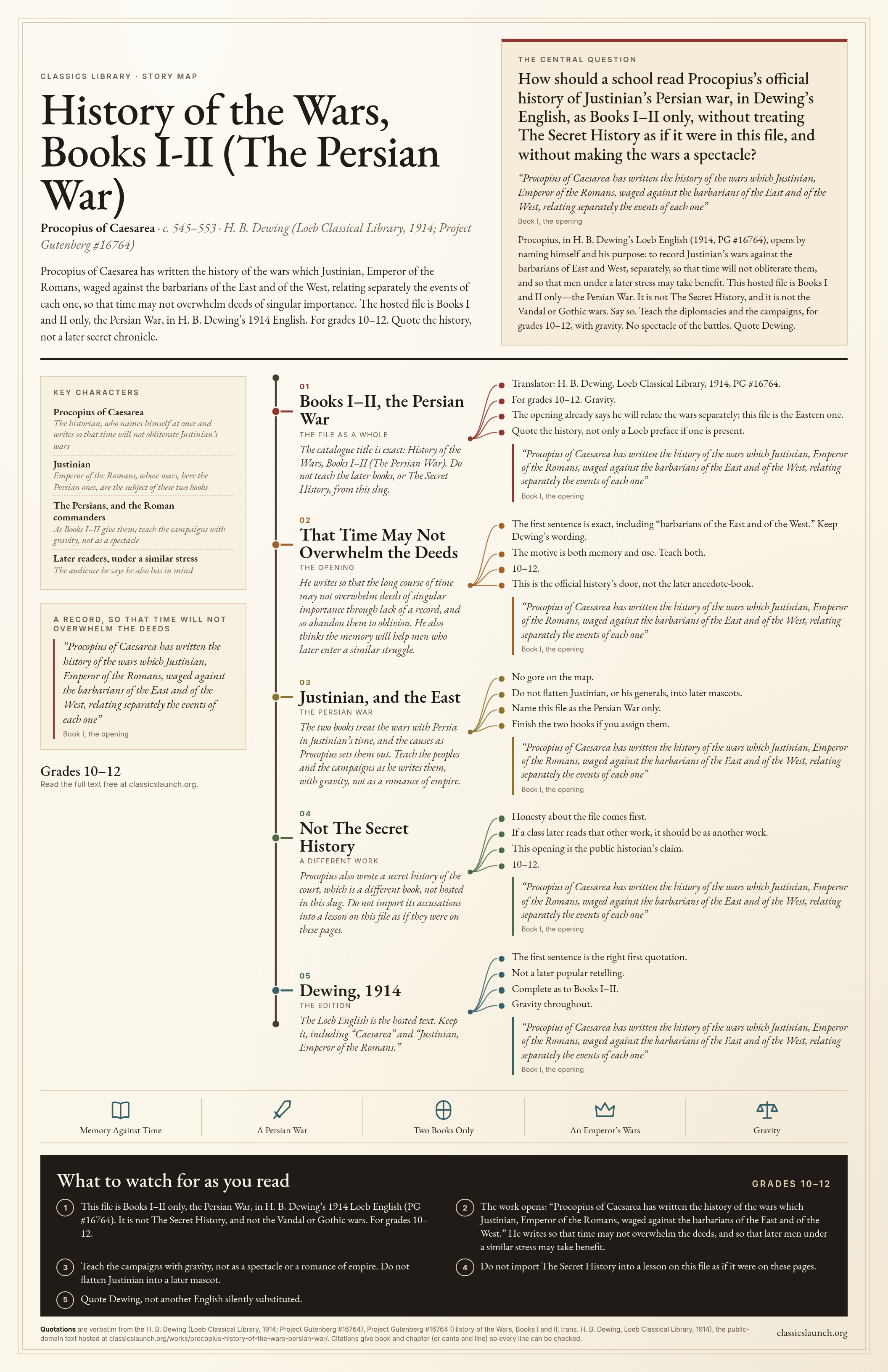
History of the Wars, Books I-II (The Persian War): A Story Map
The PDF is one tabloid page (11 × 17 in). On letter paper, choose “Fit to page.”
Procopius of Caesarea has written the history of the wars which Justinian, Emperor of the Romans, waged against the barbarians of the East and of the West, relating separately the events of each one, so that time may not overwhelm deeds of singular importance. The hosted file is Books I and II only, the Persian War, in H. B. Dewing’s 1914 English. For grades 10–12. Quote the history, not a later secret chronicle.
The central question
How should a school read Procopius’s official history of Justinian’s Persian war, in Dewing’s English, as Books I–II only, without treating The Secret History as if it were in this file, and without making the wars a spectacle?
“Procopius of Caesarea has written the history of the wars which Justinian, Emperor of the Romans, waged against the barbarians of the East and of the West, relating separately the events of each one”
Procopius, in H. B. Dewing’s Loeb English (1914, PG #16764), opens by naming himself and his purpose: to record Justinian’s wars against the barbarians of East and West, separately, so that time will not obliterate them, and so that men under a later stress may take benefit. This hosted file is Books I and II only—the Persian War. It is not The Secret History, and it is not the Vandal or Gothic wars. Say so. Teach the diplomacies and the campaigns, for grades 10–12, with gravity. No spectacle of the battles. Quote Dewing.
- 01
Books I–II, the Persian War
The file as a whole
The catalogue title is exact: History of the Wars, Books I–II (The Persian War). Do not teach the later books, or The Secret History, from this slug.
- Translator: H. B. Dewing, Loeb Classical Library, 1914, PG #16764.
- For grades 10–12. Gravity.
- The opening already says he will relate the wars separately; this file is the Eastern one.
- Quote the history, not only a Loeb preface if one is present.
“Procopius of Caesarea has written the history of the wars which Justinian, Emperor of the Romans, waged against the barbarians of the East and of the West, relating separately the events of each one”
- 02
That Time May Not Overwhelm the Deeds
The opening
He writes so that the long course of time may not overwhelm deeds of singular importance through lack of a record, and so abandon them to oblivion. He also thinks the memory will help men who later enter a similar struggle.
- The first sentence is exact, including “barbarians of the East and of the West.” Keep Dewing’s wording.
- The motive is both memory and use. Teach both.
- 10–12.
- This is the official history’s door, not the later anecdote-book.
“Procopius of Caesarea has written the history of the wars which Justinian, Emperor of the Romans, waged against the barbarians of the East and of the West, relating separately the events of each one”
- 03
Justinian, and the East
The Persian War
The two books treat the wars with Persia in Justinian’s time, and the causes as Procopius sets them out. Teach the peoples and the campaigns as he writes them, with gravity, not as a romance of empire.
- No gore on the map.
- Do not flatten Justinian, or his generals, into later mascots.
- Name this file as the Persian War only.
- Finish the two books if you assign them.
“Procopius of Caesarea has written the history of the wars which Justinian, Emperor of the Romans, waged against the barbarians of the East and of the West, relating separately the events of each one”
- 04
Not The Secret History
A different work
Procopius also wrote a secret history of the court, which is a different book, not hosted in this slug. Do not import its accusations into a lesson on this file as if they were on these pages.
- Honesty about the file comes first.
- If a class later reads that other work, it should be as another work.
- This opening is the public historian’s claim.
- 10–12.
“Procopius of Caesarea has written the history of the wars which Justinian, Emperor of the Romans, waged against the barbarians of the East and of the West, relating separately the events of each one”
- 05
Dewing, 1914
The edition
The Loeb English is the hosted text. Keep it, including “Caesarea” and “Justinian, Emperor of the Romans.”
- The first sentence is the right first quotation.
- Not a later popular retelling.
- Complete as to Books I–II.
- Gravity throughout.
“Procopius of Caesarea has written the history of the wars which Justinian, Emperor of the Romans, waged against the barbarians of the East and of the West, relating separately the events of each one”
- Memory Against Time
- A Persian War
- Two Books Only
- An Emperor’s Wars
- Gravity
What to watch for as you read
Grades 10–12- This file is Books I–II only, the Persian War, in H. B. Dewing’s 1914 Loeb English (PG #16764). It is not The Secret History, and not the Vandal or Gothic wars. For grades 10–12.
- The work opens: “Procopius of Caesarea has written the history of the wars which Justinian, Emperor of the Romans, waged against the barbarians of the East and of the West.” He writes so that time may not overwhelm the deeds, and so that later men under a similar stress may take benefit.
- Teach the campaigns with gravity, not as a spectacle or a romance of empire. Do not flatten Justinian into a later mascot.
- Do not import The Secret History into a lesson on this file as if it were on these pages.
- Quote Dewing, not another English silently substituted.
Every quotation is word for word from the H. B. Dewing (Loeb Classical Library, 1914; Project Gutenberg #16764) hosted in this library and is checked against that text each time the site is built. Citations give book and chapter (or canto and line).