Story maps · Grades 11–12
Swann's Way: A Story Map
The PDF is one tabloid page (11 × 17 in). On letter paper, choose “Fit to page.”
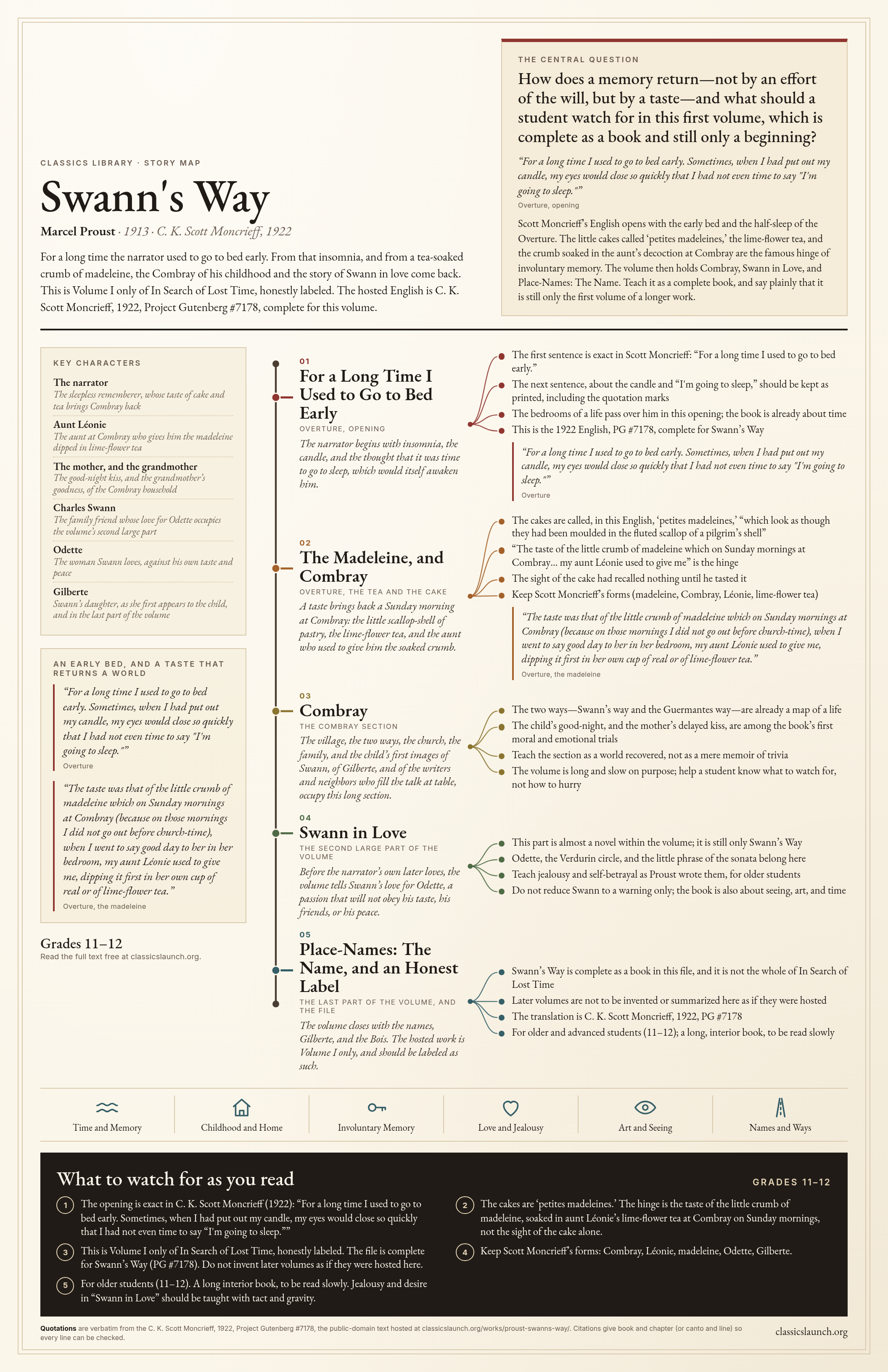
For a long time the narrator used to go to bed early. From that insomnia, and from a tea-soaked crumb of madeleine, the Combray of his childhood and the story of Swann in love come back. This is Volume I only of In Search of Lost Time, honestly labeled. The hosted English is C. K. Scott Moncrieff, 1922, Project Gutenberg #7178, complete for this volume.
The central question
How does a memory return—not by an effort of the will, but by a taste—and what should a student watch for in this first volume, which is complete as a book and still only a beginning?
“For a long time I used to go to bed early. Sometimes, when I had put out my candle, my eyes would close so quickly that I had not even time to say "I'm going to sleep."”
Scott Moncrieff’s English opens with the early bed and the half-sleep of the Overture. The little cakes called ‘petites madeleines,’ the lime-flower tea, and the crumb soaked in the aunt’s decoction at Combray are the famous hinge of involuntary memory. The volume then holds Combray, Swann in Love, and Place-Names: The Name. Teach it as a complete book, and say plainly that it is still only the first volume of a longer work.
- 01
For a Long Time I Used to Go to Bed Early
Overture, opening
The narrator begins with insomnia, the candle, and the thought that it was time to go to sleep, which would itself awaken him.
- The first sentence is exact in Scott Moncrieff: “For a long time I used to go to bed early.”
- The next sentence, about the candle and “I'm going to sleep,” should be kept as printed, including the quotation marks
- The bedrooms of a life pass over him in this opening; the book is already about time
- This is the 1922 English, PG #7178, complete for Swann’s Way
“For a long time I used to go to bed early. Sometimes, when I had put out my candle, my eyes would close so quickly that I had not even time to say "I'm going to sleep."”
- 02
The Madeleine, and Combray
Overture, the tea and the cake
A taste brings back a Sunday morning at Combray: the little scallop-shell of pastry, the lime-flower tea, and the aunt who used to give him the soaked crumb.
- The cakes are called, in this English, ‘petites madeleines,’ “which look as though they had been moulded in the fluted scallop of a pilgrim’s shell”
- “The taste of the little crumb of madeleine which on Sunday mornings at Combray… my aunt Léonie used to give me” is the hinge
- The sight of the cake had recalled nothing until he tasted it
- Keep Scott Moncrieff’s forms (madeleine, Combray, Léonie, lime-flower tea)
“The taste was that of the little crumb of madeleine which on Sunday mornings at Combray (because on those mornings I did not go out before church-time), when I went to say good day to her in her bedroom, my aunt Léonie used to give me, dipping it first in her own cup of real or of lime-flower tea.”
- 03
Combray
The Combray section
The village, the two ways, the church, the family, and the child’s first images of Swann, of Gilberte, and of the writers and neighbors who fill the talk at table, occupy this long section.
- The two ways—Swann’s way and the Guermantes way—are already a map of a life
- The child’s good-night, and the mother’s delayed kiss, are among the book’s first moral and emotional trials
- Teach the section as a world recovered, not as a mere memoir of trivia
- The volume is long and slow on purpose; help a student know what to watch for, not how to hurry
- 04
Swann in Love
The second large part of the volume
Before the narrator’s own later loves, the volume tells Swann’s love for Odette, a passion that will not obey his taste, his friends, or his peace.
- This part is almost a novel within the volume; it is still only Swann’s Way
- Odette, the Verdurin circle, and the little phrase of the sonata belong here
- Teach jealousy and self-betrayal as Proust wrote them, for older students
- Do not reduce Swann to a warning only; the book is also about seeing, art, and time
- 05
Place-Names: The Name, and an Honest Label
The last part of the volume, and the file
The volume closes with the names, Gilberte, and the Bois. The hosted work is Volume I only, and should be labeled as such.
- Swann’s Way is complete as a book in this file, and it is not the whole of In Search of Lost Time
- Later volumes are not to be invented or summarized here as if they were hosted
- The translation is C. K. Scott Moncrieff, 1922, PG #7178
- For older and advanced students (11–12); a long, interior book, to be read slowly
- Time and Memory
- Childhood and Home
- Involuntary Memory
- Love and Jealousy
- Art and Seeing
- Names and Ways
What to watch for as you read
Grades 11–12- The opening is exact in C. K. Scott Moncrieff (1922): “For a long time I used to go to bed early. Sometimes, when I had put out my candle, my eyes would close so quickly that I had not even time to say “I'm going to sleep.””
- The cakes are ‘petites madeleines.’ The hinge is the taste of the little crumb of madeleine, soaked in aunt Léonie’s lime-flower tea at Combray on Sunday mornings, not the sight of the cake alone.
- This is Volume I only of In Search of Lost Time, honestly labeled. The file is complete for Swann’s Way (PG #7178). Do not invent later volumes as if they were hosted here.
- Keep Scott Moncrieff’s forms: Combray, Léonie, madeleine, Odette, Gilberte.
- For older students (11–12). A long interior book, to be read slowly. Jealousy and desire in “Swann in Love” should be taught with tact and gravity.
Every quotation is word for word from the C. K. Scott Moncrieff, 1922 hosted in this library and is checked against that text each time the site is built. Citations give book and chapter (or canto and line).