Story maps · Grades 10–12
Quo Vadis: A Story Map
The PDF is one tabloid page (11 × 17 in). On letter paper, choose “Fit to page.”
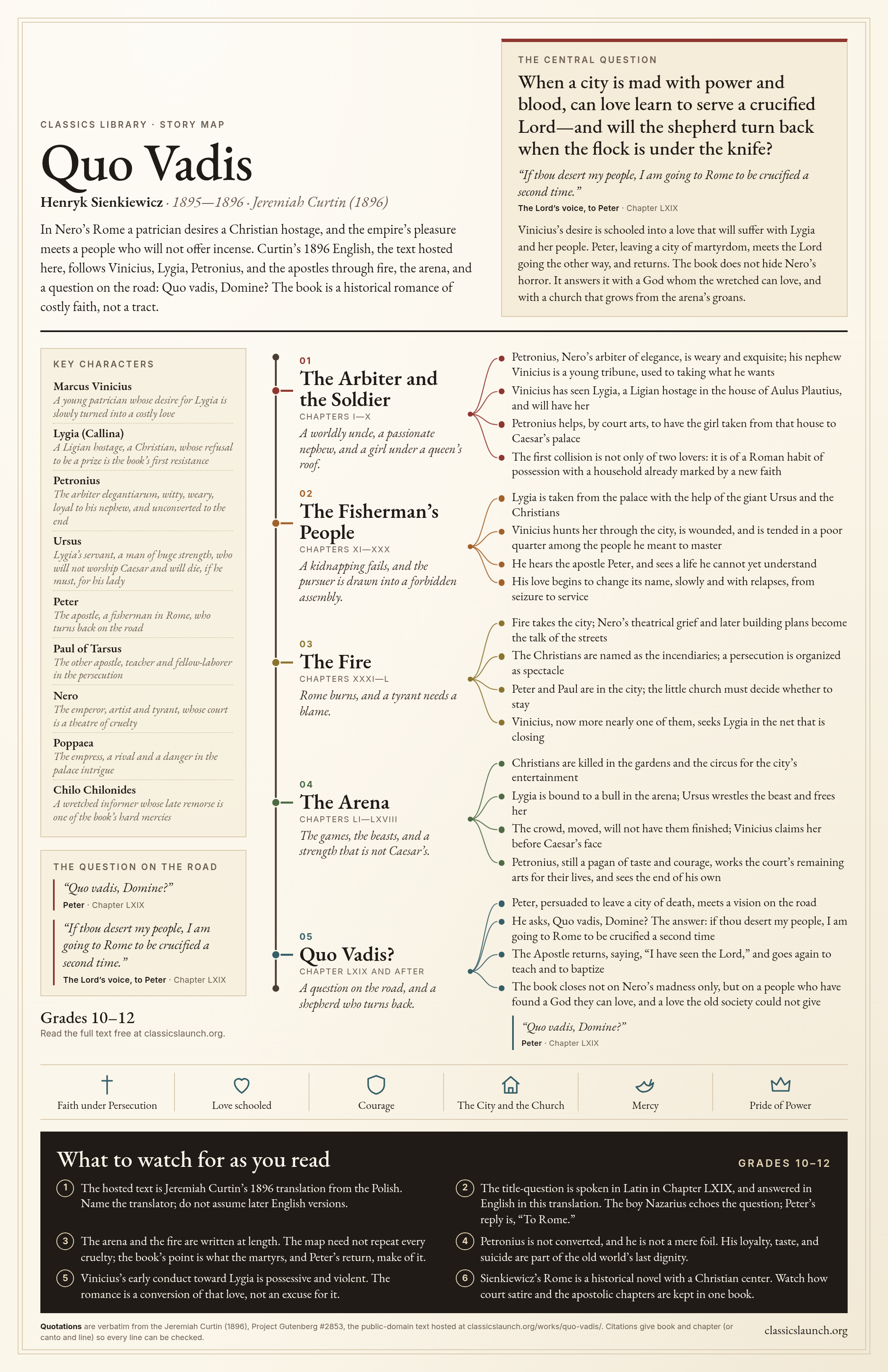
In Nero’s Rome a patrician desires a Christian hostage, and the empire’s pleasure meets a people who will not offer incense. Curtin’s 1896 English, the text hosted here, follows Vinicius, Lygia, Petronius, and the apostles through fire, the arena, and a question on the road: Quo vadis, Domine? The book is a historical romance of costly faith, not a tract.
The central question
When a city is mad with power and blood, can love learn to serve a crucified Lord—and will the shepherd turn back when the flock is under the knife?
“If thou desert my people, I am going to Rome to be crucified a second time.”
Vinicius’s desire is schooled into a love that will suffer with Lygia and her people. Peter, leaving a city of martyrdom, meets the Lord going the other way, and returns. The book does not hide Nero’s horror. It answers it with a God whom the wretched can love, and with a church that grows from the arena’s groans.
- 01
The Arbiter and the Soldier
Chapters I—X
A worldly uncle, a passionate nephew, and a girl under a queen’s roof.
- Petronius, Nero’s arbiter of elegance, is weary and exquisite; his nephew Vinicius is a young tribune, used to taking what he wants
- Vinicius has seen Lygia, a Ligian hostage in the house of Aulus Plautius, and will have her
- Petronius helps, by court arts, to have the girl taken from that house to Caesar’s palace
- The first collision is not only of two lovers: it is of a Roman habit of possession with a household already marked by a new faith
- 02
The Fisherman’s People
Chapters XI—XXX
A kidnapping fails, and the pursuer is drawn into a forbidden assembly.
- Lygia is taken from the palace with the help of the giant Ursus and the Christians
- Vinicius hunts her through the city, is wounded, and is tended in a poor quarter among the people he meant to master
- He hears the apostle Peter, and sees a life he cannot yet understand
- His love begins to change its name, slowly and with relapses, from seizure to service
- 03
The Fire
Chapters XXXI—L
Rome burns, and a tyrant needs a blame.
- Fire takes the city; Nero’s theatrical grief and later building plans become the talk of the streets
- The Christians are named as the incendiaries; a persecution is organized as spectacle
- Peter and Paul are in the city; the little church must decide whether to stay
- Vinicius, now more nearly one of them, seeks Lygia in the net that is closing
- 04
The Arena
Chapters LI—LXVIII
The games, the beasts, and a strength that is not Caesar’s.
- Christians are killed in the gardens and the circus for the city’s entertainment
- Lygia is bound to a bull in the arena; Ursus wrestles the beast and frees her
- The crowd, moved, will not have them finished; Vinicius claims her before Caesar’s face
- Petronius, still a pagan of taste and courage, works the court’s remaining arts for their lives, and sees the end of his own
- 05
Quo Vadis?
Chapter LXIX and after
A question on the road, and a shepherd who turns back.
- Peter, persuaded to leave a city of death, meets a vision on the road
- He asks, Quo vadis, Domine? The answer: if thou desert my people, I am going to Rome to be crucified a second time
- The Apostle returns, saying, “I have seen the Lord,” and goes again to teach and to baptize
- The book closes not on Nero’s madness only, but on a people who have found a God they can love, and a love the old society could not give
“Quo vadis, Domine?”
- Faith under Persecution
- Love schooled
- Courage
- The City and the Church
- Mercy
- Pride of Power
What to watch for as you read
Grades 10–12- The hosted text is Jeremiah Curtin’s 1896 translation from the Polish. Name the translator; do not assume later English versions.
- The title-question is spoken in Latin in Chapter LXIX, and answered in English in this translation. The boy Nazarius echoes the question; Peter’s reply is, “To Rome.”
- The arena and the fire are written at length. The map need not repeat every cruelty; the book’s point is what the martyrs, and Peter’s return, make of it.
- Petronius is not converted, and he is not a mere foil. His loyalty, taste, and suicide are part of the old world’s last dignity.
- Vinicius’s early conduct toward Lygia is possessive and violent. The romance is a conversion of that love, not an excuse for it.
- Sienkiewicz’s Rome is a historical novel with a Christian center. Watch how court satire and the apostolic chapters are kept in one book.
Every quotation is word for word from the Jeremiah Curtin (1896) hosted in this library and is checked against that text each time the site is built. Citations give book and chapter (or canto and line).