Story maps · Grades 11–12
Phaedra: A Story Map
The PDF is one tabloid page (11 × 17 in). On letter paper, choose “Fit to page.”
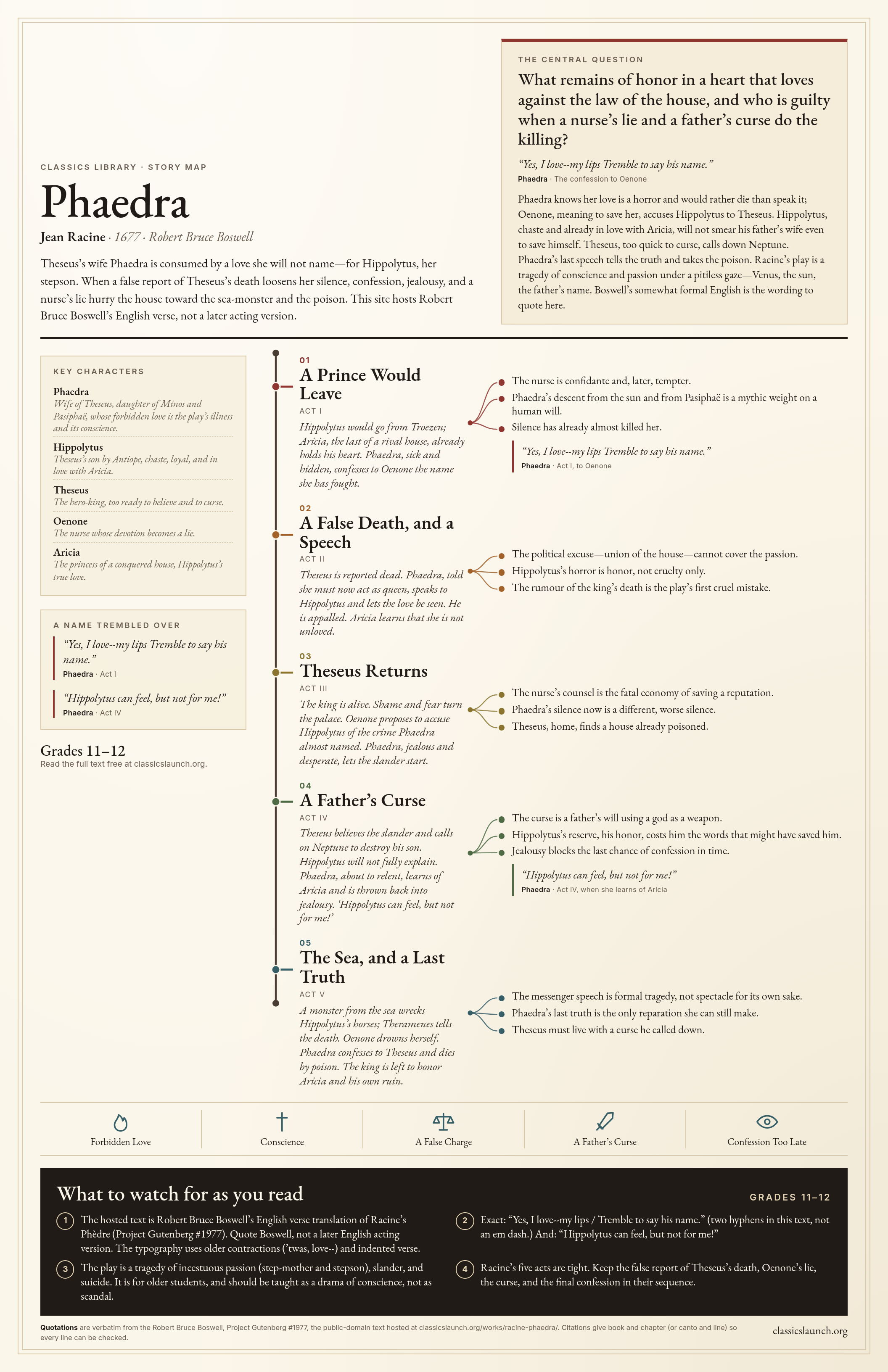
Theseus’s wife Phaedra is consumed by a love she will not name—for Hippolytus, her stepson. When a false report of Theseus’s death loosens her silence, confession, jealousy, and a nurse’s lie hurry the house toward the sea-monster and the poison. This site hosts Robert Bruce Boswell’s English verse, not a later acting version.
The central question
What remains of honor in a heart that loves against the law of the house, and who is guilty when a nurse’s lie and a father’s curse do the killing?
“Yes, I love--my lips Tremble to say his name.”
Phaedra knows her love is a horror and would rather die than speak it; Oenone, meaning to save her, accuses Hippolytus to Theseus. Hippolytus, chaste and already in love with Aricia, will not smear his father’s wife even to save himself. Theseus, too quick to curse, calls down Neptune. Phaedra’s last speech tells the truth and takes the poison. Racine’s play is a tragedy of conscience and passion under a pitiless gaze—Venus, the sun, the father’s name. Boswell’s somewhat formal English is the wording to quote here.
- 01
A Prince Would Leave
Act I
Hippolytus would go from Troezen; Aricia, the last of a rival house, already holds his heart. Phaedra, sick and hidden, confesses to Oenone the name she has fought.
- The nurse is confidante and, later, tempter.
- Phaedra’s descent from the sun and from Pasiphaë is a mythic weight on a human will.
- Silence has already almost killed her.
“Yes, I love--my lips Tremble to say his name.”
- 02
A False Death, and a Speech
Act II
Theseus is reported dead. Phaedra, told she must now act as queen, speaks to Hippolytus and lets the love be seen. He is appalled. Aricia learns that she is not unloved.
- The political excuse—union of the house—cannot cover the passion.
- Hippolytus’s horror is honor, not cruelty only.
- The rumour of the king’s death is the play’s first cruel mistake.
- 03
Theseus Returns
Act III
The king is alive. Shame and fear turn the palace. Oenone proposes to accuse Hippolytus of the crime Phaedra almost named. Phaedra, jealous and desperate, lets the slander start.
- The nurse’s counsel is the fatal economy of saving a reputation.
- Phaedra’s silence now is a different, worse silence.
- Theseus, home, finds a house already poisoned.
- 04
A Father’s Curse
Act IV
Theseus believes the slander and calls on Neptune to destroy his son. Hippolytus will not fully explain. Phaedra, about to relent, learns of Aricia and is thrown back into jealousy. ‘Hippolytus can feel, but not for me!’
- The curse is a father’s will using a god as a weapon.
- Hippolytus’s reserve, his honor, costs him the words that might have saved him.
- Jealousy blocks the last chance of confession in time.
“Hippolytus can feel, but not for me!”
- 05
The Sea, and a Last Truth
Act V
A monster from the sea wrecks Hippolytus’s horses; Theramenes tells the death. Oenone drowns herself. Phaedra confesses to Theseus and dies by poison. The king is left to honor Aricia and his own ruin.
- The messenger speech is formal tragedy, not spectacle for its own sake.
- Phaedra’s last truth is the only reparation she can still make.
- Theseus must live with a curse he called down.
- Forbidden Love
- Conscience
- A False Charge
- A Father’s Curse
- Confession Too Late
What to watch for as you read
Grades 11–12- The hosted text is Robert Bruce Boswell’s English verse translation of Racine’s Phèdre (Project Gutenberg #1977). Quote Boswell, not a later English acting version. The typography uses older contractions (’twas, love--) and indented verse.
- Exact: “Yes, I love--my lips / Tremble to say his name.” (two hyphens in this text, not an em dash.) And: “Hippolytus can feel, but not for me!”
- The play is a tragedy of incestuous passion (step-mother and stepson), slander, and suicide. It is for older students, and should be taught as a drama of conscience, not as scandal.
- Racine’s five acts are tight. Keep the false report of Theseus’s death, Oenone’s lie, the curse, and the final confession in their sequence.
Every quotation is word for word from the Robert Bruce Boswell hosted in this library and is checked against that text each time the site is built. Citations give book and chapter (or canto and line).