Story maps · Grades 10–12
The Social Cancer (Noli Me Tangere): A Story Map
The PDF is one tabloid page (11 × 17 in). On letter paper, choose “Fit to page.”
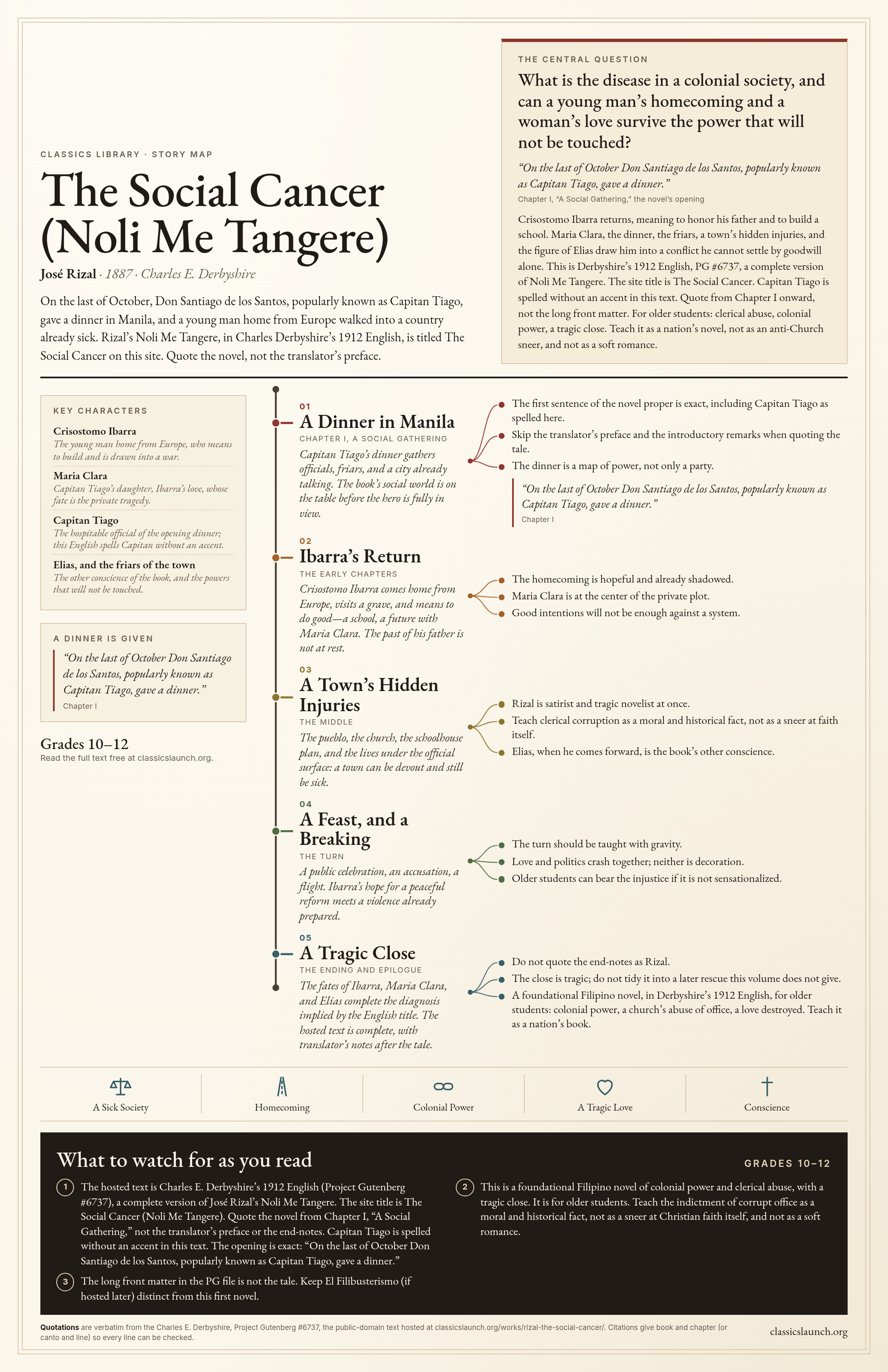
On the last of October, Don Santiago de los Santos, popularly known as Capitan Tiago, gave a dinner in Manila, and a young man home from Europe walked into a country already sick. Rizal’s Noli Me Tangere, in Charles Derbyshire’s 1912 English, is titled The Social Cancer on this site. Quote the novel, not the translator’s preface.
The central question
What is the disease in a colonial society, and can a young man’s homecoming and a woman’s love survive the power that will not be touched?
“On the last of October Don Santiago de los Santos, popularly known as Capitan Tiago, gave a dinner.”
Crisostomo Ibarra returns, meaning to honor his father and to build a school. Maria Clara, the dinner, the friars, a town’s hidden injuries, and the figure of Elias draw him into a conflict he cannot settle by goodwill alone. This is Derbyshire’s 1912 English, PG #6737, a complete version of Noli Me Tangere. The site title is The Social Cancer. Capitan Tiago is spelled without an accent in this text. Quote from Chapter I onward, not the long front matter. For older students: clerical abuse, colonial power, a tragic close. Teach it as a nation’s novel, not as an anti-Church sneer, and not as a soft romance.
- 01
A Dinner in Manila
Chapter I, A Social Gathering
Capitan Tiago’s dinner gathers officials, friars, and a city already talking. The book’s social world is on the table before the hero is fully in view.
- The first sentence of the novel proper is exact, including Capitan Tiago as spelled here.
- Skip the translator’s preface and the introductory remarks when quoting the tale.
- The dinner is a map of power, not only a party.
“On the last of October Don Santiago de los Santos, popularly known as Capitan Tiago, gave a dinner.”
- 02
Ibarra’s Return
The early chapters
Crisostomo Ibarra comes home from Europe, visits a grave, and means to do good—a school, a future with Maria Clara. The past of his father is not at rest.
- The homecoming is hopeful and already shadowed.
- Maria Clara is at the center of the private plot.
- Good intentions will not be enough against a system.
- 03
A Town’s Hidden Injuries
The middle
The pueblo, the church, the schoolhouse plan, and the lives under the official surface: a town can be devout and still be sick.
- Rizal is satirist and tragic novelist at once.
- Teach clerical corruption as a moral and historical fact, not as a sneer at faith itself.
- Elias, when he comes forward, is the book’s other conscience.
- 04
A Feast, and a Breaking
The turn
A public celebration, an accusation, a flight. Ibarra’s hope for a peaceful reform meets a violence already prepared.
- The turn should be taught with gravity.
- Love and politics crash together; neither is decoration.
- Older students can bear the injustice if it is not sensationalized.
- 05
A Tragic Close
The ending and epilogue
The fates of Ibarra, Maria Clara, and Elias complete the diagnosis implied by the English title. The hosted text is complete, with translator’s notes after the tale.
- Do not quote the end-notes as Rizal.
- The close is tragic; do not tidy it into a later rescue this volume does not give.
- A foundational Filipino novel, in Derbyshire’s 1912 English, for older students: colonial power, a church’s abuse of office, a love destroyed. Teach it as a nation’s book.
- A Sick Society
- Homecoming
- Colonial Power
- A Tragic Love
- Conscience
What to watch for as you read
Grades 10–12- The hosted text is Charles E. Derbyshire’s 1912 English (Project Gutenberg #6737), a complete version of José Rizal’s Noli Me Tangere. The site title is The Social Cancer (Noli Me Tangere). Quote the novel from Chapter I, “A Social Gathering,” not the translator’s preface or the end-notes. Capitan Tiago is spelled without an accent in this text. The opening is exact: “On the last of October Don Santiago de los Santos, popularly known as Capitan Tiago, gave a dinner.”
- This is a foundational Filipino novel of colonial power and clerical abuse, with a tragic close. It is for older students. Teach the indictment of corrupt office as a moral and historical fact, not as a sneer at Christian faith itself, and not as a soft romance.
- The long front matter in the PG file is not the tale. Keep El Filibusterismo (if hosted later) distinct from this first novel.
Every quotation is word for word from the Charles E. Derbyshire hosted in this library and is checked against that text each time the site is built. Citations give book and chapter (or canto and line).