Story maps · Grades 10–12
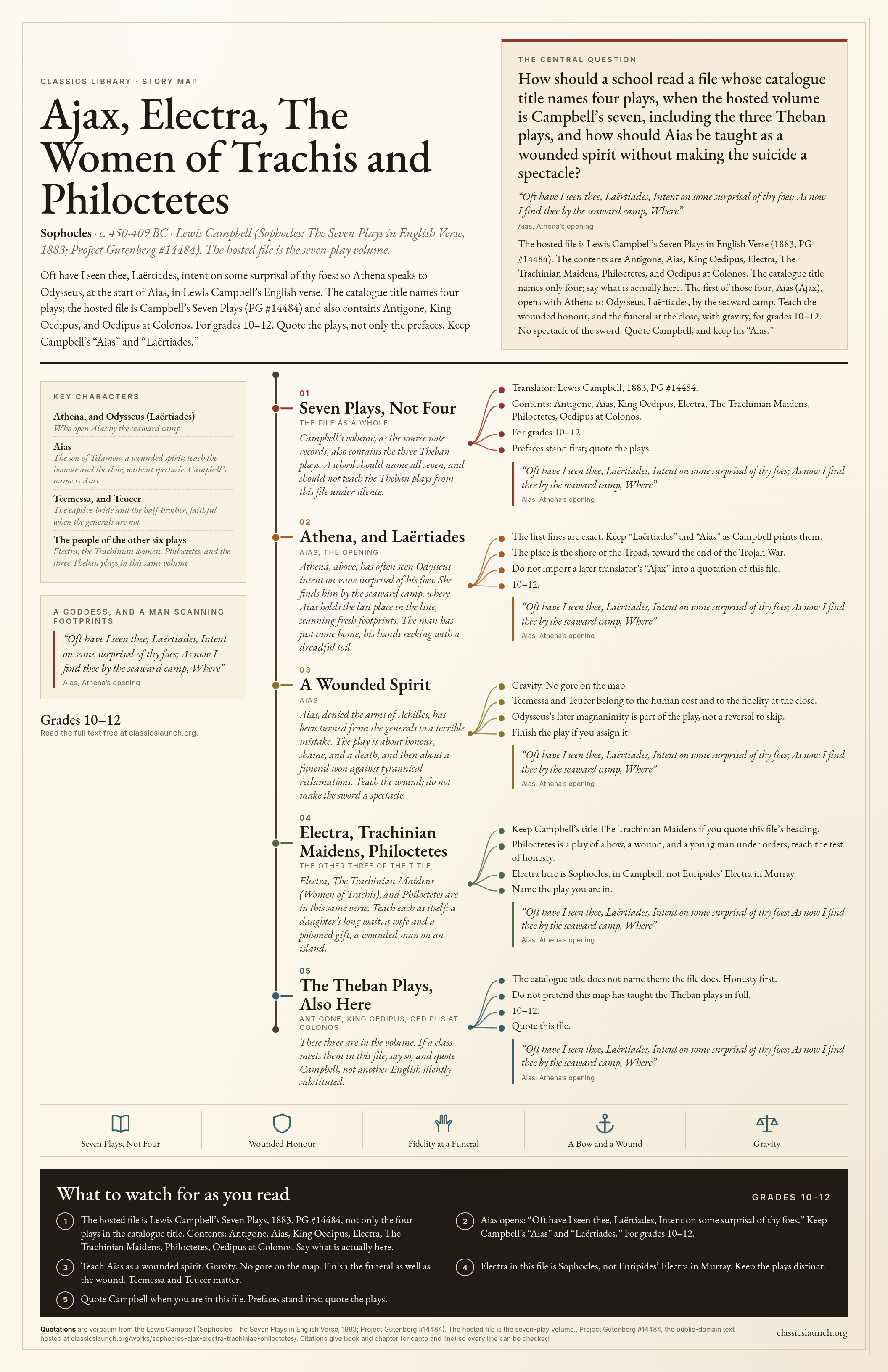
Ajax, Electra, The Women of Trachis and Philoctetes: A Story Map
The PDF is one tabloid page (11 × 17 in). On letter paper, choose “Fit to page.”
Oft have I seen thee, Laërtiades, intent on some surprisal of thy foes: so Athena speaks to Odysseus, at the start of Aias, in Lewis Campbell’s English verse. The catalogue title names four plays; the hosted file is Campbell’s Seven Plays (PG #14484) and also contains Antigone, King Oedipus, and Oedipus at Colonos. For grades 10–12. Quote the plays, not only the prefaces. Keep Campbell’s “Aias” and “Laërtiades.”
The central question
How should a school read a file whose catalogue title names four plays, when the hosted volume is Campbell’s seven, including the three Theban plays, and how should Aias be taught as a wounded spirit without making the suicide a spectacle?
“Oft have I seen thee, Laërtiades, Intent on some surprisal of thy foes; As now I find thee by the seaward camp, Where”
The hosted file is Lewis Campbell’s Seven Plays in English Verse (1883, PG #14484). The contents are Antigone, Aias, King Oedipus, Electra, The Trachinian Maidens, Philoctetes, and Oedipus at Colonos. The catalogue title names only four; say what is actually here. The first of those four, Aias (Ajax), opens with Athena to Odysseus, Laërtiades, by the seaward camp. Teach the wounded honour, and the funeral at the close, with gravity, for grades 10–12. No spectacle of the sword. Quote Campbell, and keep his “Aias.”
- 01
Seven Plays, Not Four
The file as a whole
Campbell’s volume, as the source note records, also contains the three Theban plays. A school should name all seven, and should not teach the Theban plays from this file under silence.
- Translator: Lewis Campbell, 1883, PG #14484.
- Contents: Antigone, Aias, King Oedipus, Electra, The Trachinian Maidens, Philoctetes, Oedipus at Colonos.
- For grades 10–12.
- Prefaces stand first; quote the plays.
“Oft have I seen thee, Laërtiades, Intent on some surprisal of thy foes; As now I find thee by the seaward camp, Where”
- 02
Athena, and Laërtiades
Aias, the opening
Athena, above, has often seen Odysseus intent on some surprisal of his foes. She finds him by the seaward camp, where Aias holds the last place in the line, scanning fresh footprints. The man has just come home, his hands reeking with a dreadful toil.
- The first lines are exact. Keep “Laërtiades” and “Aias” as Campbell prints them.
- The place is the shore of the Troad, toward the end of the Trojan War.
- Do not import a later translator’s “Ajax” into a quotation of this file.
- 10–12.
“Oft have I seen thee, Laërtiades, Intent on some surprisal of thy foes; As now I find thee by the seaward camp, Where”
- 03
A Wounded Spirit
Aias
Aias, denied the arms of Achilles, has been turned from the generals to a terrible mistake. The play is about honour, shame, and a death, and then about a funeral won against tyrannical reclamations. Teach the wound; do not make the sword a spectacle.
- Gravity. No gore on the map.
- Tecmessa and Teucer belong to the human cost and to the fidelity at the close.
- Odysseus’s later magnanimity is part of the play, not a reversal to skip.
- Finish the play if you assign it.
“Oft have I seen thee, Laërtiades, Intent on some surprisal of thy foes; As now I find thee by the seaward camp, Where”
- 04
Electra, Trachinian Maidens, Philoctetes
The other three of the title
Electra, The Trachinian Maidens (Women of Trachis), and Philoctetes are in this same verse. Teach each as itself: a daughter’s long wait, a wife and a poisoned gift, a wounded man on an island.
- Keep Campbell’s title The Trachinian Maidens if you quote this file’s heading.
- Philoctetes is a play of a bow, a wound, and a young man under orders; teach the test of honesty.
- Electra here is Sophocles, in Campbell, not Euripides’ Electra in Murray.
- Name the play you are in.
“Oft have I seen thee, Laërtiades, Intent on some surprisal of thy foes; As now I find thee by the seaward camp, Where”
- 05
The Theban Plays, Also Here
Antigone, King Oedipus, Oedipus at Colonos
These three are in the volume. If a class meets them in this file, say so, and quote Campbell, not another English silently substituted.
- The catalogue title does not name them; the file does. Honesty first.
- Do not pretend this map has taught the Theban plays in full.
- 10–12.
- Quote this file.
“Oft have I seen thee, Laërtiades, Intent on some surprisal of thy foes; As now I find thee by the seaward camp, Where”
- Seven Plays, Not Four
- Wounded Honour
- Fidelity at a Funeral
- A Bow and a Wound
- Gravity
What to watch for as you read
Grades 10–12- The hosted file is Lewis Campbell’s Seven Plays, 1883, PG #14484, not only the four plays in the catalogue title. Contents: Antigone, Aias, King Oedipus, Electra, The Trachinian Maidens, Philoctetes, Oedipus at Colonos. Say what is actually here.
- Aias opens: “Oft have I seen thee, Laërtiades, Intent on some surprisal of thy foes.” Keep Campbell’s “Aias” and “Laërtiades.” For grades 10–12.
- Teach Aias as a wounded spirit. Gravity. No gore on the map. Finish the funeral as well as the wound. Tecmessa and Teucer matter.
- Electra in this file is Sophocles, not Euripides’ Electra in Murray. Keep the plays distinct.
- Quote Campbell when you are in this file. Prefaces stand first; quote the plays.
Every quotation is word for word from the Lewis Campbell (Sophocles: The Seven Plays in English Verse, 1883; Project Gutenberg #14484). The hosted file is the seven-play volume. hosted in this library and is checked against that text each time the site is built. Citations give book and chapter (or canto and line).