Story maps · Grades 9–12
St. Dymphna, and the Colony at Gheel: A Story Map
The PDF is one tabloid page (11 × 17 in). On letter paper, choose “Fit to page.”
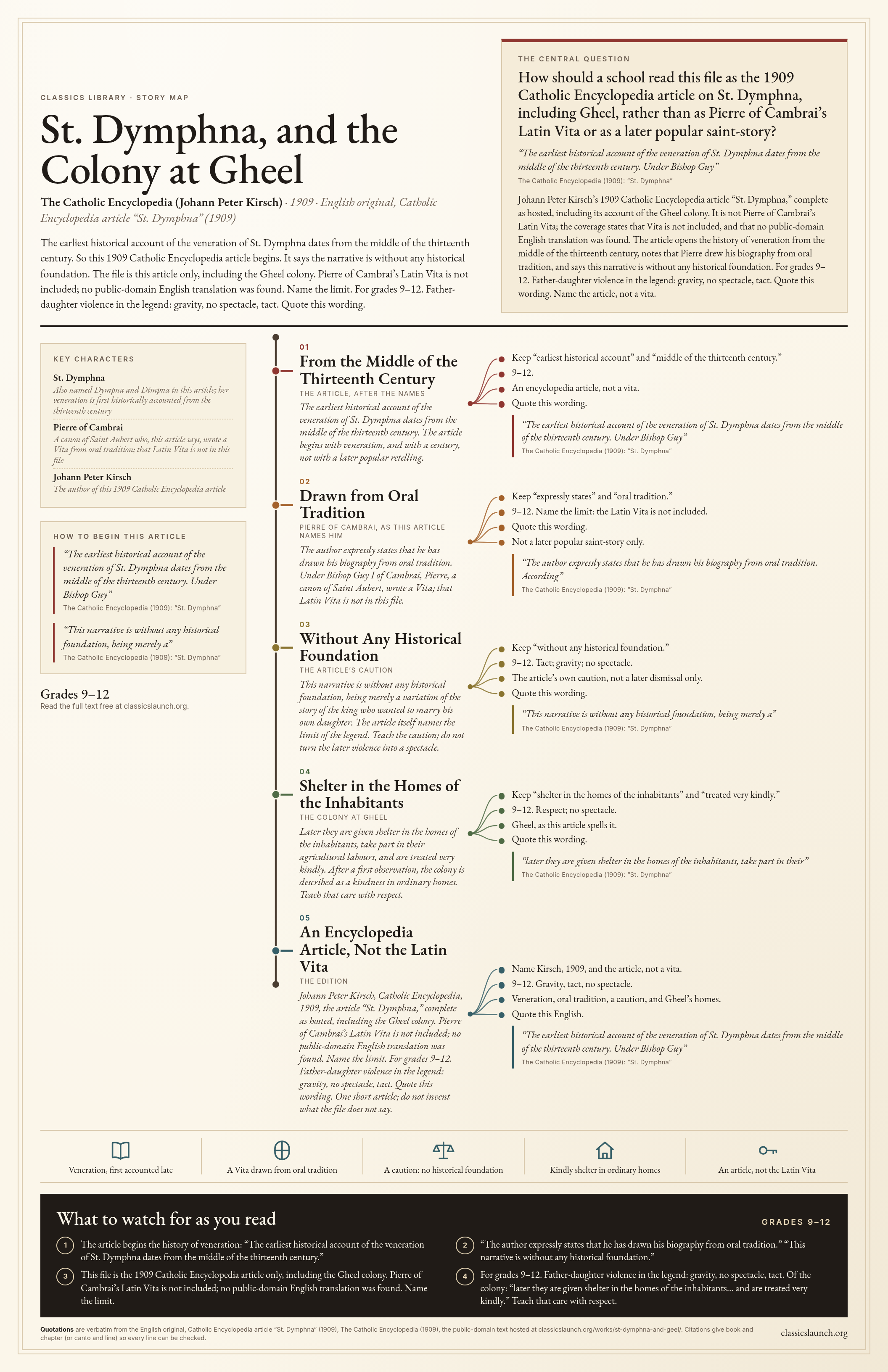
The earliest historical account of the veneration of St. Dymphna dates from the middle of the thirteenth century. So this 1909 Catholic Encyclopedia article begins. It says the narrative is without any historical foundation. The file is this article only, including the Gheel colony. Pierre of Cambrai’s Latin Vita is not included; no public-domain English translation was found. Name the limit. For grades 9–12. Father-daughter violence in the legend: gravity, no spectacle, tact. Quote this wording.
The central question
How should a school read this file as the 1909 Catholic Encyclopedia article on St. Dymphna, including Gheel, rather than as Pierre of Cambrai’s Latin Vita or as a later popular saint-story?
“The earliest historical account of the veneration of St. Dymphna dates from the middle of the thirteenth century. Under Bishop Guy”
Johann Peter Kirsch’s 1909 Catholic Encyclopedia article “St. Dymphna,” complete as hosted, including its account of the Gheel colony. It is not Pierre of Cambrai’s Latin Vita; the coverage states that Vita is not included, and that no public-domain English translation was found. The article opens the history of veneration from the middle of the thirteenth century, notes that Pierre drew his biography from oral tradition, and says this narrative is without any historical foundation. For grades 9–12. Father-daughter violence in the legend: gravity, no spectacle, tact. Quote this wording. Name the article, not a vita.
- 01
From the Middle of the Thirteenth Century
The article, after the names
The earliest historical account of the veneration of St. Dymphna dates from the middle of the thirteenth century. The article begins with veneration, and with a century, not with a later popular retelling.
- Keep “earliest historical account” and “middle of the thirteenth century.”
- 9–12.
- An encyclopedia article, not a vita.
- Quote this wording.
“The earliest historical account of the veneration of St. Dymphna dates from the middle of the thirteenth century. Under Bishop Guy”
- 02
Drawn from Oral Tradition
Pierre of Cambrai, as this article names him
The author expressly states that he has drawn his biography from oral tradition. Under Bishop Guy I of Cambrai, Pierre, a canon of Saint Aubert, wrote a Vita; that Latin Vita is not in this file.
- Keep “expressly states” and “oral tradition.”
- 9–12. Name the limit: the Latin Vita is not included.
- Quote this wording.
- Not a later popular saint-story only.
“The author expressly states that he has drawn his biography from oral tradition. According”
- 03
Without Any Historical Foundation
The article’s caution
This narrative is without any historical foundation, being merely a variation of the story of the king who wanted to marry his own daughter. The article itself names the limit of the legend. Teach the caution; do not turn the later violence into a spectacle.
- Keep “without any historical foundation.”
- 9–12. Tact; gravity; no spectacle.
- The article’s own caution, not a later dismissal only.
- Quote this wording.
“This narrative is without any historical foundation, being merely a”
- 04
Shelter in the Homes of the Inhabitants
The colony at Gheel
Later they are given shelter in the homes of the inhabitants, take part in their agricultural labours, and are treated very kindly. After a first observation, the colony is described as a kindness in ordinary homes. Teach that care with respect.
- Keep “shelter in the homes of the inhabitants” and “treated very kindly.”
- 9–12. Respect; no spectacle.
- Gheel, as this article spells it.
- Quote this wording.
“later they are given shelter in the homes of the inhabitants, take part in their”
- 05
An Encyclopedia Article, Not the Latin Vita
The edition
Johann Peter Kirsch, Catholic Encyclopedia, 1909, the article “St. Dymphna,” complete as hosted, including the Gheel colony. Pierre of Cambrai’s Latin Vita is not included; no public-domain English translation was found. Name the limit. For grades 9–12. Father-daughter violence in the legend: gravity, no spectacle, tact. Quote this wording. One short article; do not invent what the file does not say.
- Name Kirsch, 1909, and the article, not a vita.
- 9–12. Gravity, tact, no spectacle.
- Veneration, oral tradition, a caution, and Gheel’s homes.
- Quote this English.
“The earliest historical account of the veneration of St. Dymphna dates from the middle of the thirteenth century. Under Bishop Guy”
- Veneration, first accounted late
- A Vita drawn from oral tradition
- A caution: no historical foundation
- Kindly shelter in ordinary homes
- An article, not the Latin Vita
What to watch for as you read
Grades 9–12- The article begins the history of veneration: “The earliest historical account of the veneration of St. Dymphna dates from the middle of the thirteenth century.”
- “The author expressly states that he has drawn his biography from oral tradition.” “This narrative is without any historical foundation.”
- This file is the 1909 Catholic Encyclopedia article only, including the Gheel colony. Pierre of Cambrai’s Latin Vita is not included; no public-domain English translation was found. Name the limit.
- For grades 9–12. Father-daughter violence in the legend: gravity, no spectacle, tact. Of the colony: “later they are given shelter in the homes of the inhabitants… and are treated very kindly.” Teach that care with respect.
Every quotation is word for word from the English original, Catholic Encyclopedia article “St. Dymphna” (1909) hosted in this library and is checked against that text each time the site is built. Citations give book and chapter (or canto and line).