Story maps · Grades 9–12
St. Thomas Becket and the Canterbury Miracles: A Story Map
The PDF is one tabloid page (11 × 17 in). On letter paper, choose “Fit to page.”
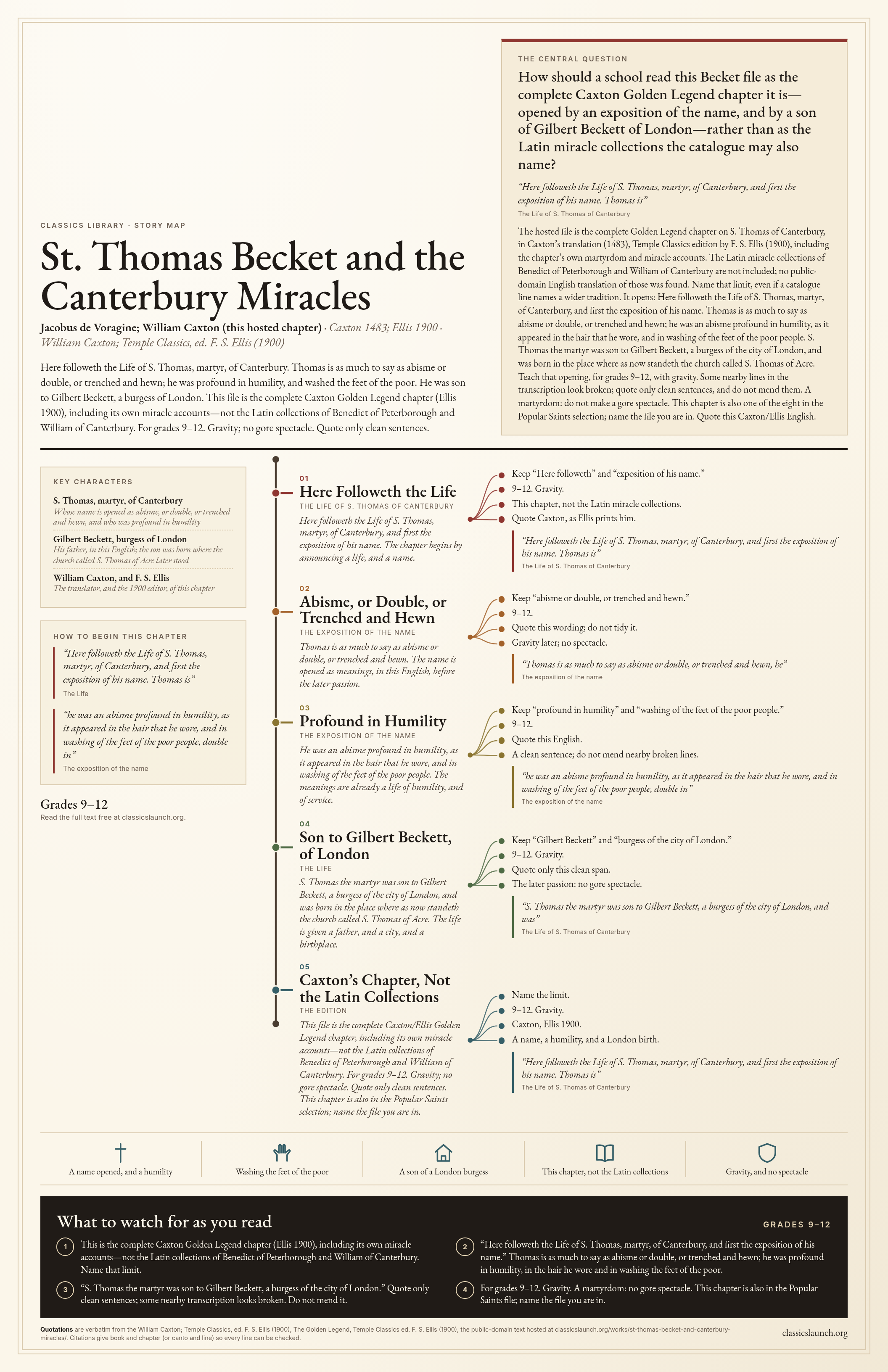
Here followeth the Life of S. Thomas, martyr, of Canterbury. Thomas is as much to say as abisme or double, or trenched and hewn; he was profound in humility, and washed the feet of the poor. He was son to Gilbert Beckett, a burgess of London. This file is the complete Caxton Golden Legend chapter (Ellis 1900), including its own miracle accounts—not the Latin collections of Benedict of Peterborough and William of Canterbury. For grades 9–12. Gravity; no gore spectacle. Quote only clean sentences.
The central question
How should a school read this Becket file as the complete Caxton Golden Legend chapter it is—opened by an exposition of the name, and by a son of Gilbert Beckett of London—rather than as the Latin miracle collections the catalogue may also name?
“Here followeth the Life of S. Thomas, martyr, of Canterbury, and first the exposition of his name. Thomas is”
The hosted file is the complete Golden Legend chapter on S. Thomas of Canterbury, in Caxton’s translation (1483), Temple Classics edition by F. S. Ellis (1900), including the chapter’s own martyrdom and miracle accounts. The Latin miracle collections of Benedict of Peterborough and William of Canterbury are not included; no public-domain English translation of those was found. Name that limit, even if a catalogue line names a wider tradition. It opens: Here followeth the Life of S. Thomas, martyr, of Canterbury, and first the exposition of his name. Thomas is as much to say as abisme or double, or trenched and hewn; he was an abisme profound in humility, as it appeared in the hair that he wore, and in washing of the feet of the poor people. S. Thomas the martyr was son to Gilbert Beckett, a burgess of the city of London, and was born in the place where as now standeth the church called S. Thomas of Acre. Teach that opening, for grades 9–12, with gravity. Some nearby lines in the transcription look broken; quote only clean sentences, and do not mend them. A martyrdom: do not make a gore spectacle. This chapter is also one of the eight in the Popular Saints selection; name the file you are in. Quote this Caxton/Ellis English.
- 01
Here Followeth the Life
The Life of S. Thomas of Canterbury
Here followeth the Life of S. Thomas, martyr, of Canterbury, and first the exposition of his name. The chapter begins by announcing a life, and a name.
- Keep “Here followeth” and “exposition of his name.”
- 9–12. Gravity.
- This chapter, not the Latin miracle collections.
- Quote Caxton, as Ellis prints him.
“Here followeth the Life of S. Thomas, martyr, of Canterbury, and first the exposition of his name. Thomas is”
- 02
Abisme, or Double, or Trenched and Hewn
The exposition of the name
Thomas is as much to say as abisme or double, or trenched and hewn. The name is opened as meanings, in this English, before the later passion.
- Keep “abisme or double, or trenched and hewn.”
- 9–12.
- Quote this wording; do not tidy it.
- Gravity later; no spectacle.
“Thomas is as much to say as abisme or double, or trenched and hewn, he”
- 03
Profound in Humility
The exposition of the name
He was an abisme profound in humility, as it appeared in the hair that he wore, and in washing of the feet of the poor people. The meanings are already a life of humility, and of service.
- Keep “profound in humility” and “washing of the feet of the poor people.”
- 9–12.
- Quote this English.
- A clean sentence; do not mend nearby broken lines.
“he was an abisme profound in humility, as it appeared in the hair that he wore, and in washing of the feet of the poor people, double in”
- 04
Son to Gilbert Beckett, of London
The Life
S. Thomas the martyr was son to Gilbert Beckett, a burgess of the city of London, and was born in the place where as now standeth the church called S. Thomas of Acre. The life is given a father, and a city, and a birthplace.
- Keep “Gilbert Beckett” and “burgess of the city of London.”
- 9–12. Gravity.
- Quote only this clean span.
- The later passion: no gore spectacle.
“S. Thomas the martyr was son to Gilbert Beckett, a burgess of the city of London, and was”
- 05
Caxton’s Chapter, Not the Latin Collections
The edition
This file is the complete Caxton/Ellis Golden Legend chapter, including its own miracle accounts—not the Latin collections of Benedict of Peterborough and William of Canterbury. For grades 9–12. Gravity; no gore spectacle. Quote only clean sentences. This chapter is also in the Popular Saints selection; name the file you are in.
- Name the limit.
- 9–12. Gravity.
- Caxton, Ellis 1900.
- A name, a humility, and a London birth.
“Here followeth the Life of S. Thomas, martyr, of Canterbury, and first the exposition of his name. Thomas is”
- A name opened, and a humility
- Washing the feet of the poor
- A son of a London burgess
- This chapter, not the Latin collections
- Gravity, and no spectacle
What to watch for as you read
Grades 9–12- This is the complete Caxton Golden Legend chapter (Ellis 1900), including its own miracle accounts—not the Latin collections of Benedict of Peterborough and William of Canterbury. Name that limit.
- “Here followeth the Life of S. Thomas, martyr, of Canterbury, and first the exposition of his name.” Thomas is as much to say as abisme or double, or trenched and hewn; he was profound in humility, in the hair he wore and in washing the feet of the poor.
- “S. Thomas the martyr was son to Gilbert Beckett, a burgess of the city of London.” Quote only clean sentences; some nearby transcription looks broken. Do not mend it.
- For grades 9–12. Gravity. A martyrdom: no gore spectacle. This chapter is also in the Popular Saints file; name the file you are in.
Every quotation is word for word from the William Caxton; Temple Classics, ed. F. S. Ellis (1900) hosted in this library and is checked against that text each time the site is built. Citations give book and chapter (or canto and line).