Story maps · Grades 11–12
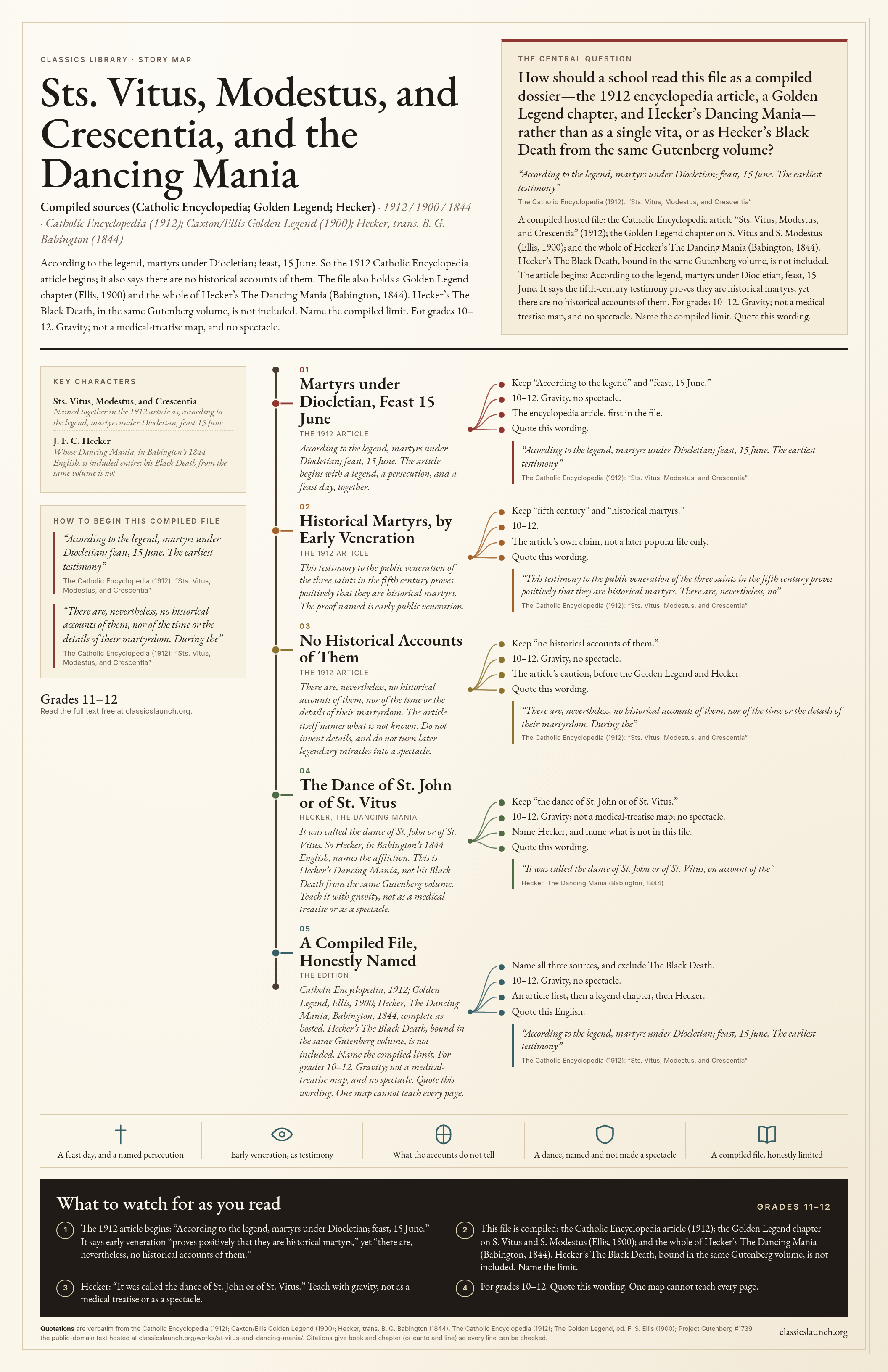
Sts. Vitus, Modestus, and Crescentia, and the Dancing Mania: A Story Map
The PDF is one tabloid page (11 × 17 in). On letter paper, choose “Fit to page.”
According to the legend, martyrs under Diocletian; feast, 15 June. So the 1912 Catholic Encyclopedia article begins; it also says there are no historical accounts of them. The file also holds a Golden Legend chapter (Ellis, 1900) and the whole of Hecker’s The Dancing Mania (Babington, 1844). Hecker’s The Black Death, in the same Gutenberg volume, is not included. Name the compiled limit. For grades 10–12. Gravity; not a medical-treatise map, and no spectacle.
The central question
How should a school read this file as a compiled dossier—the 1912 encyclopedia article, a Golden Legend chapter, and Hecker’s Dancing Mania—rather than as a single vita, or as Hecker’s Black Death from the same Gutenberg volume?
“According to the legend, martyrs under Diocletian; feast, 15 June. The earliest testimony”
A compiled hosted file: the Catholic Encyclopedia article “Sts. Vitus, Modestus, and Crescentia” (1912); the Golden Legend chapter on S. Vitus and S. Modestus (Ellis, 1900); and the whole of Hecker’s The Dancing Mania (Babington, 1844). Hecker’s The Black Death, bound in the same Gutenberg volume, is not included. The article begins: According to the legend, martyrs under Diocletian; feast, 15 June. It says the fifth-century testimony proves they are historical martyrs, yet there are no historical accounts of them. For grades 10–12. Gravity; not a medical-treatise map, and no spectacle. Name the compiled limit. Quote this wording.
- 01
Martyrs under Diocletian, Feast 15 June
The 1912 article
According to the legend, martyrs under Diocletian; feast, 15 June. The article begins with a legend, a persecution, and a feast day, together.
- Keep “According to the legend” and “feast, 15 June.”
- 10–12. Gravity, no spectacle.
- The encyclopedia article, first in the file.
- Quote this wording.
“According to the legend, martyrs under Diocletian; feast, 15 June. The earliest testimony”
- 02
Historical Martyrs, by Early Veneration
The 1912 article
This testimony to the public veneration of the three saints in the fifth century proves positively that they are historical martyrs. The proof named is early public veneration.
- Keep “fifth century” and “historical martyrs.”
- 10–12.
- The article’s own claim, not a later popular life only.
- Quote this wording.
“This testimony to the public veneration of the three saints in the fifth century proves positively that they are historical martyrs. There are, nevertheless, no”
- 03
No Historical Accounts of Them
The 1912 article
There are, nevertheless, no historical accounts of them, nor of the time or the details of their martyrdom. The article itself names what is not known. Do not invent details, and do not turn later legendary miracles into a spectacle.
- Keep “no historical accounts of them.”
- 10–12. Gravity, no spectacle.
- The article’s caution, before the Golden Legend and Hecker.
- Quote this wording.
“There are, nevertheless, no historical accounts of them, nor of the time or the details of their martyrdom. During the”
- 04
The Dance of St. John or of St. Vitus
Hecker, The Dancing Mania
It was called the dance of St. John or of St. Vitus. So Hecker, in Babington’s 1844 English, names the affliction. This is Hecker’s Dancing Mania, not his Black Death from the same Gutenberg volume. Teach it with gravity, not as a medical treatise or as a spectacle.
- Keep “the dance of St. John or of St. Vitus.”
- 10–12. Gravity; not a medical-treatise map; no spectacle.
- Name Hecker, and name what is not in this file.
- Quote this wording.
“It was called the dance of St. John or of St. Vitus, on account of the”
- 05
A Compiled File, Honestly Named
The edition
Catholic Encyclopedia, 1912; Golden Legend, Ellis, 1900; Hecker, The Dancing Mania, Babington, 1844, complete as hosted. Hecker’s The Black Death, bound in the same Gutenberg volume, is not included. Name the compiled limit. For grades 10–12. Gravity; not a medical-treatise map, and no spectacle. Quote this wording. One map cannot teach every page.
- Name all three sources, and exclude The Black Death.
- 10–12. Gravity, no spectacle.
- An article first, then a legend chapter, then Hecker.
- Quote this English.
“According to the legend, martyrs under Diocletian; feast, 15 June. The earliest testimony”
- A feast day, and a named persecution
- Early veneration, as testimony
- What the accounts do not tell
- A dance, named and not made a spectacle
- A compiled file, honestly limited
What to watch for as you read
Grades 11–12- The 1912 article begins: “According to the legend, martyrs under Diocletian; feast, 15 June.” It says early veneration “proves positively that they are historical martyrs,” yet “there are, nevertheless, no historical accounts of them.”
- This file is compiled: the Catholic Encyclopedia article (1912); the Golden Legend chapter on S. Vitus and S. Modestus (Ellis, 1900); and the whole of Hecker’s The Dancing Mania (Babington, 1844). Hecker’s The Black Death, bound in the same Gutenberg volume, is not included. Name the limit.
- Hecker: “It was called the dance of St. John or of St. Vitus.” Teach with gravity, not as a medical treatise or as a spectacle.
- For grades 10–12. Quote this wording. One map cannot teach every page.
Every quotation is word for word from the Catholic Encyclopedia (1912); Caxton/Ellis Golden Legend (1900); Hecker, trans. B. G. Babington (1844) hosted in this library and is checked against that text each time the site is built. Citations give book and chapter (or canto and line).