Story maps · Grades 11–12
The Charterhouse of Parma: A Story Map
The PDF is one tabloid page (11 × 17 in). On letter paper, choose “Fit to page.”
On the 15th of May, 1796, Bonaparte enters Milan, and a later Italian son of that world, Fabrizio del Dongo, will wander from Waterloo to a prince’s prison at Parma. Scott-Moncrieff’s 1925 English is the hosted text: two Gutenberg volumes joined, with Balzac’s study in front.
The central question
What kind of life can a young man of courage and impulse have in a small, spying court, and what does love cost him there?
“On the 15th of May, 1796, General Bonaparte made his entry into Milan at the head of that young army which had shortly before crossed the Bridge of Lodi”
The book begins in the shock of Bonaparte’s Italy, then follows Fabrizio—not ‘Fabrice’—through a confused day near Waterloo, a doting aunt who becomes Duchessa Sanseverina, the court of Parma, a prison in the Farnese tower, and the love of Clelia Conti. Scott-Moncrieff’s English keeps Italian forms (Fabrizio, Duchessa, ‘shew’). The hosted file joins PG #66374 and #66375 and ends at the close of Volume II. Do not quote Balzac’s long opening study, or Beyle’s reply, as if they were the novel. The ending is quieter and more costly than a romance of escape.
- 01
Milan, 1796
Chapter One
Bonaparte’s young army enters Milan. The Italian world of the del Dongos is born in that shock of energy, which the later court of Parma will try to freeze.
- Start from the novel’s first chapter, not from Balzac’s preceding study.
- The date and the Bridge of Lodi are this English’s opening music.
- Gina, later the Duchessa, already belongs to this world of courage.
“On the 15th of May, 1796, General Bonaparte made his entry into Milan at the head of that young army which had shortly before crossed the Bridge of Lodi”
- 02
Fabrizio and Waterloo
The early wanderings
Young Fabrizio del Dongo runs toward Napoleon and finds, at Waterloo, not a clear hero’s day but confusion, mud, and a baptism into the century.
- This English names him Fabrizio, never Fabrice.
- The battle is seen from a lost young man’s ground, not from a staff map.
- He comes home marked, and not in the way his family wished.
- 03
The Duchessa and Parma
The court
Gina becomes Duchessa Sanseverina. At the little court of Parma, with Count Mosca, she tries to make a life and a career for the nephew she loves.
- The court is comic and dangerous at once: a police, a prince, a spy’s world.
- The Duchessa’s love is the book’s great adult passion, and it is not simple.
- Scott-Moncrieff may write ‘shew’ and other older spellings; quote them as they stand.
- 04
The Farnese Tower
The imprisonment
Fabrizio is shut in the famous prison. From a window he sees Clelia Conti, and a love begins under the eyes of a jailer-world.
- The tower is a real place in the book’s Parma, not only a symbol.
- Clelia’s vow and her courage are the second moral center.
- A court intrigue and a daring help will not end all cost.
- 05
Volume II, and a Charterhouse
The close
The second volume completes the intrigue, the love, and the price. The hosted text joins both PG volumes and ends at the end of Volume II. Do not stop at Volume I.
- Flag the join: PG #66374 and #66375, ending ‘END OF VOLUME II.’
- Skip Balzac’s study and the author’s reply when quoting the tale.
- The last movement is not a triumph; it is a long reckoning. For older students.
- Youth and History
- A Spying Court
- Love
- Prison
- Costly Endings
What to watch for as you read
Grades 11–12- The hosted text is C. K. Scott-Moncrieff’s 1925 English, Project Gutenberg #66374 and #66375 joined, ending at the close of Volume II. Quote the novel, not Balzac’s long ‘Study of M. Beyle’ or Beyle’s reply, which stand in front of Chapter One.
- This English uses Italian forms: Fabrizio (not Fabrice), Duchessa Sanseverina, Clelia Conti. Older spellings such as ‘shew’ appear; quote them as printed.
- The book is a long court novel with love, politics, a prison, and a sober end. It is for older students.
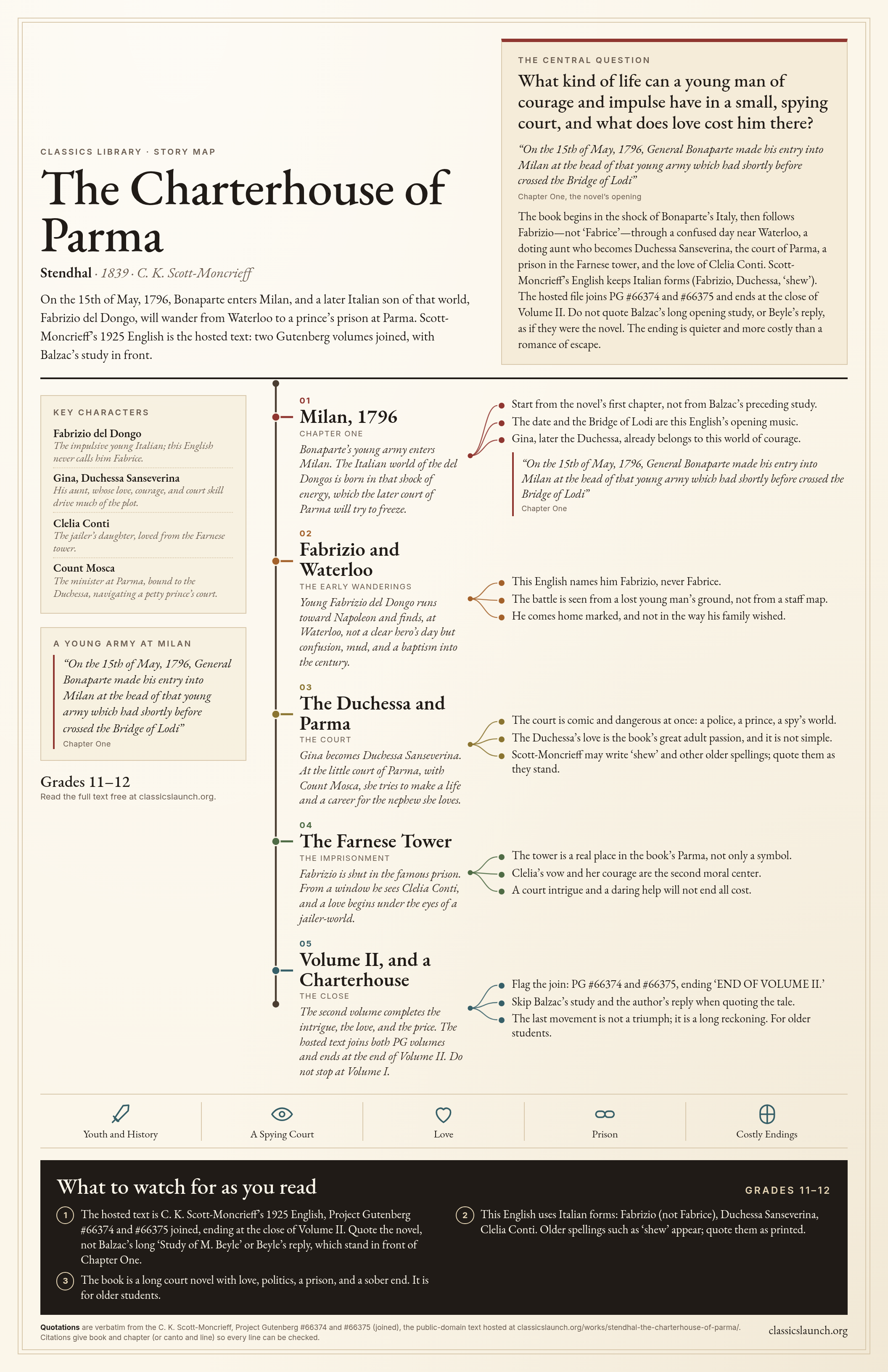
Every quotation is word for word from the C. K. Scott-Moncrieff hosted in this library and is checked against that text each time the site is built. Citations give book and chapter (or canto and line).