Story maps · Grades 11–12
The Life and Opinions of Tristram Shandy, Gentleman: A Story Map
The PDF is one tabloid page (11 × 17 in). On letter paper, choose “Fit to page.”
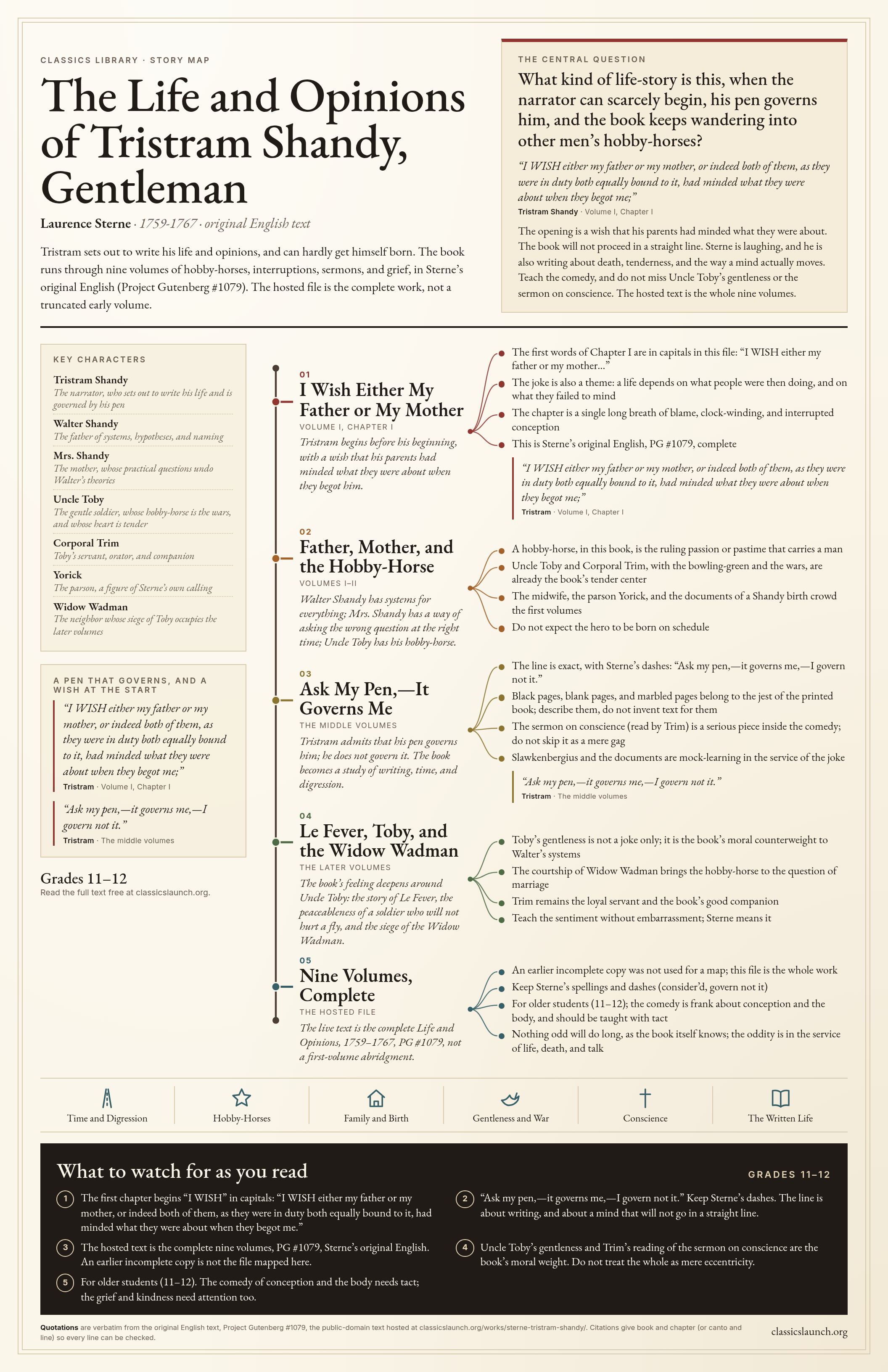
Tristram sets out to write his life and opinions, and can hardly get himself born. The book runs through nine volumes of hobby-horses, interruptions, sermons, and grief, in Sterne’s original English (Project Gutenberg #1079). The hosted file is the complete work, not a truncated early volume.
The central question
What kind of life-story is this, when the narrator can scarcely begin, his pen governs him, and the book keeps wandering into other men’s hobby-horses?
“I WISH either my father or my mother, or indeed both of them, as they were in duty both equally bound to it, had minded what they were about when they begot me;”
The opening is a wish that his parents had minded what they were about. The book will not proceed in a straight line. Sterne is laughing, and he is also writing about death, tenderness, and the way a mind actually moves. Teach the comedy, and do not miss Uncle Toby’s gentleness or the sermon on conscience. The hosted text is the whole nine volumes.
- 01
I Wish Either My Father or My Mother
Volume I, Chapter I
Tristram begins before his beginning, with a wish that his parents had minded what they were about when they begot him.
- The first words of Chapter I are in capitals in this file: “I WISH either my father or my mother…”
- The joke is also a theme: a life depends on what people were then doing, and on what they failed to mind
- The chapter is a single long breath of blame, clock-winding, and interrupted conception
- This is Sterne’s original English, PG #1079, complete
“I WISH either my father or my mother, or indeed both of them, as they were in duty both equally bound to it, had minded what they were about when they begot me;”
- 02
Father, Mother, and the Hobby-Horse
Volumes I–II
Walter Shandy has systems for everything; Mrs. Shandy has a way of asking the wrong question at the right time; Uncle Toby has his hobby-horse.
- A hobby-horse, in this book, is the ruling passion or pastime that carries a man
- Uncle Toby and Corporal Trim, with the bowling-green and the wars, are already the book’s tender center
- The midwife, the parson Yorick, and the documents of a Shandy birth crowd the first volumes
- Do not expect the hero to be born on schedule
- 03
Ask My Pen,—It Governs Me
The middle volumes
Tristram admits that his pen governs him; he does not govern it. The book becomes a study of writing, time, and digression.
- The line is exact, with Sterne’s dashes: “Ask my pen,—it governs me,—I govern not it.”
- Black pages, blank pages, and marbled pages belong to the jest of the printed book; describe them, do not invent text for them
- The sermon on conscience (read by Trim) is a serious piece inside the comedy; do not skip it as a mere gag
- Slawkenbergius and the documents are mock-learning in the service of the joke
“Ask my pen,—it governs me,—I govern not it.”
- 04
Le Fever, Toby, and the Widow Wadman
The later volumes
The book’s feeling deepens around Uncle Toby: the story of Le Fever, the peaceableness of a soldier who will not hurt a fly, and the siege of the Widow Wadman.
- Toby’s gentleness is not a joke only; it is the book’s moral counterweight to Walter’s systems
- The courtship of Widow Wadman brings the hobby-horse to the question of marriage
- Trim remains the loyal servant and the book’s good companion
- Teach the sentiment without embarrassment; Sterne means it
- 05
Nine Volumes, Complete
The hosted file
The live text is the complete Life and Opinions, 1759–1767, PG #1079, not a first-volume abridgment.
- An earlier incomplete copy was not used for a map; this file is the whole work
- Keep Sterne’s spellings and dashes (consider’d, govern not it)
- For older students (11–12); the comedy is frank about conception and the body, and should be taught with tact
- Nothing odd will do long, as the book itself knows; the oddity is in the service of life, death, and talk
- Time and Digression
- Hobby-Horses
- Family and Birth
- Gentleness and War
- Conscience
- The Written Life
What to watch for as you read
Grades 11–12- The first chapter begins “I WISH” in capitals: “I WISH either my father or my mother, or indeed both of them, as they were in duty both equally bound to it, had minded what they were about when they begot me.”
- “Ask my pen,—it governs me,—I govern not it.” Keep Sterne’s dashes. The line is about writing, and about a mind that will not go in a straight line.
- The hosted text is the complete nine volumes, PG #1079, Sterne’s original English. An earlier incomplete copy is not the file mapped here.
- Uncle Toby’s gentleness and Trim’s reading of the sermon on conscience are the book’s moral weight. Do not treat the whole as mere eccentricity.
- For older students (11–12). The comedy of conception and the body needs tact; the grief and kindness need attention too.
Every quotation is word for word from the original English text hosted in this library and is checked against that text each time the site is built. Citations give book and chapter (or canto and line).