Story maps · Grades 4–12
Stickeen: A Story Map
The PDF is one tabloid page (11 × 17 in). On letter paper, choose “Fit to page.”
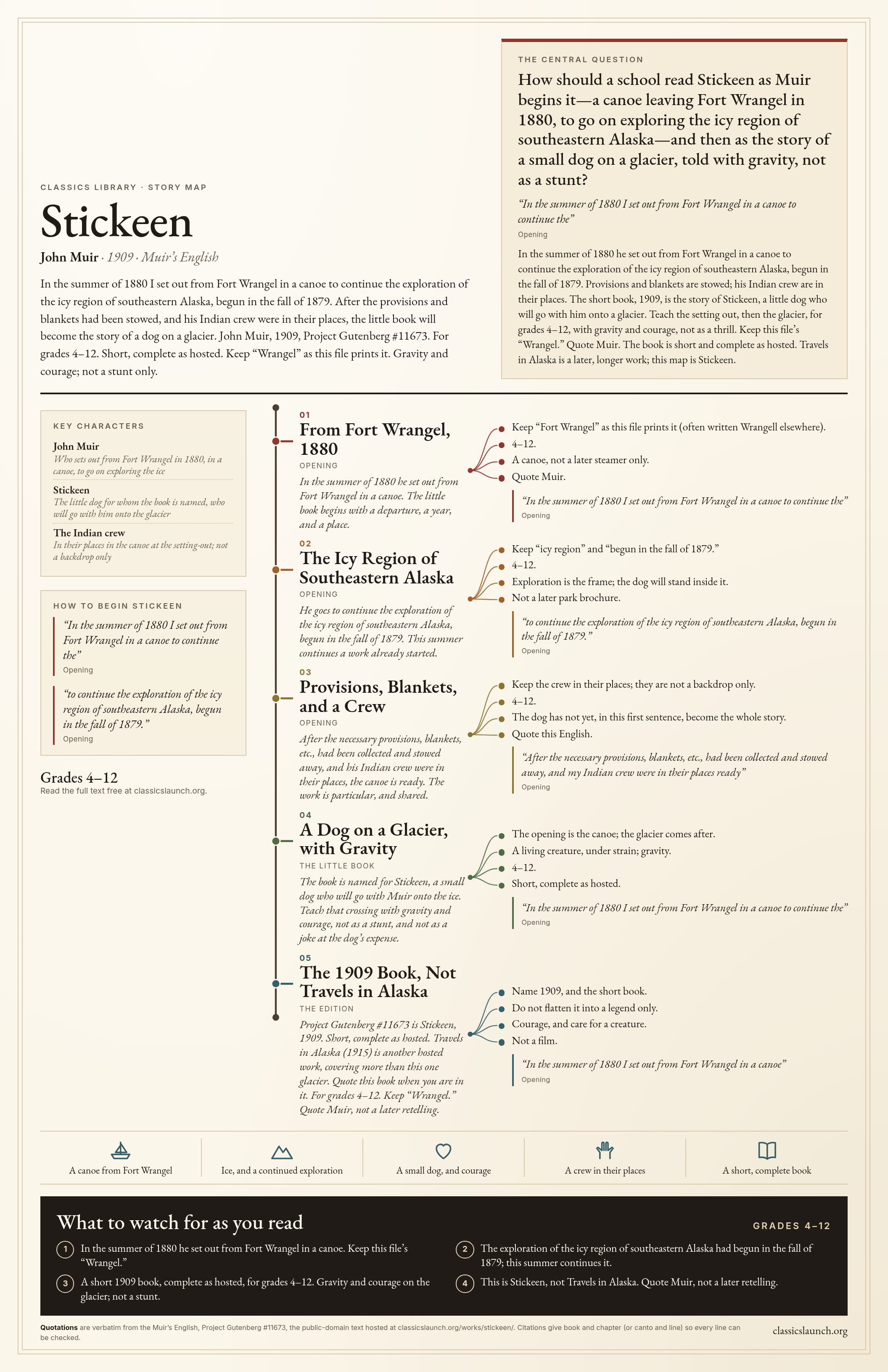
In the summer of 1880 I set out from Fort Wrangel in a canoe to continue the exploration of the icy region of southeastern Alaska, begun in the fall of 1879. After the provisions and blankets had been stowed, and his Indian crew were in their places, the little book will become the story of a dog on a glacier. John Muir, 1909, Project Gutenberg #11673. For grades 4–12. Short, complete as hosted. Keep “Wrangel” as this file prints it. Gravity and courage; not a stunt only.
The central question
How should a school read Stickeen as Muir begins it—a canoe leaving Fort Wrangel in 1880, to go on exploring the icy region of southeastern Alaska—and then as the story of a small dog on a glacier, told with gravity, not as a stunt?
“In the summer of 1880 I set out from Fort Wrangel in a canoe to continue the”
In the summer of 1880 he set out from Fort Wrangel in a canoe to continue the exploration of the icy region of southeastern Alaska, begun in the fall of 1879. Provisions and blankets are stowed; his Indian crew are in their places. The short book, 1909, is the story of Stickeen, a little dog who will go with him onto a glacier. Teach the setting out, then the glacier, for grades 4–12, with gravity and courage, not as a thrill. Keep this file’s “Wrangel.” Quote Muir. The book is short and complete as hosted. Travels in Alaska is a later, longer work; this map is Stickeen.
- 01
From Fort Wrangel, 1880
Opening
In the summer of 1880 he set out from Fort Wrangel in a canoe. The little book begins with a departure, a year, and a place.
- Keep “Fort Wrangel” as this file prints it (often written Wrangell elsewhere).
- 4–12.
- A canoe, not a later steamer only.
- Quote Muir.
“In the summer of 1880 I set out from Fort Wrangel in a canoe to continue the”
- 02
The Icy Region of Southeastern Alaska
Opening
He goes to continue the exploration of the icy region of southeastern Alaska, begun in the fall of 1879. This summer continues a work already started.
- Keep “icy region” and “begun in the fall of 1879.”
- 4–12.
- Exploration is the frame; the dog will stand inside it.
- Not a later park brochure.
“to continue the exploration of the icy region of southeastern Alaska, begun in the fall of 1879.”
- 03
Provisions, Blankets, and a Crew
Opening
After the necessary provisions, blankets, etc., had been collected and stowed away, and his Indian crew were in their places, the canoe is ready. The work is particular, and shared.
- Keep the crew in their places; they are not a backdrop only.
- 4–12.
- The dog has not yet, in this first sentence, become the whole story.
- Quote this English.
“After the necessary provisions, blankets, etc., had been collected and stowed away, and my Indian crew were in their places ready”
- 04
A Dog on a Glacier, with Gravity
The little book
The book is named for Stickeen, a small dog who will go with Muir onto the ice. Teach that crossing with gravity and courage, not as a stunt, and not as a joke at the dog’s expense.
- The opening is the canoe; the glacier comes after.
- A living creature, under strain; gravity.
- 4–12.
- Short, complete as hosted.
“In the summer of 1880 I set out from Fort Wrangel in a canoe to continue the”
- 05
The 1909 Book, Not Travels in Alaska
The edition
Project Gutenberg #11673 is Stickeen, 1909. Short, complete as hosted. Travels in Alaska (1915) is another hosted work, covering more than this one glacier. Quote this book when you are in it. For grades 4–12. Keep “Wrangel.” Quote Muir, not a later retelling.
- Name 1909, and the short book.
- Do not flatten it into a legend only.
- Courage, and care for a creature.
- Not a film.
“In the summer of 1880 I set out from Fort Wrangel in a canoe”
- A canoe from Fort Wrangel
- Ice, and a continued exploration
- A small dog, and courage
- A crew in their places
- A short, complete book
What to watch for as you read
Grades 4–12- In the summer of 1880 he set out from Fort Wrangel in a canoe. Keep this file’s “Wrangel.”
- The exploration of the icy region of southeastern Alaska had begun in the fall of 1879; this summer continues it.
- A short 1909 book, complete as hosted, for grades 4–12. Gravity and courage on the glacier; not a stunt.
- This is Stickeen, not Travels in Alaska. Quote Muir, not a later retelling.
Every quotation is word for word from the Muir’s English hosted in this library and is checked against that text each time the site is built. Citations give book and chapter (or canto and line).